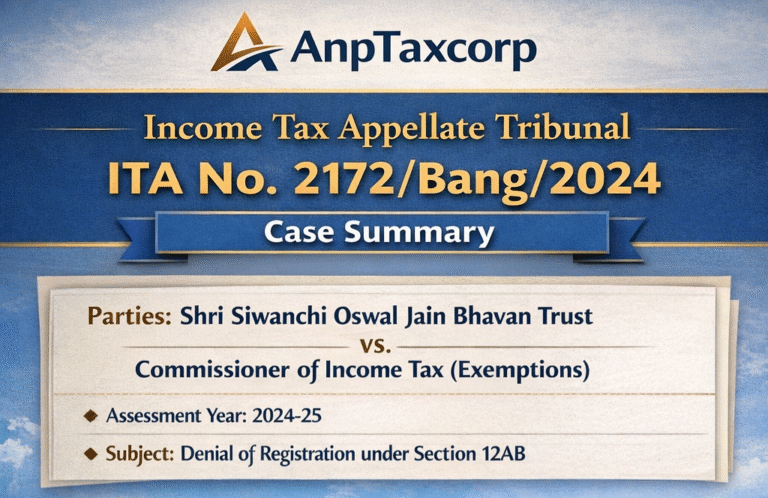
The Income Tax Appellate Tribunal (ITAT), Bangalore Bench has delivered a significant ruling in ITA No. 2172/Bang/2024, reinforcing the legal position that newly formed charitable trusts cannot be denied registration merely due to limited commencement of activities. The case of Shri Siwanchi Oswal Jain Bhavan Trust vs. Commissioner of Income Tax (Exemptions) provides important clarity on the scope and interpretation of Section 12AB of Income Tax Act and its interplay with Section 80G(5) of Income Tax Act.
Background of the Case
The assessee, Shri Siwanchi Oswal Jain Bhavan Trust, was established in September 2024 with the objective of undertaking charitable and religious activities. Its primary goals included the construction, renovation, and maintenance of places of worship, along with providing boarding and lodging facilities for devotees and visitors.
Following its incorporation, the trust applied for registration under Section 12AB, which is a prerequisite for claiming exemption on charitable income. Additionally, it sought approval under Section 80G(5), which enables donors to claim tax deductions for contributions made to eligible charitable institutions.
However, the Commissioner of Income Tax (Exemptions) rejected the trust’s application. The rejection was primarily based on the observation that the trust had not carried out substantial charitable activities, given its recent formation. The authority also raised concerns regarding the genuineness of the activities and the readiness of the trust to operate in line with its stated objectives.
Key Issues for Consideration
The matter before the ITAT revolved around critical legal questions:
- Whether a newly formed trust can be denied registration under Section 12AB solely because it has not yet undertaken significant charitable activities.
- Whether the Commissioner is required to evaluate the objects of the trust independently of the volume of activities.
- Whether the rejection of approval under Section 80G(5) can be sustained when the denial of Section 12AB registration itself is under challenge.
These issues are particularly relevant for newly established charitable entities that often face scrutiny at the registration stage.
Tribunal’s Observations
The ITAT Bangalore Bench made several noteworthy observations while adjudicating the matter.
Firstly, the Tribunal emphasized that at the stage of granting registration under Section 12AB, the primary focus should be on the objects of the trust and the genuineness of its activities, rather than the scale or extent of such activities. A newly established trust, by its very nature, may not have substantial operations immediately after its formation. Therefore, expecting significant activity within a short period is neither practical nor legally justified.
Secondly, the Tribunal observed that the Commissioner must not adopt a mechanical approach while rejecting applications. Instead, the authority is expected to conduct an independent inquiry, verify the charitable nature of the trust’s objectives, and provide a reasonable opportunity of being heard to the applicant.
The ITAT also highlighted that the issues concerning Section 12AB registration and Section 80G approval are closely interconnected. If the foundation of denial under Section 12AB is flawed, the rejection of 80G approval cannot stand independently without proper reconsideration.
Decision of the Tribunal
After considering the facts and legal position, the ITAT set aside the order passed by the Commissioner of Income Tax (Exemptions). The Tribunal restored the matter back to the file of the authority for fresh adjudication.
Importantly, the appeal was allowed “for statistical purposes”, which implies that the Tribunal did not grant outright registration but directed the authority to re-examine the application in accordance with law, ensuring proper verification and adherence to principles of natural justice.
Key Takeaways
This ruling provides valuable guidance for both taxpayers and tax authorities:
- Newly formed trusts should not be denied registration merely due to limited or initial-stage activities.
- The focus at the registration stage must remain on the charitable objects and genuineness, rather than operational scale.
- Authorities are required to follow a fair and reasoned approach, avoiding mechanical rejection of applications.
- The linkage between Section 12AB and Section 80G(5) means that both approvals should be considered holistically.
- Proper opportunity of hearing is essential before passing adverse orders.
Practical Implications
For professionals advising charitable trusts, this decision underscores the importance of drafting a robust trust deed with clearly defined charitable objectives. Even in the absence of extensive activities, trusts should maintain basic documentation demonstrating their intent and initial steps toward achieving their goals.
From a compliance perspective, this judgment serves as a reminder that procedural fairness and substantive evaluation are critical at the stage of granting registration. It also offers reassurance to new trusts that the law does not penalize them for being at an early stage of operations.