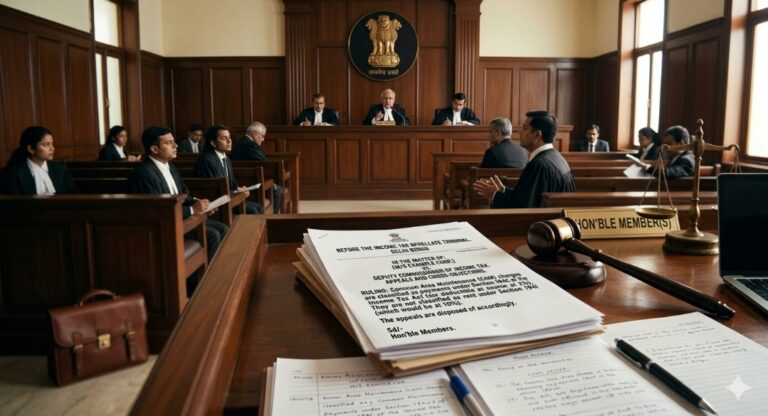
In a significant ruling that brings clarity to the tax treatment of Common Area Maintenance (CAM) charges, the Delhi Bench of the Income Tax Appellate Tribunal (ITAT) has held that such payments are not in the nature of rent and therefore attract Tax Deducted at Source (TDS) under Section 194C, not Section 194-I of the Income Tax Act.
The decision came in the case of DCIT v. Biba Apparels Pvt. Ltd., where the tribunal dismissed the Revenue’s appeals for Assessment Years 2013–14, 2014–15, and 2015–16, thereby granting relief to the assessee.
Background of the Dispute
The controversy arose from TDS applicability on CAM charges paid by Biba Apparels Pvt. Ltd. for its retail outlets located in Ambience Mall, New Delhi. The company had deducted TDS at the rate of 2% under Section 194C, treating the payments as contractual service charges.
However, the tax department took a contrary view. It argued that CAM charges formed part of the rent paid for occupying commercial premises and should therefore be subjected to TDS under Section 194-I at a higher rate of 10%. On this basis, the department raised a demand alleging short deduction of TDS.
Assessee’s Stand: CAM Charges Are Service Payments
Biba Apparels strongly contested the Revenue’s position. The company submitted that CAM charges were:
- Payments for maintenance and upkeep of common areas
- Related to services such as security, cleaning, electricity, and facility management
- Governed by separate agreements independent of the lease deed
It was emphasized that these charges were not consideration for the use of the premises but were instead payments for availing maintenance services in shared spaces.
Tribunal’s Analysis and Findings
The ITAT bench, comprising Judicial Member Raj Kumar Chauhan and Accountant Member Renu Jauhri, carefully examined the nature of CAM charges and the contractual framework governing them.
The tribunal observed that:
- CAM charges arise from independent service arrangements
- They are not intrinsically linked to the lease agreement
- The payments are made for specific maintenance services, not for the right to occupy property
In a key observation, the bench stated that such charges “cannot, by any stretch, be construed as payment of rent for occupying the premises.”
This distinction became crucial in determining the correct TDS provision applicable to the payments.
Reliance on Judicial Precedent
The tribunal also relied on the ruling of the Delhi High Court in Commissioner of Income-tax (TDS) v. Liberty Retail Revolutions Ltd., which had similarly held that CAM charges are contractual payments for services and not rent.
By following this precedent, the ITAT reinforced the principle that substance over form must guide tax interpretation, especially in cases where multiple agreements govern different aspects of a commercial arrangement.
Section 194C vs Section 194-I: Key Distinction
To understand the significance of this ruling, it is important to distinguish between the two provisions:
- Section 194C applies to payments made to contractors for carrying out work, including service contracts. TDS is generally deducted at a lower rate (e.g., 2%).
- Section 194-I applies to rent payments for the use of land, building, or machinery and attracts higher TDS rates (typically 10%).
By classifying CAM charges under Section 194C, the tribunal has effectively reduced the compliance burden and potential tax exposure for businesses operating in malls and commercial complexes.
Final Verdict
The ITAT upheld the deletion of the tax demand raised by the department and dismissed all appeals filed by the Revenue. It concluded that CAM charges are purely maintenance-related payments and do not fall within the ambit of rent.
Practical Implications for Businesses
This ruling carries significant implications for:
- Retailers operating in shopping malls
- Commercial tenants in office complexes
- Businesses paying facility management or maintenance charges
Key takeaways include:
- Separate agreements for CAM services strengthen the argument that such payments are not rent
- Proper documentation and classification of expenses are essential to avoid TDS disputes
- Businesses can rely on this ruling to defend similar positions in ongoing or future assessments
Conclusion
The ITAT Delhi’s decision in DCIT v. Biba Apparels Pvt. Ltd. provides much-needed clarity on the tax treatment of CAM charges. By affirming that these payments are for maintenance services and not rent, the tribunal has aligned tax treatment with commercial reality.
Follow the Link below to Watch the Video: