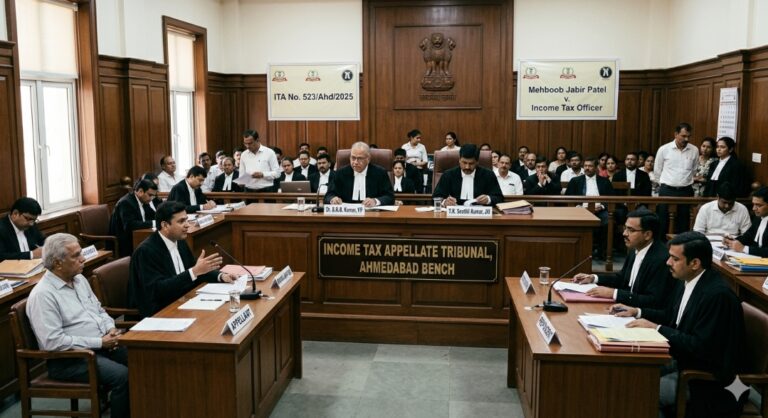
In a significant ruling on capital gains taxation, the Ahmedabad Bench of the Income Tax Appellate Tribunal (ITAT) has held that the execution and registration of a sale deed constitute a completed transfer for the purposes of capital gains tax under the Income Tax Act, 1961. The Tribunal clarified that subsequent delays in receiving sale consideration or dishonour of cheques do not postpone the taxability of capital gains unless the transaction is legally cancelled or rescinded.
The decision was delivered by Vice President Dr. B.R.R. Kumar and Judicial Member T.R. Senthil Kumar in the case of Mehboob Jabir Patel v. Income Tax Officer, Ward-1, Godhra (I.T.A. No. 523/Ahd/2025).
Background of the Dispute
The dispute revolved around the sale of a parcel of land situated at Halol. The assessee, Mehboob Jabir Patel, had executed and registered sale deeds on 12 April 2013 for a total sale consideration of approximately ₹1.66 crore.
During assessment proceedings for Assessment Year (AY) 2014-15, the Assessing Officer (AO) brought to tax short-term capital gains amounting to ₹52.38 lakh arising from the transaction.
However, the assessee contested the addition on the ground that a substantial portion of the agreed sale consideration had not been received at the time of registration. According to him, several cheques issued by the purchasers were dishonoured, and the remaining payment was received only in April 2015.
The assessee further argued that he continued to retain possession of the property until full payment was received. He relied upon a legal notice issued to the purchasers in November 2013 and a confirmation deed executed in December 2015 to contend that the effective transfer took place only during Financial Year 2015-16, corresponding to AY 2016-17.
Based on this reasoning, he had already offered the capital gains income for taxation in AY 2016-17.
Revenue’s Stand
The Revenue authorities rejected the assessee’s contentions. The Assessing Officer observed that the registered sale deeds clearly evidenced the transfer of ownership rights in the property during Financial Year 2013-14.
The AO held that once the sale deeds were duly executed and registered, the transaction amounted to a “transfer” within the meaning of Section 2(47) of the Income Tax Act. Consequently, the resulting capital gains became taxable in AY 2014-15 itself.
The Commissioner of Income Tax (Appeals) affirmed this view, leading the assessee to file an appeal before the ITAT.
ITAT’s Observations
After examining the facts and legal position, the Tribunal upheld the findings of the lower authorities.
The Bench emphasized that registration of a sale deed is a crucial event that legally completes the transfer of property for capital gains purposes. It observed that subsequent disputes regarding payment obligations between the parties do not alter the date of transfer once a valid and registered sale deed exists.
The Tribunal categorically held:
“Registration of a sale deed completes transfer for capital gains purposes. Non-receipt of consideration or delayed payment does not defer chargeability unless the transaction itself is cancelled or legally rescinded.”
The Bench noted that although the assessee had raised disputes regarding dishonoured cheques and delayed payments, there was no evidence showing that the registered sale deeds had ever been cancelled, annulled, or declared invalid by any competent authority.
Therefore, the transfer remained legally effective from the date of registration.
Retention of Possession Does Not Change Taxability
One of the key arguments advanced by the assessee was that he continued to retain possession of the property until the entire consideration was received.
The Tribunal rejected this contention and observed that mere retention of physical possession cannot override the legal effect of a registered conveyance deed.
According to the Bench, once ownership rights are transferred through a valid registered document, subsequent disputes between the parties regarding possession or payment cannot postpone the incidence of capital gains taxation.
The Tribunal remarked that retention of possession or contractual disputes after registration do not affect the taxability arising from a completed transfer.
Relief Against Double Taxation
While dismissing the primary contention of the assessee, the Tribunal accepted an alternative plea regarding double taxation.
The assessee had claimed that the same capital gains had already been offered and assessed in AY 2016-17. Recognizing the possibility of the same income being taxed twice, the Tribunal directed the Assessing Officer to verify this claim.
If the capital gains had indeed been subjected to tax in AY 2016-17, the AO was instructed to grant appropriate consequential relief in accordance with law.
Accordingly, the appeal was partly allowed for statistical purposes.
Key Takeaway
This ruling reinforces an important principle in capital gains taxation: the date of registration of a sale deed generally determines the timing of tax liability. Delayed receipt of sale consideration, dishonoured cheques, or subsequent disputes between the parties do not postpone capital gains taxation unless the transaction itself is legally cancelled.
Taxpayers involved in property transactions should therefore carefully evaluate the tax implications arising from the execution and registration of sale deeds, irrespective of the actual timing of receipt of consideration. The judgment also highlights the importance of ensuring that the same income is not taxed twice and provides relief where double taxation can be demonstrated.
Follow the Link below to Watch the video: