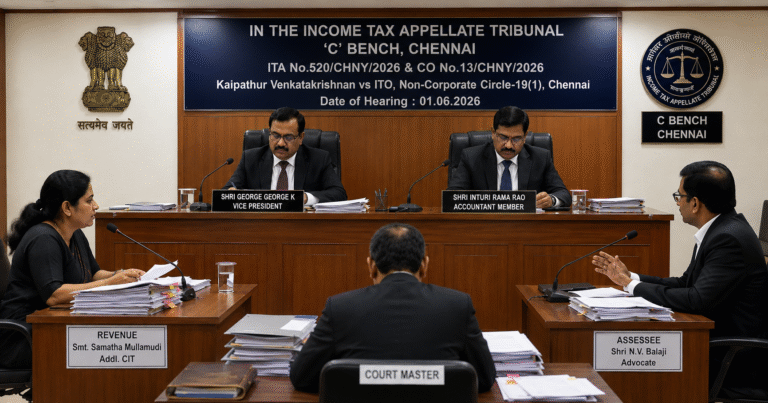
In a significant ruling reinforcing the limits of an Assessing Officer’s powers, the Chennai Bench of the Income Tax Appellate Tribunal (ITAT) has held that an Assessing Officer (AO) cannot make a fresh addition while passing an order merely to give effect to directions issued by an appellate authority.
The decision came in the case of ITO v. Kaipathur Venkatakrishnan (ITA No. 520/CHNY/2026), where the Tribunal upheld the deletion of a ₹5 crore addition that had been introduced by the AO under the head “Income from Other Sources” while implementing an earlier ITAT order.
Background of the Dispute
The assessee had originally filed his income tax return for Assessment Year 2008-09 declaring a modest income. Subsequently, the assessment was reopened under Section 148 of the Income-tax Act, 1961.
During the reassessment proceedings, the Revenue alleged that the assessee had received ₹5 crore as his share of consideration from the sale of an immovable property. Since the assessee’s father was treated as the substantive owner of the property, the addition towards long-term capital gains (LTCG) was made in the assessee’s hands only on a protective basis.
The substantive assessment in the hands of the assessee’s father and the protective assessment in the hands of the assessee eventually travelled through multiple appellate stages.
Supreme Court Cancels the Sale Deed
A crucial development occurred when the Supreme Court cancelled the underlying sale deed that formed the basis of the alleged capital gains transaction.
Relying on the Supreme Court’s decision, the Chennai ITAT, in an earlier consolidated order, held that since the sale deed itself stood cancelled, there was no valid transfer of property in the eyes of law. Consequently, no taxable long-term capital gain could arise from such a transaction.
As a result, the Tribunal deleted the substantive addition and also upheld the deletion of the corresponding protective addition.
Fresh Addition by AO in Appeal Effect Order
While giving effect to the Tribunal’s order, the AO deleted the long-term capital gains addition as directed. However, the AO simultaneously introduced a new addition of ₹5 crore under the head “Income from Other Sources.”
The AO reasoned that although the capital gains addition had failed due to the cancellation of the sale deed, the assessee had admittedly received ₹5 crore from the transaction. Since there was no evidence that the amount had been refunded, the AO sought to tax the amount as income from other sources.
This fresh addition resulted in a revised taxable income exceeding ₹5 crore and generated a substantial tax demand.
CIT(A) Deletes the Addition
The Commissioner of Income Tax (Appeals) [CIT(A)] deleted the addition, observing that the AO had exceeded the scope of the appellate directions.
According to the CIT(A), the Tribunal had never directed the AO to examine the taxability of ₹5 crore under the head “Income from Other Sources.” The issue before the Tribunal was confined to the taxability of capital gains arising from the alleged transfer of property.
Therefore, while giving effect to the Tribunal’s order, the AO was required only to implement the directions contained in that order and had no authority to introduce an entirely new source of income.
ITAT Upholds Deletion
The Chennai ITAT agreed with the CIT(A) and dismissed the Revenue’s appeal.
The Tribunal noted that the original assessment proceedings revolved around the question of long-term capital gains and not around taxation of the amount as income from other sources.
Importantly, neither the original assessment order nor the earlier appellate orders contained any finding regarding taxation of the ₹5 crore under a different head of income.
The Tribunal emphasized that while passing an order giving effect to an appellate decision, the AO is bound by the scope of the directions issued by the appellate authority. He cannot travel beyond those directions and initiate fresh issues that were never part of the original dispute.
Reliance on Allahabad High Court Judgment
The Tribunal relied on the Allahabad High Court’s landmark ruling in S.P. Kochhar v. ITO (145 ITR 255). The High Court had held that when a matter is remanded or directions are issued by an appellate authority, the Assessing Officer’s powers are restricted to the subject matter of the appeal.
Any attempt to examine issues outside the scope of such directions would amount to exceeding jurisdiction.
Key Takeaway
This ruling is an important reminder that appellate effect proceedings are not fresh assessment proceedings. An Assessing Officer cannot use an order giving effect to a Tribunal decision as an opportunity to create new tax demands or raise entirely new issues.
The decision strengthens taxpayer protection against jurisdictional overreach and reiterates that appellate directions must be implemented strictly within their defined boundaries. For tax professionals and taxpayers alike, the judgment serves as a valuable precedent on the limited scope of appeal effect orders under the Income-tax Act.
Case Citation: ITO v. Kaipathur Venkatakrishnan, ITA No. 520/CHNY/2026 & C.O. No. 13/CHNY/2026, order dated 02 June 2026, Chennai ITAT.
Follow the Link Below to Watch the Video: