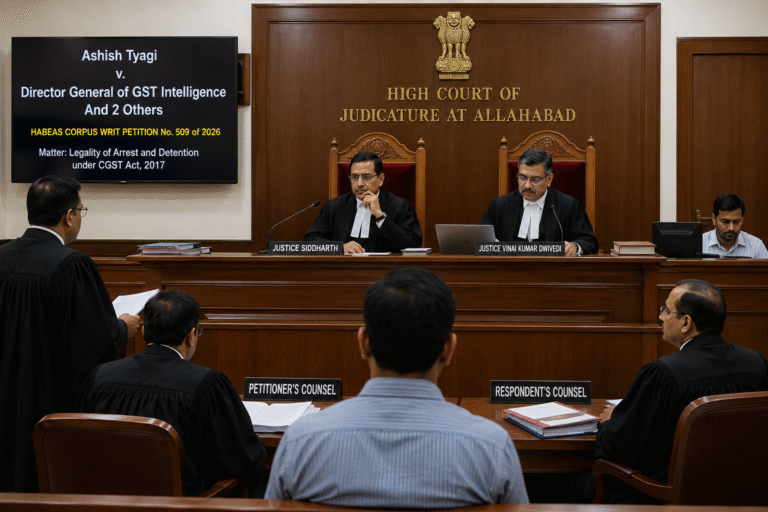
In a significant judgment reinforcing procedural safeguards under the Goods and Services Tax (GST) regime, the Allahabad High Court has ordered the immediate release of a taxpayer after finding serious irregularities in the arrest process adopted by GST authorities. The Court held that the arrest and subsequent detention were illegal because the grounds of arrest did not contain a mandatory CBIC Document Identification Number (DIN), and the arrest memo failed to specify the place of arrest.
The ruling was delivered in Ashish Tyagi v. Director General of GST Intelligence and Others (Habeas Corpus Writ Petition No. 509 of 2026) and serves as an important reminder that statutory authorities must strictly comply with procedural requirements while exercising arrest powers under the Central Goods and Services Tax Act, 2017.
Background of the Case
The petitioner, Ashish Tyagi, was arrested by the Directorate General of GST Intelligence (DGGI), Ghaziabad, in connection with alleged GST offences punishable under Sections 132(1)(a), 132(1)(f), and 132(1)(i) of the CGST Act, 2017.
The allegations primarily related to the issuance of invoices and other activities that were claimed to constitute offences under the GST law. Following his arrest, Tyagi challenged the legality of the detention by filing a habeas corpus petition before the Allahabad High Court.
The petitioner argued that the arrest was carried out in complete disregard of mandatory procedural safeguards prescribed under the GST framework and judicial precedents.
Petitioner’s Contentions
Before the High Court, the petitioner raised several serious objections regarding the legality of his arrest.
It was contended that the arrest memo neither contained the grounds of arrest nor attached them as an annexure. This, according to the petitioner, was contrary to Circular No. 02/2022-23 issued by the GST Department, which requires proper communication of the grounds of arrest to the person being detained.
The petitioner further submitted that the remand magistrate failed to examine these deficiencies before authorising judicial custody.
Another crucial argument was that the grounds of arrest allegedly provided to the petitioner did not contain a CBIC-DIN (Central Board of Indirect Taxes and Customs – Document Identification Number). The petitioner relied on a departmental circular issued in March 2025, which mandates that official communications and departmental documents must bear a valid CBIC-DIN for authenticity and traceability.
High Court’s Observations
The Division Bench comprising Justice Siddharth and Justice Vinai Kumar Dwivedi carefully examined the arrest records and found merit in the petitioner’s submissions.
The Court observed that the grounds of arrest dated 10 December 2025 did not contain any CBIC-DIN. The Bench noted that although the petitioner had signed the arrest memo acknowledging receipt of the grounds of arrest and informing a friend about his arrest through a phone call, the absence of a CBIC-DIN on the arrest document raised serious concerns regarding compliance with departmental instructions.
The Court recorded:
“We further find that the grounds of arrest dated 10.12.2025 do not bear any CBIC DIN.”
The Bench also noticed another significant defect in the arrest memo. The document failed to disclose the place where the petitioner was arrested.
According to the Court, this omission violated the safeguards laid down by the Supreme Court in the landmark decision of D.K. Basu v. State of West Bengal, which prescribes mandatory requirements to ensure transparency and accountability in arrests.
Violation of CBIC Circular and Constitutional Safeguards
The High Court gave considerable weight to the petitioner’s contention that departmental instructions requiring the use of CBIC-DIN had not been followed.
The DIN system was introduced by the CBIC to ensure transparency, prevent unauthorised communications, and maintain an electronic audit trail of official documents. Failure to mention the DIN on a crucial document such as the grounds of arrest undermines the legitimacy and authenticity of the action taken by tax authorities.
The Court observed that when statutory authorities exercise drastic powers such as arrest, strict adherence to prescribed procedures becomes indispensable. Any deviation from mandatory safeguards may render the entire action vulnerable to judicial scrutiny.
Court Declares Detention Illegal
After considering the deficiencies in the arrest process, the Allahabad High Court concluded that the petitioner’s detention was unlawful.
The Court held that the absence of a CBIC-DIN on the grounds of arrest, coupled with the failure to disclose the place of arrest in the arrest memo, amounted to significant procedural violations.
Consequently, the Court directed the immediate release of Ashish Tyagi from custody.
However, the Bench clarified that its order would not prevent the GST authorities from initiating fresh proceedings against the petitioner in accordance with law and after complying with all legal requirements.
Significance of the Judgment
This ruling is likely to have far-reaching implications for GST enforcement proceedings across the country. The judgment underscores that procedural safeguards are not mere technicalities but essential protections against arbitrary exercise of power.
The decision reinforces the principle that GST authorities must strictly comply with CBIC circulars, statutory provisions, and constitutional safeguards while exercising arrest powers. It also highlights the continued relevance of the Supreme Court’s guidelines in D.K. Basu for ensuring fairness and transparency during arrests.
For taxpayers and professionals, the judgment serves as an important precedent demonstrating that non-compliance with mandatory procedural requirements can invalidate even serious enforcement actions under the GST regime.
Case Title: Ashish Tyagi v. Director General of GST Intelligence and 2 Others
Case Number: Habeas Corpus Writ Petition No. 509 of 2026
Court: Allahabad High Court
Bench: Justice Siddharth and Justice Vinai Kumar Dwivedi
Follow the Link below to watch the video: