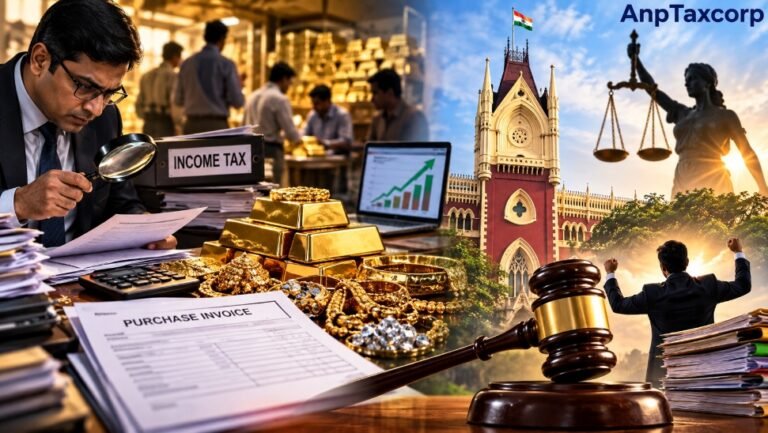
Calcutta High Court upholds ITAT relief in ₹85.13 crore bogus purchases case, holding that a different view by AO or CIT(A) is not enough for interference under Section 260A.
The Calcutta High Court has upheld the Income Tax Appellate Tribunal’s (ITAT) decision granting substantial relief to a bullion trader in a case involving alleged bogus purchases of ₹85.13 crore. The Court held that merely because the Assessing Officer (AO) and Commissioner of Income Tax (Appeals) [CIT(A)] took a different view of the evidence, the High Court could not interfere with the factual findings of the ITAT under Section 260A of the Income Tax Act, 1961.
The judgment was delivered on 22 September 2026 by a Division Bench comprising Justice Rajarshi Bharadwaj and Justice Sudip Deb in Principal Commissioner of Income Tax-13, Kolkata v. Utkarsh Rai, ITAT 174 of 2026.
Background of the Case
The assessee, Utkarsh Rai, was engaged in the business of bullion trading through his proprietorship concern. The dispute related to Assessment Year 2020-21.
During assessment proceedings, the Assessing Officer treated purchases amounting to approximately ₹85.13 crore as bogus purchases and made an addition under Section 69C of the Income Tax Act.
The AO relied upon several circumstances while questioning the genuineness of the transactions. These included the alleged failure of certain vendors to file their income-tax returns, the nature of the vendors’ businesses, non-compliance with notices issued under Section 133(6), and discrepancies noticed in documents and banking transactions. The CIT(A) subsequently upheld the addition.
Assessee’s Evidence Supporting the Purchases
Before the appellate authorities, the assessee relied upon documentary evidence to establish the genuineness of the purchases.
The material relied upon included purchase invoices, ledger accounts, confirmations from suppliers, banking records, GST-related documents and stock registers. The assessee also highlighted an important commercial aspect of the transactions—the corresponding sales had not been disputed by the Revenue.
The assessee contended that the purchases could not simply be treated as entirely bogus merely because certain suppliers subsequently failed to file income-tax returns, had their GST registrations cancelled or were allegedly engaged in businesses different from that of the assessee.
ITAT Grants Relief
The ITAT examined the material available on record and did not accept the proposition that the entire purchases of ₹85.13 crore should be treated as unexplained expenditure.
The Tribunal observed that the surrounding circumstances and documentary evidence had to be considered collectively. In particular, the corresponding sales were not disputed by the Revenue.
However, the ITAT also took note of the discrepancies identified by the Assessing Officer. Instead of accepting the purchases at face value for tax purposes, it adopted a gross-profit approach and applied a gross-profit rate of 0.15% to the disputed purchases.
Calcutta High Court’s Observations
The Revenue challenged the ITAT’s order before the Calcutta High Court under Section 260A of the Income Tax Act.
The High Court examined whether the Tribunal’s findings disclosed any perversity or raised a substantial question of law warranting interference.
The Court declined to interfere with the ITAT’s factual findings. It specifically held that the fact that the AO or CIT(A) had adopted a different interpretation of the evidence was, by itself, insufficient to justify interference with the Tribunal’s decision under Section 260A.
The Court also took note of the fact that the corresponding sales had not been challenged. According to the Court, treating the entire purchases as bogus in such circumstances could lead to an unrealistic and commercially incongruous gross-profit rate in the bullion trading business.
Scope of Section 260A
The decision also reinforces the limited scope of High Court jurisdiction under Section 260A of the Income Tax Act.
An appeal under Section 260A is not intended to provide another opportunity for a complete reappreciation of factual evidence merely because the Revenue prefers a different interpretation. The High Court can interfere where the Tribunal’s findings suffer from perversity or where a substantial question of law arises.
In the present case, the Calcutta High Court found that the ITAT had considered the relevant evidence and arrived at findings of fact. The Revenue was unable to establish circumstances warranting interference with those findings.
Key Takeaway for Taxpayers
The judgment is significant in disputes involving alleged bogus purchases, particularly where the taxpayer can produce contemporaneous documentary evidence supporting the transactions.
Purchase invoices, supplier confirmations, banking records, GST records, stock registers and evidence of corresponding sales can assume considerable importance when the genuineness of purchases is questioned during assessment.
At the same time, the judgment does not mean that every disputed purchase must automatically be accepted merely because payment was made through banking channels. The overall evidence and surrounding circumstances remain relevant. In this case, the ITAT itself considered the discrepancies pointed out by the AO and adopted a reasonable gross-profit estimation rather than accepting the entire disputed purchases without adjustment.
Conclusion
The Calcutta High Court’s decision in Principal Commissioner of Income Tax-13, Kolkata v. Utkarsh Rai reiterates an important principle concerning appellate jurisdiction under Section 260A of the Income Tax Act.
A difference in appreciation of evidence between the Assessing Officer, CIT(A) and ITAT does not, by itself, create a substantial question of law. Where the ITAT has examined the available evidence and arrived at a plausible factual conclusion, the High Court will not ordinarily substitute its own view unless the findings are shown to be perverse or otherwise give rise to a substantial question of law.
The Revenue’s appeal was accordingly dismissed, leaving the ITAT’s decision and the relief granted to the assessee undisturbed.
Case: Principal Commissioner of Income Tax-13, Kolkata v. Utkarsh Rai
Case No.: ITAT 174 of 2026
Assessment Year: 2020-21
Court: Calcutta High Court
Decision Date: 22 September 2026
Key Provisions: Sections 69C, 133(6) and 260A of the Income Tax Act, 1961
Subject: Bogus Purchases / Bullion Trading / Section 260A