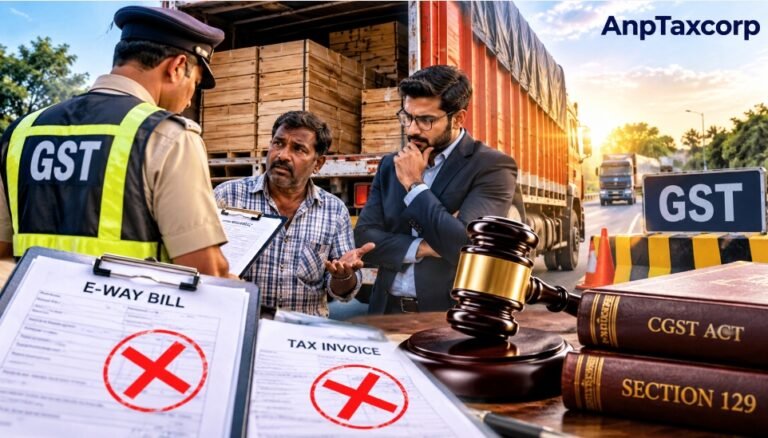
GSTAT Bengaluru rules that an e-way bill and tax invoice generated after interception cannot retrospectively validate goods movement, upholding penalty under Section 129 of the CGST Act.
Case Title: Heramb Enterprises v. C Pushpalatha, Additional Commissioner of Commercial Taxes
Case No.: APL/142/BUR/2026
Forum: GST Appellate Tribunal, Bengaluru Bench
Issue: Validity of subsequently generated e-way bill and tax invoice after interception of goods
Introduction
The GST Appellate Tribunal, Bengaluru Bench, has held that documents generated only after interception of goods cannot retrospectively validate a movement that was not supported by the prescribed GST documents at the time of transportation.
In Heramb Enterprises v. C Pushpalatha, Additional Commissioner of Commercial Taxes, the Tribunal examined whether an e-way bill and tax invoice generated after the interception of a vehicle could cure the statutory violation and protect the taxpayer from proceedings under Section 129 of the CGST Act. The Tribunal answered the issue against the appellant and upheld the penalty imposed by the Revisional Authority.
The ruling highlights the importance of maintaining proper GST transportation documents before the movement of goods begins and carries significant implications for businesses, transporters and recipients involved in inter-State and intra-State movement of taxable goods.
Facts of the Case
The dispute arose following the interception of a vehicle carrying plywood at Udayambag, Belagavi, on 6 October 2020.
The vehicle was carrying goods from Intercon Wood Industries, Perumbavoor, Kerala, and the tax invoice and e-way bill available with the vehicle indicated transportation to the appellant’s premises at Vadgao, Belagavi.
However, the authorities found that the goods were actually being unloaded at REC Flow Technology LLP, a destination different from the one reflected in the documents accompanying the vehicle.
According to the authorities, there were no corresponding tax documents or e-way bill covering the movement of the goods to the actual destination. Consequently, the proper officer initiated action under Section 129 of the CGST Act and imposed a penalty.
The appellant subsequently generated a fresh e-way bill and tax invoice on the same day, after the vehicle had already been intercepted.
Proceedings Before the Authorities
The First Appellate Authority granted partial relief to the appellant. It observed that the goods had reached the destination within the validity period of the e-way bill and found no apparent intention to evade tax. The penalty was consequently reduced to ₹500 under the CGST Act and ₹500 under the KGST Act.
The Revisional Authority, however, took a different view. It observed that the documents relied upon by the appellant had been generated only after interception of the vehicle. According to the Revisional Authority, these documents appeared to have been created subsequently to explain or cover the irregular movement of goods.
The original penalty was therefore restored.
Arguments Before GSTAT
Before the GST Appellate Tribunal, the appellant contended that the transaction was genuine and that the supplier, transporter and recipient were registered dealers. It was also submitted that the transaction was duly recorded in the books of account.
The appellant further argued that the e-way bill could not be generated before transportation because of a technical glitch. Another objection raised before the Tribunal concerned the limitation applicable to the revisional proceedings.
The Tribunal rejected both the limitation objection and the explanation relating to the alleged technical problem.
GSTAT’s Findings
The Tribunal referred to Section 68 of the CGST Act, which requires the person in charge of a conveyance carrying goods to carry the prescribed documents, including the e-way bill wherever applicable.
It also considered Section 129, which provides for detention, seizure and release of goods and conveyances where goods are transported in contravention of the provisions of the GST law or the rules.
The Tribunal found that the appellant was aware of the applicable procedure but had failed to generate the necessary e-way bill and tax invoice for the actual destination before commencement of the relevant movement.
Importantly, the appellant did not produce evidence establishing that a technical glitch had prevented generation of the documents before transportation. The Tribunal therefore did not accept the technical-glitch explanation.
The Tribunal observed that the subsequent generation of the e-way bill and invoice, after the appellant became aware of the detention, could not retrospectively cure the statutory contravention.
Key Legal Principle
The decision reinforces an important principle of GST compliance: transportation documents must correctly reflect the actual movement of goods and must be available at the legally relevant point of interception.
A document generated after interception cannot automatically validate an earlier movement that was unsupported by the prescribed documentation.
The Tribunal treated the absence of the relevant tax invoice and e-way bill at the time of interception as a substantive violation rather than a mere technical or procedural lapse.
The Tribunal also distinguished cases relied upon by the appellant concerning expired e-way bills and other procedural irregularities, noting that those decisions were factually different and therefore did not assist the appellant.
Decision of the Tribunal
The GSTAT Bengaluru Bench ultimately upheld the Revisional Authority’s order and dismissed the appeal.
The ruling serves as an important compliance reminder for taxpayers and logistics operators. Businesses should ensure that the tax invoice, e-way bill and other prescribed transportation documents accurately correspond with the actual destination and movement of goods before the vehicle starts its journey.
Where goods are diverted to another destination, businesses should also ensure that the GST documentation is appropriately updated in accordance with the applicable legal requirements before the movement takes place.
Conclusion
The Heramb Enterprises ruling demonstrates that GST authorities and appellate forums may draw a clear distinction between a genuine procedural lapse and a situation where statutory documents are generated only after enforcement action has commenced.
For businesses transporting taxable goods, the practical lesson is straightforward: GST transportation documentation should be accurate, complete and generated at the appropriate stage—not created merely after interception to explain an otherwise undocumented movement.
Proper e-way bill compliance, accurate invoicing and consistency between the physical movement of goods and GST records remain essential to avoid detention, penalty and prolonged litigation under Section 129 of the CGST Act.