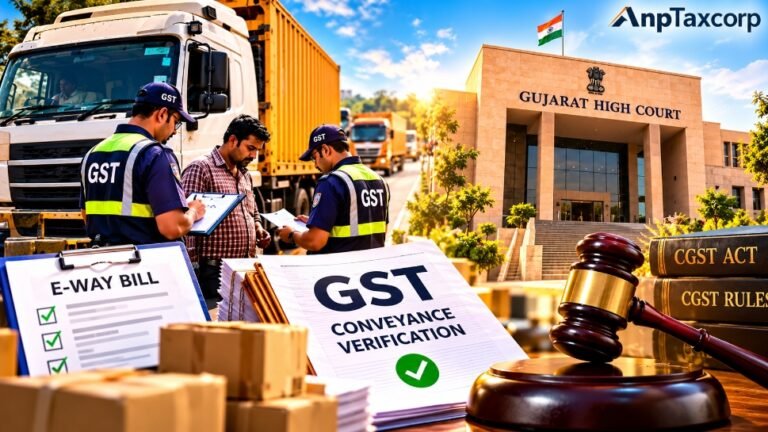
Gujarat High Court dismisses Shreeji Steel’s writ petition, holding that an authorised GST officer could verify the vehicle under Rule 138B and directing the taxpayer to pursue the statutory appeal under Section 107 of the CGST Act.
The Gujarat High Court has dismissed a writ petition challenging GST confiscation proceedings, holding that the physical verification of a vehicle carrying goods was conducted by a duly authorised proper officer under Rule 138B of the CGST Rules, 2017. The Court also reiterated that where an effective statutory remedy of appeal is available, a taxpayer ordinarily cannot bypass that remedy and directly invoke the writ jurisdiction of the High Court.
The judgment is significant for businesses transporting goods because it clarifies the authority of GST officers to intercept and verify conveyances and also highlights the importance of pursuing the statutory appellate mechanism under the GST law.
Background of the Case
The matter arose from proceedings involving Shreeji Steel, a dealer engaged in the trading of waste and scrap of cast iron. The goods were purchased from A.S. Construction, Gandhidham, and were being transported directly to A.K. Tools Industries through a vehicle bearing registration number PB 13 BR 9947.
On 13 February 2025, the vehicle was intercepted by the State Tax Officer (1), Kachchh Mobile Squad, at Radhanpar Highway near Samakhiyali. The GST authorities carried out physical verification of the vehicle and the goods.
Following the inspection, the authorities issued Form GST MOV-04, recording the result of physical verification, followed by a detention order in Form GST MOV-06. Subsequently, proceedings under Section 130 of the CGST Act, 2017 were initiated through a notice in Form GST MOV-10, proposing confiscation of the goods and conveyance.
The proposed penalty was approximately ₹2.47 lakh, while the proposed fine in lieu of confiscation of the goods was approximately ₹13.75 lakh. A further amount of approximately ₹2.47 lakh was proposed as fine relating to the conveyance.
Challenge Before the Gujarat High Court
Shreeji Steel challenged the GST proceedings before the High Court on several grounds.
One of the principal arguments was that the officer who physically verified the vehicle was allegedly not authorised in accordance with Rule 138B of the CGST Rules. The petitioner also questioned the legality of the subsequent confiscation proceedings.
It was further argued that certain documents relied upon by the department had not been supplied to the taxpayer, allegedly resulting in a violation of the principles of natural justice.
The petitioner also raised concerns regarding the role of the officer involved in the proceedings and contended that the statutory requirements governing interception and verification of goods in transit had not been properly followed.
Court Examines Authority of GST Officer
The Gujarat High Court examined the provisions of Rule 138B of the CGST Rules, 2017, which empower the Commissioner or an officer authorised by the Commissioner to authorise a proper officer to intercept a conveyance for verification of the e-way bill and related documents.
The Court found that the officer who conducted the physical verification of Shreeji Steel’s vehicle possessed the necessary authorisation.
Consequently, the Court rejected the taxpayer’s contention that the physical verification itself was undertaken without proper jurisdiction.
The Bench comprising Justice A.S. Supehia and Justice Vaibhavi D. Nanavati observed that the material available on record did not establish any violation of the relevant provisions because the physical verification had been conducted by a proper officer authorised by the Commissioner.
No Violation of Natural Justice
The Court also considered the allegation that relevant documents had not been furnished to the taxpayer.
The record showed that Form GST MOV-04 and Form GST MOV-06 had been supplied to the person in charge of the conveyance. The subsequent MOV-10 notice was also supplied to Shreeji Steel.
Documents relating to the cancellation of the supplier’s GST registration were also made available.
Importantly, the taxpayer was granted an opportunity for personal hearing on 22 January 2026. Although the taxpayer did not appear for the personal hearing, a written reply was filed and was considered by the authorities before passing the final order.
The Court therefore found no sufficient basis to conclude that the principles of natural justice had been violated.
Alternative Remedy Under Section 107
Another important aspect of the judgment was the availability of a statutory appeal.
The department pointed out that the final adjudication order could be challenged through an appeal under Section 107 of the CGST Act, 2017.
The High Court referred to the Supreme Court’s principles concerning the exercise of writ jurisdiction where an alternative statutory remedy is available. In particular, the Court relied upon the decision in Assistant Commissioner of State Tax v. Commercial Steel Ltd.
The High Court found that the present matter did not involve circumstances justifying direct interference under Article 226 of the Constitution.
There was no established violation of fundamental rights, denial of natural justice, patent lack of jurisdiction, or challenge to the constitutional validity of the statutory provisions. Therefore, the taxpayer was required to pursue the statutory appellate remedy.
Final Decision
The Gujarat High Court ultimately dismissed the writ petition filed by Shreeji Steel.
The Court upheld the department’s position that the vehicle had been physically verified by an authorised proper officer and found no sufficient procedural defect warranting interference in writ jurisdiction.
The taxpayer was left with the statutory remedy of filing an appeal under Section 107 of the CGST Act against the adjudication order.
Key Takeaways for GST Taxpayers
This judgment carries several practical lessons for businesses involved in the transportation of goods:
- GST officers can intercept and verify goods in transit when authorised under the applicable provisions of the CGST Rules.
- Rule 138B authorisation is important and taxpayers challenging vehicle verification must establish an actual jurisdictional defect rather than merely alleging lack of authority.
- Proper documentation is critical. Businesses should maintain valid e-way bills, invoices, transport documents and other supporting records while goods are in transit.
- Natural justice objections must be supported by facts. Where notices and relevant documents are supplied and an opportunity of hearing is provided, merely alleging denial of natural justice may not be sufficient.
- The statutory appeal mechanism should not be ignored. Where an adjudication order has been passed, an appeal under Section 107 of the CGST Act may ordinarily be the appropriate remedy.
Conclusion
The Gujarat High Court’s decision reinforces two important principles of GST litigation: authorised GST officers have statutory powers to verify goods and conveyances in transit, and taxpayers should ordinarily exhaust the prescribed appellate remedy before approaching the High Court.
For businesses regularly transporting goods across State borders, the judgment underlines the importance of GST compliance at the movement stage itself. Proper e-way bill compliance, accurate documentation and timely response to GST notices can significantly reduce the risk of detention, penalty and confiscation proceedings.
Case: Shreeji Steel v. State Tax Officer (1), Kutch Mobile Squad
Case No.: R/Special Civil Application No. 10249 of 2026
Court: Gujarat High Court
Decision: Writ petition dismissed; statutory appellate remedy under Section 107 remains available.