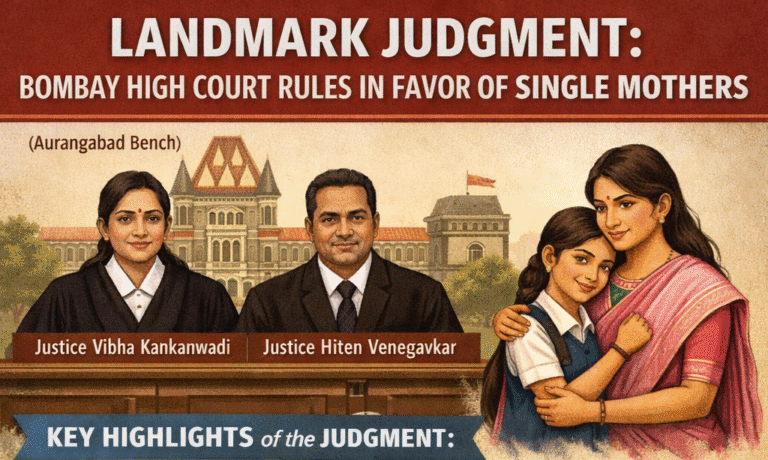
In a progressive and constitutionally significant ruling delivered on February 2, 2026, the Bombay High Court (Aurangabad Bench) held that a child raised solely by a single mother cannot be compelled to use the father’s name, surname, or caste in official records.
Background of the Case
The case arose from a plea filed by a 12-year-old girl and her mother, a survivor of sexual assault. The child had been raised exclusively by her mother since birth, with no involvement from the biological father.
In school records, the father’s name and caste (Maratha) were entered at the time of admission. However, the mother belongs to the Scheduled Caste (Mahar) community and had solely nurtured and supported the child. Seeking correction of the official documents to reflect the mother’s name and caste instead of the father’s, the petitioner approached the school authorities.
The school refused to make the requested changes, citing rigid administrative formats and technical constraints that treated the father’s details as mandatory.
Court’s Observations
A division bench comprising Justice Vibha Kankanwadi and Justice Hiten Venegavkar took a strong view against such mechanical reliance on administrative rules. The Court emphasized that:
- A single mother who independently raises a child must be legally recognized as a “complete parent.”
- Forcing a child to carry the identity of an absent father imposes a structural and social burden.
- Public identity documents must reflect lived reality, not merely biological connections.
- Administrative forms that treat the father’s name as compulsory while making the mother’s optional perpetuate inequality.
Caste Determination and Social Reality
Significantly, the Court clarified that caste determination cannot be confined strictly to biological lineage. Instead, it must take into account the social environment in which the child is brought up. Since the child was raised entirely within the mother’s Scheduled Caste community, denying recognition of that identity would ignore social reality and constitutional principles of equality and dignity.
A Step Toward Administrative Reform
The judgment also called for reform in documentation practices that structurally privilege paternal identity. The Court observed that such formats reflect outdated assumptions and must evolve to align with constitutional morality and gender equality.
Why This Judgment Matters
This ruling strengthens the legal recognition of single mothers, safeguards children’s identity rights, and reinforces the constitutional commitment to equality and dignity. It marks an important step in dismantling systemic biases embedded in administrative procedures.