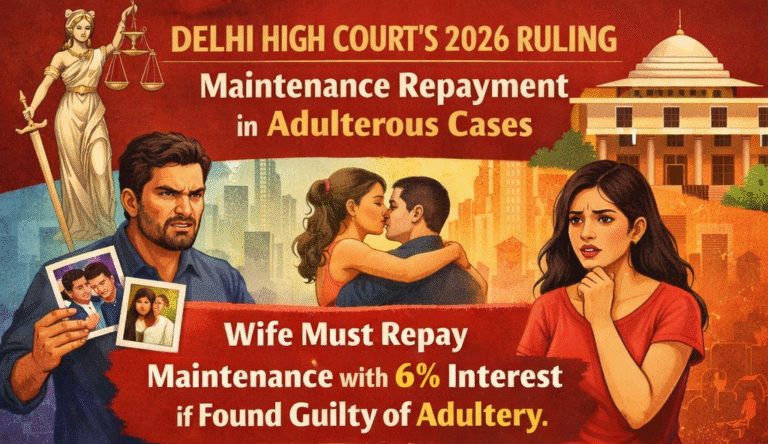
In a significant ruling delivered in February 2026, the Delhi High Court held that a wife may be required to refund the entire amount of interim maintenance received—along with 6% interest—if allegations of adultery against her are ultimately proved during trial.
The judgment was delivered by Justice Swarana Kanta Sharma, while hearing a husband’s plea challenging a 2021 trial court order that had granted his wife ₹26,000 per month as interim maintenance under the Protection of Women from Domestic Violence Act, 2005 (PWDV Act).
Key Highlights of the Judgment
1️⃣ Adultery and Maintenance: A Conditional Bar
The Court clarified that mere allegations of adultery cannot deprive a woman of interim maintenance. However, if during final adjudication it is established that the wife was “living in adultery,” she would not be entitled to maintenance.
This position aligns with established legal principles under matrimonial and maintenance laws in India.
2️⃣ Mandatory Undertaking to Repay Maintenance
In a notable direction, the High Court ordered the wife to file an affidavit of undertaking before the trial court. The affidavit must state that:
- If she is ultimately found to be living in an adulterous relationship,
- She will return the entire maintenance amount received,
- Along with 6% annual interest.
This condition ensures a balance between protecting genuine claimants and discouraging misuse of interim relief mechanisms.
3️⃣ Disputed Facts Require Evidence
The Court observed that:
- The husband had submitted photographs claiming they proved adultery.
- The wife denied these allegations, calling them fabricated and accusing the husband of “character assassination.”
- She also alleged prolonged physical, sexual, and economic abuse.
Given the serious and conflicting claims, the High Court held that such issues can only be resolved through proper trial and evidence, not at the interim stage.
4️⃣ Expedited Trial Ordered
To prevent prolonged litigation, the High Court directed the trial court to make every effort to conclude the domestic violence proceedings within one year.
Background of the Dispute
- The couple married in 2014.
- They separated shortly after marriage.
- The wife alleged sustained domestic violence and humiliation.
- The husband challenged the maintenance order, arguing that:
- His income had been overestimated.
- The wife was engaged in an adulterous relationship.
The trial court had previously granted ₹26,000 per month as interim maintenance under the PWDV Act, which the husband contested before the High Court.
Why This Judgment Matters
This ruling is important because it:
✔ Reinforces that interim maintenance cannot be denied solely on unproven allegations.
✔ Clarifies that proven adultery may disentitle a wife from maintenance.
✔ Introduces a safeguard mechanism through a repayment undertaking with interest.
✔ Emphasizes speedy disposal of domestic violence cases.
The decision attempts to strike a careful balance between protecting women from economic vulnerability and preventing misuse of interim relief provisions.