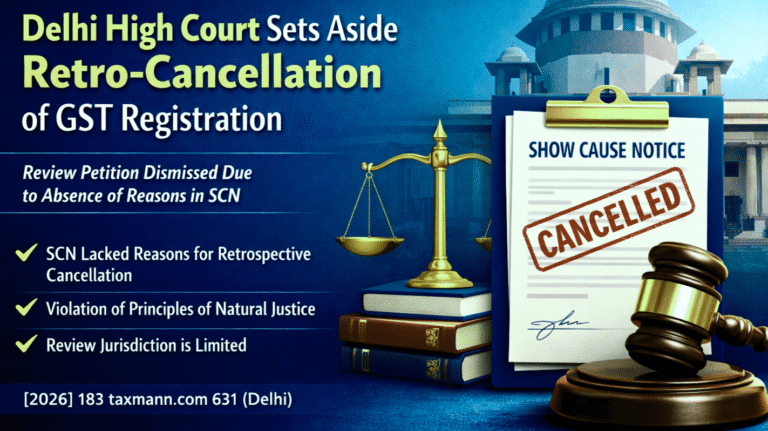
In a significant ruling strengthening the principles of natural justice in GST proceedings, the Delhi High Court held that retrospective cancellation of GST registration cannot be sustained when the Show Cause Notice (SCN) fails to specify the reasons for such action.
The Court also dismissed the department’s review petition, observing that no apparent error existed in the earlier judgment setting aside the retrospective cancellation.
Citation: [2026] 183 taxmann.com 631 (Delhi)
Background of the Case
Under the GST framework, the tax authorities may cancel a taxpayer’s registration under Section 29 of the Central Goods and Services Tax Act, 2017 if certain statutory conditions are satisfied. In some cases, such cancellation is ordered retrospectively, which can significantly impact tax liability and input tax credit claims.
In the present case:
- The taxpayer received a Show Cause Notice (SCN) proposing cancellation of GST registration.
- However, the SCN did not contain any reasons indicating that the cancellation would be retrospective.
- Despite this, the department later issued an order cancelling the registration with retrospective effect.
Aggrieved by the action, the taxpayer approached the High Court challenging the legality of the cancellation.
Earlier High Court Order
The Delhi High Court examined the matter and held that:
- The SCN did not disclose the intention or reasons for retrospective cancellation.
- Such omission deprived the taxpayer of an effective opportunity to respond.
Accordingly, the Court set aside the retrospective cancellation of the GST registration.
Department’s Review Petition
Following the judgment, the tax department filed a review petition before the same court seeking reconsideration of the earlier decision.
The department argued that the Court should review and modify its order regarding the retrospective cancellation.
Observations of the High Court
While dismissing the review application, the Delhi High Court made the following key observations:
1. SCN Must Contain Clear Reasons
A Show Cause Notice must clearly indicate:
- The grounds for cancellation, and
- Whether the department proposes retrospective cancellation.
If such reasons are absent, the taxpayer cannot effectively defend the case.
2. Retrospective Cancellation Has Serious Consequences
Cancellation with retrospective effect may:
- Invalidate past transactions,
- Affect input tax credit (ITC) claims, and
- Create tax complications for recipients of supplies.
Therefore, such action must be supported by clear reasoning in the SCN itself.
3. Limited Scope of Review Jurisdiction
The Court emphasized that a review petition is not an appeal in disguise.
A review can only be allowed when:
- There is an error apparent on the face of the record, or
- A manifest injustice is demonstrated.
In the present case, the department failed to point out any such error.
Final Ruling
The Delhi High Court dismissed the department’s review petition, holding that:
- The earlier judgment setting aside the retrospective cancellation of GST registration remains valid.
- The absence of reasons in the SCN was sufficient to invalidate such action.
Key Takeaways
- SCN must clearly state the grounds for cancellation of GST registration.
- If retrospective cancellation is proposed, the reasons must be specifically mentioned in the SCN.
- Authorities cannot introduce new grounds later in the final order.
- Review jurisdiction is limited and cannot be used to re-argue the case.
Conclusion
This decision of the Delhi High Court reinforces that procedural fairness is a cornerstone of GST administration. Tax authorities must ensure that Show Cause Notices clearly articulate the reasons and scope of proposed action, especially when such action may have retrospective implications for taxpayers.