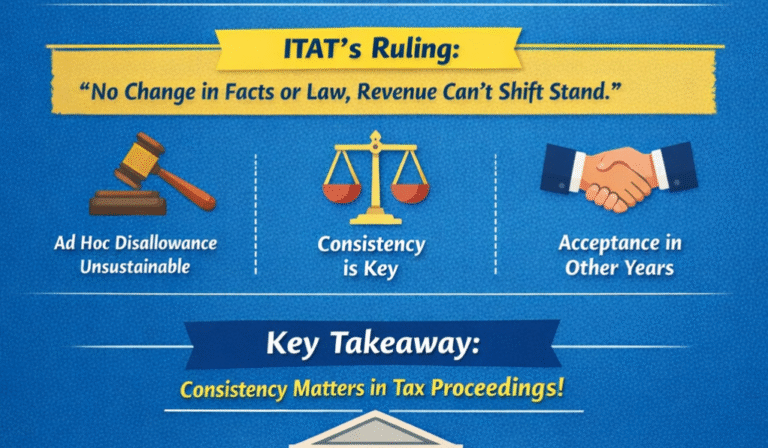
In a noteworthy ruling, the Delhi Bench of the Income Tax Appellate Tribunal (ITAT) reaffirmed the importance of the principle of consistency in income tax proceedings while deleting a proportionate disallowance of power and fuel expenses. The decision highlights the judiciary’s continued disapproval of arbitrary and ad hoc additions made by tax authorities without proper evidentiary backing.
Background of the Case
The assessee, engaged in business operations requiring substantial consumption of power and fuel, claimed these expenses as part of its regular business expenditure during the relevant assessment year. Such expenses were integral to the nature of its operations and had been consistently incurred over the years.
During the scrutiny assessment, the Assessing Officer (AO) raised concerns regarding the quantum of power and fuel expenses claimed. Without identifying any specific defects in the books of account or pointing out instances of non-business usage, the AO proceeded to make a proportionate disallowance of these expenses. The disallowance appeared to be based on estimation rather than concrete evidence, thereby raising questions about its sustainability.
Aggrieved by the addition, the assessee challenged the disallowance, contending that the expenses were wholly and exclusively incurred for the purposes of business. It was further argued that similar claims had been accepted by the department in other assessment years, including a subsequent year, without any disallowance.
Core Issue
The central issue before the Tribunal was whether the Assessing Officer was justified in making an ad hoc and proportionate disallowance of power and fuel expenses in the absence of any change in facts, law, or supporting evidence—particularly when similar claims had been accepted in other years.
Tribunal’s Observations
After considering the submissions and examining the material on record, the ITAT made several important observations:
1. Absence of Defects in Books of Account
The Tribunal noted that the AO had not rejected the books of account under Section 145 of the Income Tax Act, 1961. Nor had the AO identified any specific discrepancies or defects in the maintenance of records. In such circumstances, making an estimated disallowance without a solid foundation was held to be unjustified.
2. Ad Hoc Disallowance Not Sustainable
The ITAT reiterated the settled legal position that ad hoc disallowances cannot be sustained unless supported by tangible evidence. Tax authorities are expected to base their conclusions on verifiable facts rather than conjectures or assumptions. In the present case, the absence of any concrete material rendered the disallowance arbitrary.
3. Principle of Consistency
A significant aspect of the ruling was the Tribunal’s reliance on the principle of consistency. It observed that the department had accepted similar claims made by the assessee in a subsequent assessment year. Since there was no change in the nature of business, accounting methods, or relevant facts, the Revenue was not justified in taking a divergent view for the year under consideration.
The Tribunal emphasized that consistency is an essential element of tax administration, ensuring certainty and predictability for taxpayers. Any deviation from a settled position must be backed by new facts or a change in legal provisions.
4. No Fresh Evidence by Revenue
The Tribunal also highlighted that the Revenue failed to bring on record any fresh material or distinguishing factor that could justify a departure from its earlier or subsequent stance. In the absence of such evidence, the disallowance lacked merit.
Final Ruling
Based on the above findings, the Delhi ITAT held that the disallowance of power and fuel expenses was unsustainable in law. Accordingly, the Tribunal deleted the proportionate disallowance made by the Assessing Officer.
Key Takeaways
This ruling reinforces several important principles relevant to taxpayers and tax professionals:
- Consistency is Key: Once a particular issue has been accepted in earlier or subsequent years, the Revenue should maintain consistency unless there is a material change in facts or law.
- No Room for Arbitrary Additions: Ad hoc disallowances without supporting evidence are likely to be struck down.
- Importance of Proper Documentation: Maintaining robust books of account and supporting records strengthens the taxpayer’s position.
- Burden on Revenue: Any deviation from an accepted position must be justified with fresh evidence or valid reasoning.
Conclusion
The Delhi ITAT’s ruling serves as a reminder that tax assessments must be conducted in a fair, transparent, and consistent manner. Arbitrary disallowances not only create unnecessary litigation but also undermine taxpayer confidence in the system. By upholding the principle of consistency, the Tribunal has once again emphasized the need for disciplined and evidence-based tax administration.
👉Case Numbers: ITA No. 3661/Del/2023 and ITA No. 3926/Del/2023.
👉Case Title: Jindal Pipes Limited Vs. Deputy Commissioner of Income Tax