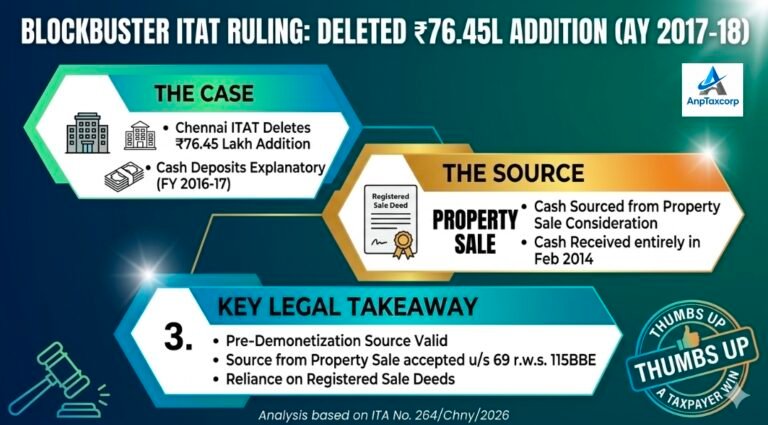
ITAT Chennai has deleted a ₹76.45 lakh addition made under Section 69 read with Section 115BBE of the Income-tax Act, holding that cash deposits cannot be treated as unexplained merely because there was a substantial time gap between the original receipt of cash and its subsequent deposit in the bank.
In a significant ruling concerning cash deposits, unexplained investments and source of cash, the Chennai Bench of the Income Tax Appellate Tribunal (ITAT) has granted relief to the assessee in Humnabad Mohammed Omer v. DCIT, ITA No. 264/Chny/2026, order dated 22 July 2026.
The case involved cash deposits made during Financial Year 2016-17 relevant to Assessment Year 2017-18. The Assessing Officer treated the deposits as unexplained and made an addition of approximately ₹76.45 lakh under Section 69 of the Income-tax Act, with the income being subjected to the special tax provisions of Section 115BBE.
Background of the Case
The assessee explained that the cash deposited into the bank account represented money originating from the sale consideration of an immovable property.
According to the explanation, the property had been sold in February 2014 and the sale consideration had been received in cash. The assessee relied upon registered sale deeds and other documentary evidence to establish both the property transaction and the original source of the funds.
The Revenue, however, questioned the availability of the cash after a considerable interval. The deposits were made approximately two to three years after the cash had originally been received.
The tax authorities also examined the assessee’s conduct regarding temporary interest-free advances made to various persons and their subsequent recovery. The transactions were viewed from the perspective of what would constitute normal human or commercial behaviour.
The dispute ultimately centred on whether the assessee had sufficiently established the source and availability of the cash at the time when it was deposited into the bank.
ITAT: Mere Time Gap Does Not Make Cash Unexplained
The Chennai ITAT accepted the assessee’s explanation and deleted the addition.
A significant aspect of the ruling is that the Tribunal did not consider the time gap between receipt of cash and subsequent bank deposit, by itself, sufficient to reject the explanation.
Where the original source of the money is supported by reliable documentary evidence, the mere fact that the assessee retained cash for a considerable period cannot automatically lead to the conclusion that the cash was no longer available.
In other words, the passage of time, without supporting evidence showing that the money had been spent, transferred or otherwise utilised, does not by itself establish that the assessee could not have possessed the cash when the subsequent deposit was made.
Burden of Proof and Revenue’s Responsibility
The decision also highlights an important principle concerning the burden of proof in Section 69 cases.
Once the assessee provides credible evidence establishing the original source of the funds, including registered documents relating to the property transaction, and the underlying transaction is not effectively disproved by the Revenue, the explanation cannot be rejected merely on assumptions.
The Tribunal’s approach indicates that the Revenue must produce positive and cogent material demonstrating that the funds were diverted, utilised elsewhere or otherwise unavailable to the assessee.
A mere suspicion that an assessee would ordinarily not retain a large amount of cash for several years cannot replace evidence.
Human Probability Cannot Replace Evidence
Another important issue considered in the case was the assessee’s practice of providing temporary, interest-free advances to several persons and subsequently recovering those amounts.
The Revenue questioned the commercial prudence of such transactions and sought to evaluate them through the principle of human probabilities.
However, the Tribunal accepted that the transactions could not be rejected merely because they appeared commercially unusual or imprudent, particularly when the assessee provided an explanation connecting them with religious or personal practices and the Revenue did not bring sufficient contrary evidence on record.
The ruling therefore reinforces the principle that what appears unusual is not necessarily unexplained income.
Payment of Tax Further Supported the Explanation
An additional factor favouring the assessee was the utilisation of the deposited funds towards discharge of the related tax liability.
The immediate application of the funds for payment of tax provided further support to the assessee’s explanation regarding the purpose and source of the bank deposits.
Key Takeaways for Taxpayers and Practitioners
The ruling is particularly relevant in cases involving Section 69 additions arising from unexplained cash deposits.
The following principles emerge:
- A genuine property transaction supported by registered documents can be strong evidence of the original source of cash.
- A delay of two or three years between receipt and bank deposit is not, by itself, conclusive evidence that the cash was unavailable.
- Once the assessee establishes the source with credible evidence, the Revenue cannot sustain an addition merely on suspicion.
- The Revenue should bring material evidence showing subsequent utilisation or diversion of the money if it seeks to dispute availability of the cash.
- Unusual financial conduct or interest-free advances cannot automatically be treated as unexplained transactions merely because they do not conform to perceived commercial behaviour.
- The principle of human probabilities cannot be applied in isolation to override documentary evidence.
- Actual utilisation of the deposited amount towards payment of tax may provide additional corroboration of the assessee’s explanation.
Significance of the ITAT Chennai Ruling
The decision provides useful support to taxpayers facing additions under Section 69 read with Section 115BBE, particularly where old cash balances are questioned during assessment proceedings.
The ruling demonstrates that the assessment of unexplained cash must be based on the entire evidentiary record, rather than merely on the time elapsed between the original receipt and subsequent deposit.
For practitioners handling cash-deposit disputes, the case underlines the importance of preserving registered sale deeds, evidence of receipt of sale consideration, cash-flow statements, supporting records of subsequent transactions and evidence demonstrating the availability and utilisation of funds.
Ultimately, the ruling reiterates a fundamental principle of tax jurisprudence: strong suspicion, however compelling, cannot take the place of legally sustainable evidence.
Case Citation
Humnabad Mohammed Omer v. DCIT
ITA No. 264/Chny/2026
Order dated: 22 July 2026
ITAT Chennai Bench