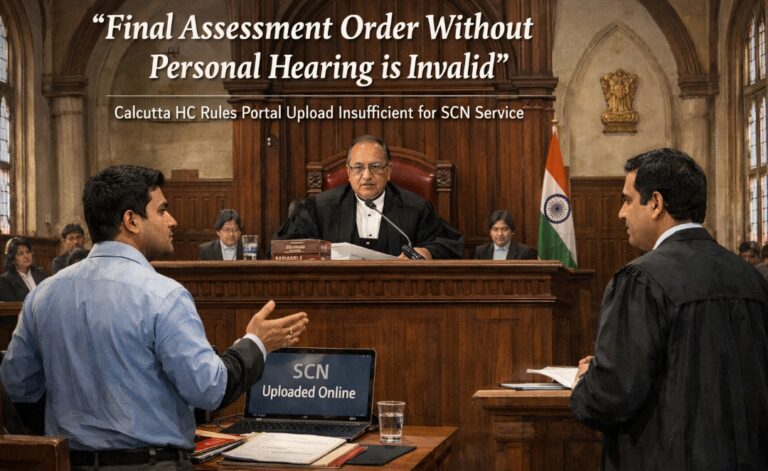
The Calcutta High Court has once again reinforced the foundational principle of natural justice by holding that a final assessment order passed without granting a personal hearing is legally unsustainable—even in cases where a pre–show cause notice (SCN) hearing is not explicitly mandated.
Background of the Case
The matter revolved around an income tax assessment proceeding where the taxpayer challenged the validity of a final assessment order. The primary grievance was that although a show cause notice had been issued, no effective personal hearing was granted before the order was passed. The tax department argued that the SCN had been duly uploaded on the income tax portal and that the statutory requirement of service had been fulfilled.
However, the taxpayer contended that mere uploading of the notice on the portal did not amount to proper service, particularly when the taxpayer had no actual knowledge of the notice. As a result, the taxpayer was deprived of the opportunity to present their case, thereby violating the principles of natural justice.
Key Legal Issue
The central question before the court was whether an assessment order can be sustained when:
- The show cause notice is served only through portal upload, and
- No personal hearing is granted prior to passing the final order.
This issue assumes significance in the era of faceless assessments, where digital communication has replaced traditional modes of interaction between taxpayers and tax authorities.
Court’s Observations
The High Court made a clear distinction between procedural compliance and substantive justice. While it acknowledged that there may not be a mandatory requirement for a personal hearing at the SCN stage in every case, it emphasized that denying a hearing altogether before passing a final adverse order is impermissible.
The court observed that service of notice through mere portal upload is not sufficient if it does not ensure actual or constructive knowledge of the taxpayer. In situations where the taxpayer can demonstrate lack of awareness, reliance solely on digital uploading cannot be treated as valid service.
Importantly, the court reiterated that the right to be heard is a fundamental component of natural justice. Even in faceless or automated systems, this right cannot be diluted or bypassed under the guise of procedural efficiency.
Ruling of the Court
Based on these findings, the court held that the final assessment order was invalid and liable to be set aside. It directed the tax authorities to undertake a fresh adjudication after providing the taxpayer with a proper opportunity of being heard.
The ruling underscores that compliance with natural justice is not a mere formality but a substantive requirement that goes to the root of the validity of any quasi-judicial proceeding.
Implications for Taxpayers and Authorities
This judgment has significant implications for both taxpayers and the tax administration:
For taxpayers:
- It strengthens the right to challenge assessment orders passed without adequate opportunity of hearing.
- It provides a strong ground to contest cases where notices were uploaded but not effectively communicated.
For tax authorities:
- It serves as a reminder to ensure that procedural fairness is maintained, especially in faceless regimes.
- Authorities must adopt mechanisms that ensure actual communication and not just technical compliance.
Conclusion
The decision of the Calcutta High Court is a timely reminder that technology cannot override the principles of fairness and justice. While digital platforms have streamlined tax administration, they must operate within the framework of natural justice. The ruling strikes a balance between administrative efficiency and taxpayer rights, reinforcing that no adverse order should be passed without giving the affected party a meaningful opportunity to be heard.
This judgment will likely serve as an important precedent in cases involving faceless assessments and digital communication, ensuring that justice is not sacrificed at the altar of convenience.