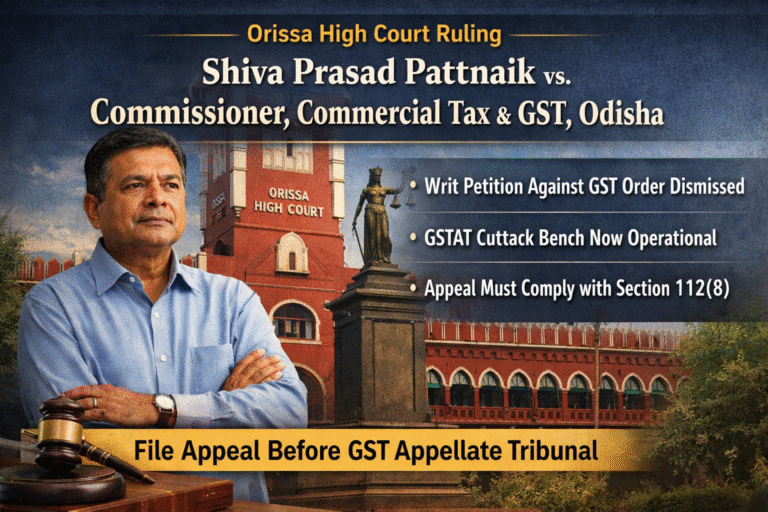
The Orissa High Court in the case of Shiva Prasad Pattnaik vs. Commissioner, Commercial Tax & GST, Odisha has delivered a significant ruling that reshapes the approach taxpayers must adopt while challenging GST orders. The judgment reinforces a fundamental legal principle—when an effective statutory remedy exists, writ jurisdiction should not be invoked as a substitute.
Background of the Case
The dispute arose when the petitioner, Shiva Prasad Pattnaik, challenged an assessment order passed under Section 73 of the GST Act for the tax period April 2019 to March 2020. The adjudicating authority had raised a demand, which was subsequently upheld by the first appellate authority.
Instead of pursuing the next statutory remedy available under Section 112, which provides for an appeal before the GST Appellate Tribunal (GSTAT), the petitioner approached the High Court by filing a writ petition under Articles 226 and 227 of the Constitution of India.
Historically, such writ petitions were entertained by High Courts due to the non-functionality of the GST Appellate Tribunal across many states. This created a practical vacuum, compelling taxpayers to seek constitutional remedies.
Key Legal Issue
The central issue before the Court was straightforward yet crucial:
Can a writ petition be entertained when the GST Appellate Tribunal is now operational and an effective alternative remedy exists?
Court’s Observations
The Court took note of a significant development—the GSTAT Bench at Cuttack is now operational. This fact fundamentally altered the legal landscape.
The Court observed that the GST law provides a complete appellate mechanism, beginning with adjudication, followed by first appeal, and then a second appeal before the Tribunal. Once this mechanism is functional, bypassing it would defeat the legislative intent.
The judges emphasized the well-settled doctrine of “exhaustion of alternative remedies.” According to this principle, a writ petition should not be entertained if an adequate and efficacious statutory remedy is available, except in exceptional circumstances such as:
- Violation of natural justice
- Lack of jurisdiction
- Constitutional challenges
In the present case, no such exceptional grounds were convincingly established.
The Ruling
Based on these observations, the Orissa High Court declined to entertain the writ petition. Instead, it directed the petitioner to approach the appropriate forum—the GST Appellate Tribunal.
The Court also highlighted the importance of complying with Section 112(8) of the GST Act, which mandates a pre-deposit of a specified percentage of the disputed tax amount before filing an appeal.
Further, the petitioner was instructed to adhere to the prescribed timelines for filing the appeal before the Tribunal.
Significance of Section 112(8)
Section 112(8) plays a crucial role in GST litigation. It requires taxpayers to deposit:
- 20% of the disputed tax amount (in addition to earlier deposits)
This provision ensures that appeals are filed with seriousness and discourages frivolous litigation. However, it also imposes a financial burden, making it essential for taxpayers to plan their litigation strategy carefully.
Practical Implications for Taxpayers
This judgment carries far-reaching implications:
- End of Direct Writs in Routine GST Matters
With the GSTAT now functional, taxpayers can no longer routinely approach High Courts against GST orders. - Mandatory Use of Appellate Mechanism
Appeals must be filed before the Tribunal, ensuring uniformity in dispute resolution. - Increased Importance of Compliance
Procedural requirements like pre-deposit and timelines must be strictly followed. - Reduced Burden on High Courts
The decision helps streamline litigation by directing cases to specialized forums.
A Shift from Earlier Practice
Earlier, due to the absence of the GSTAT, High Courts across India—including the Orissa High Court—had adopted a more lenient approach in entertaining writ petitions. This judgment marks a clear departure from that practice.
Now, with the Tribunal operational, the judiciary is signaling a return to procedural discipline and respect for the statutory framework.
Conclusion
The ruling in Shiva Prasad Pattnaik vs. Commissioner is a landmark in the evolving GST litigation landscape. It underscores the importance of following the prescribed appellate hierarchy and limits the scope of writ jurisdiction in tax matters.
For taxpayers and professionals alike, the message is clear:
👉 The GST Appellate Tribunal is now the primary forum for dispute resolution.
Approaching the High Court directly will be an exception—not the rule.
If you’re dealing with a GST dispute, careful planning, timely action, and compliance with statutory requirements are now more critical than ever.