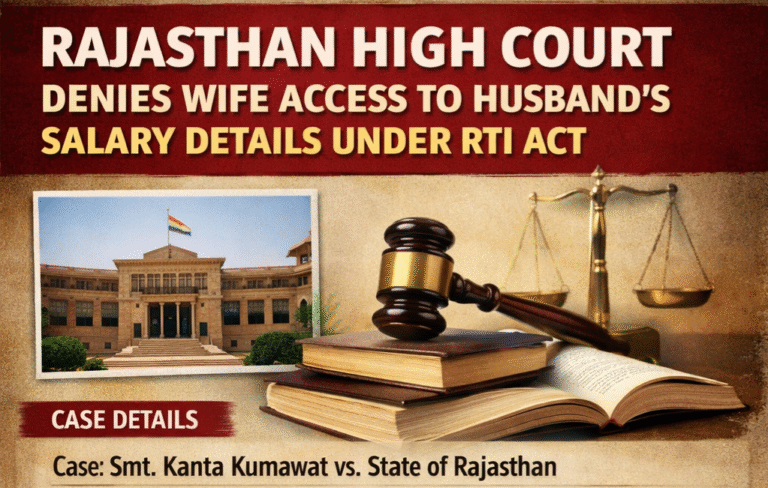
In a significant judgment delivered on February 20, 2026, the Rajasthan High Court ruled that a wife cannot seek her husband’s salary details under the Right to Information (RTI) Act, holding that such information constitutes “personal information” and is exempt from disclosure.
The ruling came in Smt. Kanta Kumawat v. State of Rajasthan, decided by Justice Kuldeep Mathur.
Case Background
The petitioner, Smt. Kanta Kumawat, had sought details of her husband’s salary from the police department by filing an RTI application. The request was made in the backdrop of matrimonial disputes.
However, the concerned authority declined to provide the information. The Rajasthan State Information Commission upheld the rejection, prompting the petitioner to approach the High Court.
Legal Position: Salary Details as “Personal Information”
The High Court relied on the Supreme Court’s decision in Girish Ramchandra Deshpande v. Central Information Commissioner & Ors., which categorically held that service records, salary details, income tax returns, and other employment-related information of a public servant fall within the ambit of “personal information.”
Under Section 8(1)(j) of the RTI Act, 2005, personal information that has no relationship to any public activity or interest—or would cause an unwarranted invasion of privacy—cannot be disclosed unless there is an overriding larger public interest.
Court’s Reasoning
Justice Kuldeep Mathur observed:
- Salary and service details of a government employee are personal in nature.
- Disclosure cannot be justified merely because the applicant is the spouse.
- Matrimonial disputes do not automatically create a “public interest” ground under the RTI Act.
- The RTI Act is not a tool for resolving private disputes.
The Court emphasized that the law protects the privacy of individuals, even when they are public servants.
Key Takeaways from the Judgment
- Spousal relationship does not override privacy protections under RTI.
- Salary details are protected under Section 8(1)(j) of the RTI Act.
- Matrimonial litigation cannot be pursued through RTI mechanisms.
- Public interest must be genuine and overriding—not personal or private.
Implications of the Ruling
This judgment reinforces the growing judicial recognition of the right to privacy in India. While transparency remains a core objective of the RTI Act, courts continue to draw a clear distinction between matters of public accountability and personal information.
For individuals involved in matrimonial disputes, the ruling clarifies that financial disclosures must be sought through appropriate legal proceedings—such as maintenance or divorce proceedings—rather than through RTI applications.
Conclusion
By upholding the decision of the Rajasthan State Information Commission, the Rajasthan High Court has reaffirmed that the RTI Act is meant to ensure transparency in public administration—not to facilitate access to personal information in private disputes.
The ruling serves as an important precedent in balancing transparency with individual privacy rights under Indian law.