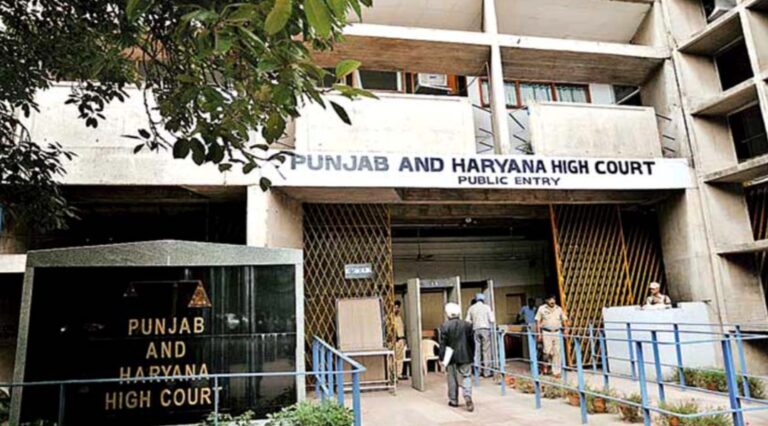
The Punjab and Haryana High Court, in its order dated 27 October 2025, granted regular bail to the accused in a high-value GST investigation involving alleged issuance of fake invoices worth ₹48.92 crore and wrongful availment of Input Tax Credit (ITC). The case, titled Dipanshu Anand v. Principal Commissioner, Central GST, Ludhiana, centred on claims that multiple fictitious firms were used to generate bogus invoices and pass on inadmissible ITC running into several crores. While acknowledging the seriousness of economic offences, the Court held that continued judicial custody was unwarranted, particularly when the investigation was substantially documentary and no further custodial interrogation was required. Emphasising the principle that bail is the rule and jail is the exception, the High Court directed release of the petitioner on regular bail subject to conditions.
Background & Facts of the Case
- The instant petition (CRM-M/ … /2025) was filed before the Punjab & Haryana High Court by the accused, let us call him the petitioner, who was in judicial custody.
- The investigation was conducted by the Directorate General of GST Intelligence (DGGI), Regional Unit, Amritsar, for and on behalf of the CGST Commissionerate, Ludhiana.
- The allegations: The petitioner, through a sole-proprietorship concern (M/s Shivansh Enterprises) and a partnership concern (M/s Gauri Shankar Metal Industries), allegedly utilised eight firms (purportedly fictitious) to generate bogus invoices/entries, thereby claiming and utilising wrongful Input Tax Credit (ITC).
- The aggregate value of bogus invoices alleged was ₹48.92 crore.
- The alleged resultant tax evasion was about ₹7.46 crore.
- The period of the alleged misconduct spanned from financial year 2017-18 to 2020-21 (for one firm) and up to 2024-25 in the independent anti-evasion branch investigation.
- Searches were conducted in October 2021 at the premises of the firms.
- Show-Cause Notice (SCN) under Section 74 of the CGST Act was issued on 31 July 2024.
- The petitioner was arrested on 3 July 2025.
Legal Provisions & Charges
- The prosecution case was made out under Section 132(1)(c) & (l) and Section 132(1)(i) of the CGST Act, 2017.
- Section 132 deals with offences and penalties: issuance of invoice without supply of goods/services; wrongful availment or utilisation of input tax credit; or evasion of tax.
- The punishment for these offences (depending on value) can include imprisonment and fine.
- The Court noted that the alleged offences carry maximum punishment up to five years.
- The fact that the underlying alleged wrongful ITC/evaded tax is large does not automatically bar bail; the Court analysed from the vantage of bail jurisprudence.
Arguments on behalf of the Petitioner
- The petitioner contended that he was falsely implicated. His firms had genuinely received supplies and made payments through banking channels.
- He had voluntarily deposited amounts under Section 74(5) of the CGST Act (₹1.72 crore by his sole-proprietorship; ₹0.7666 crore by the partnership firm) though the SCNs were not yet adjudicated.
- He had no prior criminal antecedents.
- He had been in custody since 3 July 2025 (already approx four months by the time of the decision) and further custodial interrogation was not being sought.
Key Findings of the Court & Grounds for Granting Bail
The High Court analysed the matter and granted regular bail. The key observations and reasons were:
- The petitioner had already undergone a significant period of incarceration (since 3 July 2025) and further detention was not justified when investigation did not require custodial interrogation.
- The evidence was primarily documentary/electronic in nature and was largely in possession of the investigating agency; hence the risk of tampering was minimal.
- The maximum punishment being 5 years and the offence being compoundable strengthened the view in favour of bail in appropriate circumstances.
- The Court reiterated the fundamental tenet that “bail is the rule and jail is the exception”.
- The Court observed that the mere allegation of large evasion/invoice value does not automatically justify continued detention if the other factors weigh in favour of the accused.
Conditions of Bail
While granting bail, the Court imposed typical conditions (to safeguard the trial process). Some conditions included:
- Furnish personal bond with two sureties of like amount to the satisfaction of the trial Court.
- Surrender passport (if any) and do not apply for new passport.
- Do not tamper with prosecution evidence, not influence or threaten witnesses.
- Do not dispose of or deal with properties involved in the investigation.
- Cooperate in trial and do not seek unnecessary adjournments.
Implications & Observations for Practitioners / Readers
- This decision is a useful precedent for accused persons in GST/ITC fraud cases who are in custody but where the investigation is largely complete, evidence is documentary, and no custodial interrogation is required — i.e., the typical “economic offence but minimal risk of tampering” scenario.
- It emphasises that court must balance between the seriousness of economic offences and the fundamental rights of the accused (Article 21) to a fair, speedy trial and freedom from indefinite pre-trial detention.
- For prosecuting agencies: If they wish to oppose bail in economic offences, they must convincingly demonstrate that custodial interrogation is yet required, risk of tampering/absconding exists, or assets are at risk of dissipation. Mere size of alleged fraud alone may not suffice.
- For blog readers (especially tax/GS T professionals): The case underscores that in ITC fraud/fake invoice matters, departmental steps (like seizure of records, data analytics of e-way bills/invoices, bank payment trail) carry weight — and that once these are in hand, the argument for further detention weakens.
- From a policy/corporate perspective: The case is a reminder that aggressive availment/claim of ITC based on invoices from suspicious firms is fraught with risk — and even if detention is secured, the penal consequence and reputational damage loom large.