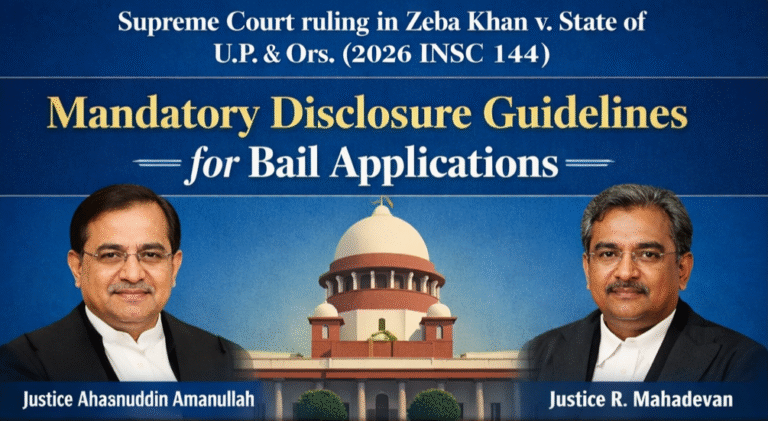
In a significant judgment aimed at strengthening transparency in criminal proceedings, the Supreme Court of India in Zeba Khan v. State of U.P. & Ors. (2026 INSC 144) set aside a bail order granted by the Allahabad High Court and introduced a mandatory disclosure framework for all bail applications across the country.
The ruling marks a major step toward preventing the suppression of material facts by accused persons while seeking bail.
Background of the Case
The case involved an accused allegedly linked to a systematic racket engaged in fabricating law degrees. The Supreme Court found that bail had been secured after concealing significant criminal antecedents.
Taking serious note of this concealment, the Bench comprising Justice Ahsanuddin Amanullah and Justice R. Mahadevan observed that courts must be provided with complete and truthful information before deciding on bail.
The Court emphasized that suppression of criminal history undermines judicial discretion and affects the fairness of the justice delivery system.
Mandatory Disclosure Framework for Bail Applications
To curb misuse of the bail process, the Supreme Court laid down strict guidelines requiring every bail application to be accompanied by a detailed affidavit disclosing the following:
1️⃣ Case Details
- FIR number
- Date of registration
- Police station concerned
- Sections invoked
- Maximum prescribed punishment
2️⃣ Custody Status
- Exact date of arrest
- Total duration of custody undergone
3️⃣ Trial Status
- Present stage of the case (Investigation, Chargesheet, Trial, etc.)
- Number of witnesses examined
4️⃣ Criminal History
- Details of all prior FIRs
- Current status (pending, acquitted, or convicted)
5️⃣ Previous Bail Applications
- Details of earlier bail pleas
- Courts approached
- Outcomes of those applications
6️⃣ Coercive Processes
- Pending non-bailable warrants
- Whether declared a proclaimed offender
Administrative Directions to High Courts
Importantly, the Court directed the Registrar (Judicial) to circulate this judgment to all High Courts across India. The objective is to ensure that these disclosure requirements are incorporated into their respective administrative rules and bail procedures.
Why This Judgment Matters
This ruling strengthens judicial transparency and accountability in bail proceedings. By making full disclosure mandatory:
- Courts can make informed decisions.
- Suppression of criminal history can be prevented.
- Abuse of the bail system can be minimized.
- Judicial time can be saved.
The judgment reinforces the principle that bail jurisprudence must balance individual liberty with the larger interest of justice.
Conclusion
The decision in Zeba Khan v. State of U.P. & Ors. represents a decisive move by the Supreme Court to prevent manipulation of the legal process through concealment of material facts. By institutionalizing mandatory disclosures, the Court has set a new standard for integrity in bail proceedings.
This ruling is likely to have a long-term impact on criminal litigation practice across India, ensuring greater transparency and fairness in the administration of justice.