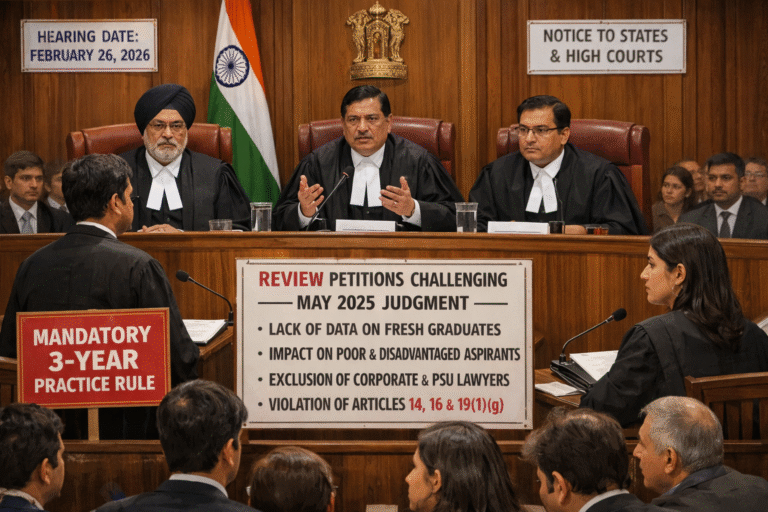
In a significant procedural development, the Supreme Court of India on February 10, 2026, agreed to hear in open court the review petitions challenging the mandatory three-year litigation practice requirement for entry into judicial service.
The Bench led by Chief Justice of India Surya Kant, along with Justices Augustine George Masih and K. Vinod Chandran, passed the order permitting oral arguments—an exceptional move in review proceedings.
Why the Open Court Hearing Is Significant
Ordinarily, review petitions are decided in judges’ chambers through circulation, without oral submissions. However, considering the far-reaching impact of the issue on judicial appointments across India, the Bench deemed it appropriate to list the matter for a public hearing.
The Court has scheduled the oral arguments for February 26, 2026, and issued formal notices to all States and High Courts, directing them to respond by the returnable date.
Background: The May 2025 Landmark Judgment
The review petitions challenge a judgment delivered on May 20, 2025, by a Bench led by then Chief Justice B.R. Gavai, which reinstated the mandatory three-year litigation practice requirement for candidates applying to the post of Civil Judge (Junior Division).
The Court had reasoned that prior courtroom experience ensures:
- Greater competence
- Better understanding of procedural law
- Enhanced judicial maturity
The ruling marked a return to the earlier system that required candidates to practice as advocates before joining the subordinate judiciary.
Grounds Raised in the Review Petitions
The petitioners, including advocate Chandra Sen Yadav and the Bhumika Trust, have raised several constitutional and practical concerns:
1. Lack of Empirical Evidence
They argue that there is no objective data demonstrating that fresh law graduates perform poorly as judicial officers.
2. Disproportionate Impact
The rule allegedly places an unfair burden on aspirants from economically and socially disadvantaged backgrounds who may not be able to sustain three years of litigation practice.
3. Exclusion of Other Legal Professionals
The petitioners contend that the mandate excludes capable law graduates working in corporate firms, public sector undertakings (PSUs), and other non-litigation roles.
4. Constitutional Violations
The challenge invokes alleged violations of:
- Article 14 (Equality before law)
- Article 16 (Equality of opportunity in public employment)
- Article 19(1)(g) (Freedom to practice any profession)
What Lies Ahead
With the matter now listed for open court hearing, the issue assumes national significance. The outcome could reshape eligibility criteria for entry-level judicial appointments across India and determine whether courtroom litigation experience must remain a mandatory prerequisite.
All eyes will be on February 26, 2026, as the Supreme Court hears arguments that could potentially redefine access to the subordinate judiciary.