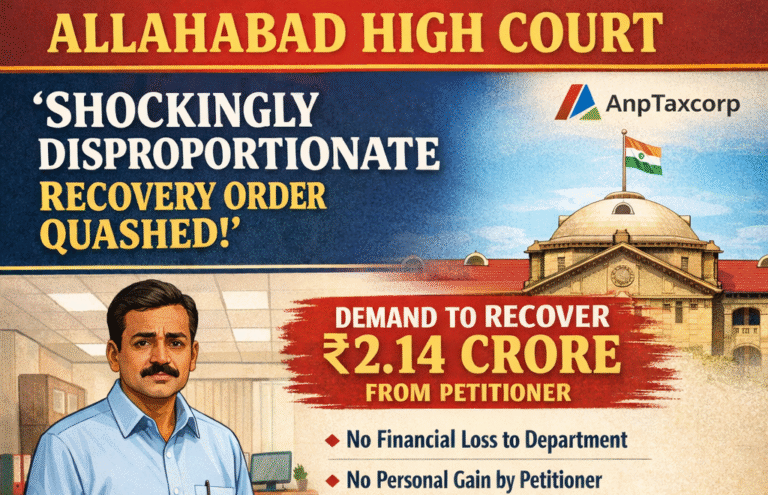
In a significant judgment dated. 9 April 2026, reinforcing the principles of fairness and proportionality in disciplinary proceedings, the Allahabad High Court set aside a recovery order of ₹2.14 crore imposed on an employee, terming the punishment as “shockingly disproportionate.” The ruling in Satyaverat v. State of U.P. and 3 Others ( Writ-A No. 8001 of 2025) serves as an important precedent for cases involving excessive penalties without adequate justification.
Background of the Case
The petitioner, Mr. Satyaverat, was employed as an Assistant Accountant with Uttar Pradesh Power Corporation Limited (UPPCL). During his tenure, he was posted at the Electricity Distribution Division-III in Shamli. It was alleged that during this period, he failed to act diligently in monitoring outstanding dues from a corporate debtor, M/s Sikka Papers Ltd.
The controversy arose when the electricity department did not participate in insolvency proceedings under the Insolvency and Bankruptcy Code (IBC) against the said company. This alleged lapse was claimed to have resulted in financial loss to the department. Consequently, disciplinary proceedings were initiated against the petitioner for negligence in duty.
Inquiry and Disciplinary Action
Interestingly, the Inquiry Officer, after examining the facts, exonerated the petitioner of all charges. However, the Managing Director of UPPCL disagreed with the findings of the Inquiry Officer and independently concluded that the petitioner was guilty of misconduct. The reasoning was that the petitioner had failed to notice and act upon substantial pending dues owed by the company.
Based on this conclusion, the disciplinary authority imposed multiple penalties on the petitioner:
- Censure
- Withholding of one annual increment with cumulative effect
- Recovery of ₹2.14 crore from the petitioner
Aggrieved by this order, the petitioner approached the High Court challenging the legality and proportionality of the punishment.
High Court’s Observations
Justice Saurabh Shyam Shamshery, while hearing the matter, made critical observations regarding the absence of foundational elements necessary to justify such a harsh penalty.
The Court noted that:
- There was no specific charge that the department had suffered financial loss directly due to the petitioner’s actions.
- There was no finding that the petitioner had derived any personal or monetary benefit from the alleged misconduct.
- The Inquiry Officer had already exonerated the petitioner, and the disciplinary authority’s disagreement lacked sufficient reasoning.
The Court emphasized that while some degree of negligence could be attributed to the petitioner for not being fully diligent, the punishment must still be proportionate to the nature and gravity of the misconduct.
Reliance on Supreme Court Precedent
The High Court also referred to the decision of the Supreme Court of India in Punjab & Sind Bank vs. Raj Kumar, where it was held that disciplinary penalties must be reasonable and supported by clear findings. Arbitrary imposition of financial liability without establishing direct responsibility is legally unsustainable.
Applying this principle, the Court observed that the recovery order lacked any justification, particularly when:
- The petitioner was not solely responsible for the alleged loss
- No direct nexus was established between his conduct and the financial consequences
- No charge of wrongful gain or misappropriation was made
Final Verdict
In light of these observations, the High Court held that the recovery of ₹2.14 crore from the petitioner was “shockingly disproportionate” and could not be sustained in law. Accordingly, the Court quashed the recovery order.
However, the Court upheld the lesser penalties of:
- Censure
- Withholding of one increment with cumulative effect
These were considered proportionate to the level of negligence attributed to the petitioner.
Key Legal Takeaways
This judgment reiterates several important legal principles:
- Doctrine of Proportionality
Punishment in disciplinary matters must be commensurate with the misconduct. Excessive penalties without adequate basis are liable to be struck down. - Requirement of Specific Charges
Financial recovery cannot be imposed unless there is a clear charge and finding regarding loss caused by the employee. - No Recovery Without Proof of Gain or Loss
In the absence of evidence showing either departmental loss or personal gain, recovery orders are unsustainable. - Independent Application of Mind
Disciplinary authorities must provide cogent reasons when disagreeing with an Inquiry Officer’s findings. - Judicial Review of Disciplinary Action
Courts can intervene where punishment is arbitrary, excessive, or violates principles of natural justice.
Conclusion
The ruling in Satyaverat v. State of U.P. and Others is a crucial addition to service jurisprudence. It sends a strong message that disciplinary authorities must act judiciously and ensure that penalties are fair, reasoned, and proportionate. For professionals and government employees alike, this judgment underscores the importance of accountability—both in performance and in the exercise of disciplinary powers.
This decision will likely influence future cases where disproportionate financial recoveries are imposed without adequate legal backing, reinforcing the judiciary’s role as a safeguard against administrative overreach.