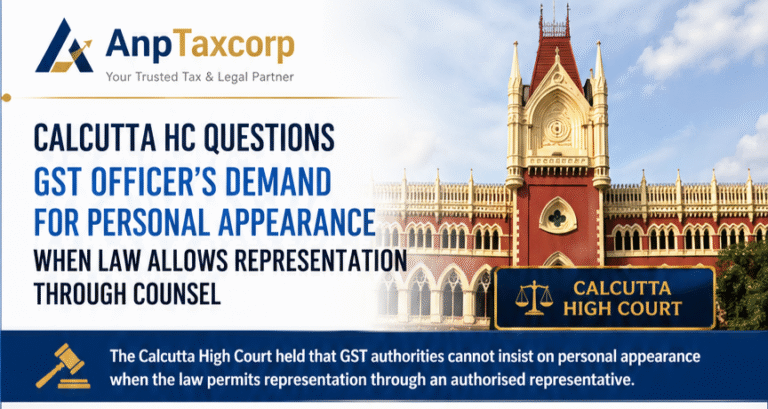
In a significant ruling reinforcing procedural fairness under GST law, the Calcutta High Court has held that tax authorities cannot compel a taxpayer to appear in person when the statute clearly permits representation through an authorised representative. The judgment underscores the importance of adhering to statutory provisions and ensuring that administrative actions do not override legal rights granted to taxpayers.
Background of the Case
The case, titled Nishu v. Union of India & Ors. (WPA 1392 of 2026), arose from the detention of goods during transit. The petitioner, a sole proprietor of Sunshine Enterprises based in Kanpur, Uttar Pradesh, had supplied 480 cartons of pan masala worth ₹36.24 lakh to Maa Kali Traders in Howrah, West Bengal.
The consignment was supported by valid tax invoices, e-way bills, and transport documentation. However, on December 18, 2025, the goods and the vehicle transporting them were intercepted and detained by GST authorities.
Despite repeated requests for release, the authorities insisted that the petitioner appear in person before them. Instead, she sought to participate in the proceedings through her legal counsel, asserting her statutory right to representation.
Legal Issue: Right to Representation Under GST Law
At the heart of the dispute was the interpretation of Section 116 of the Central Goods and Services Tax Act, 2017, which explicitly allows a person to appear before GST authorities through an authorised representative, including an advocate.
The GST department, however, relied on a report from Uttar Pradesh authorities alleging that the petitioner’s firm was non-existent and had been created to fraudulently claim input tax credit. Based on this, they continued to demand her personal appearance.
Court’s Observations
Justice Kausik Chanda strongly disapproved of the approach taken by the GST authorities. The Court categorically held that there was no legal justification for insisting on personal appearance when the law clearly permits representation through counsel.
The Court observed:
“Insofar as the insistence on personal appearance is concerned, this Court finds no justification in the stand adopted by the respondents.”
This ruling reinforces that statutory rights cannot be curtailed by administrative discretion.
Delay and Procedural Lapses Criticised
The Court also expressed concern over the delay in proceedings. More than four months had passed since the interception of goods, yet no formal seizure order had been issued.
Highlighting the perishable nature of the goods, the Court emphasized that authorities are required to act within the timelines prescribed under the GST framework. The failure to do so was viewed as a serious procedural lapse.
Additionally, the Court rejected the argument that proceedings could be delayed due to the petitioner’s non-appearance, especially when she had chosen to appear through an authorised advocate.
Clarification on Ownership of Goods
Referring to a government circular dated December 31, 2018, the Court clarified that when goods are accompanied by valid invoices, either the consignor or consignee should be treated as the owner for the purposes of proceedings under Section 129 of the GST Act.
In this case, the invoices clearly identified Sunshine Enterprises as the consignor and Maa Kali Traders as the consignee. The Court noted that authorities should have determined ownership based on these documents instead of prolonging the matter.
Interestingly, the Court also took note of a communication from the consignee requesting that the goods not be released without its consent, adding another layer of complexity to the dispute.
Directions Issued by the Court
While disposing of the writ petition, the Court issued clear and time-bound directions:
- The GST officer was directed to fix a hearing on April 10, 2026
- The petitioner must be allowed to participate through her advocate
- Notice of hearing must be issued to the consignee within 24 hours
- A reasoned order must be passed within 48 hours after hearing all parties
The Court further clarified that if the petitioner deposits the amount required under Section 129(1)(a) of the GST Act, the goods and vehicle should be released in accordance with law, subject to the outcome of proceedings.
Key Takeaways for Taxpayers and Practitioners
This ruling is a crucial reminder for both taxpayers and GST authorities:
- Right to Representation: Taxpayers have a clear statutory right to be represented by authorised representatives, including advocates.
- Administrative Discipline: Authorities must act within prescribed timelines and cannot delay proceedings arbitrarily.
- Documentary Evidence Matters: Valid invoices and transport documents play a key role in determining ownership and legality of transactions.
- Judicial Oversight: Courts continue to ensure that GST enforcement aligns with principles of natural justice and statutory compliance.
Conclusion
The judgment of the Calcutta High Court sets an important precedent by reinforcing taxpayer rights and curbing administrative overreach. It sends a strong message that procedural safeguards under GST law are not mere formalities but binding legal protections.
For businesses and legal professionals, this decision highlights the importance of understanding procedural rights under GST and taking timely legal recourse when such rights are infringed.