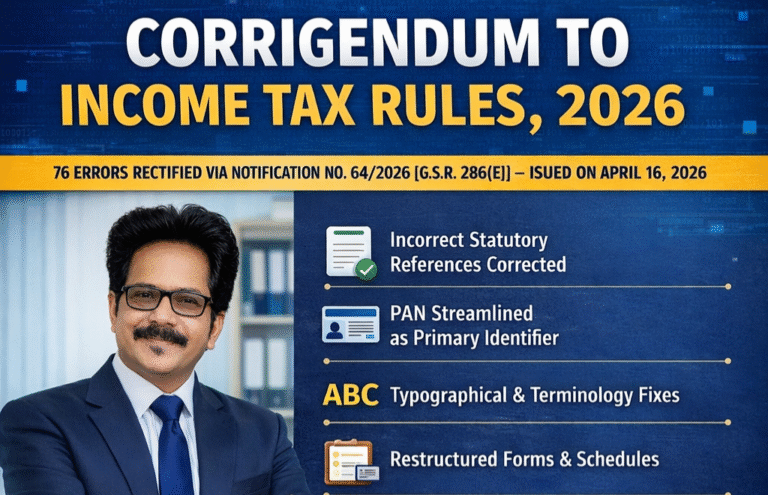
In a significant development for taxpayers and professionals, the Central Board of Direct Taxes (CBDT) has released a crucial corrigendum to the newly notified Income Tax Rules, 2026. Issued through Notification No. 64/2026 [G.S.R. 286(E)] dated April 16, 2026, the corrigendum addresses and rectifies 76 errors identified in the rules. These corrections are aimed at improving technical accuracy, eliminating inconsistencies, and ensuring seamless implementation of the Income Tax Act, 2025.
The Income Tax Rules, 2026 mark a major overhaul of India’s tax framework, replacing the long-standing 1962 Rules. Given the scale and complexity of this transition, such refinements are both expected and necessary to maintain legal precision and administrative efficiency.
Nature of the Corrections
The corrections introduced by the CBDT are largely technical, clerical, and structural in nature. Importantly, they do not alter the substantive provisions of taxation or create new tax liabilities. Instead, they focus on ensuring that the rules are logically consistent, legally aligned, and user-friendly for taxpayers, chartered accountants, and other stakeholders.
Key Rectifications in the Corrigendum
1. Correction of Statutory and Rule References
One of the major areas addressed in the corrigendum is the correction of incorrect statutory references. In several instances, references to sections were mistakenly used instead of rules, or vice versa. For example, in Rule 243, references to “section 242” and “section 244” have now been corrected to “rule 242” and “rule 244.” Such corrections are essential to avoid confusion and ensure proper interpretation of the law.
2. Streamlining PAN as the Primary Identifier
Another notable change is the rationalization of taxpayer identification requirements. The corrigendum removes the dual usage of “PAN/Aadhaar” in several reporting fields and replaces it with “PAN” as the primary identifier. Aadhaar-related references have been eliminated from specific forms where they were redundant. This move simplifies compliance and reinforces PAN as the central identification mechanism in tax reporting.
3. Typographical and Terminology Corrections
Numerous typographical errors have been corrected to enhance the clarity of the rules. Mistakes such as “adjustme t” have been rectified to “adjustment,” and “articulars” has been corrected to “Particulars.” Additionally, certain terminologies have been refined for precision. For instance, the term “securitisation trust” has been replaced with “Venture Capital Company or Venture Capital Fund” in relevant notes to better reflect the intended scope.
4. Restructuring of Forms and Schedules
The corrigendum also addresses structural inconsistencies in various forms and schedules. Numbering errors in sections dealing with assets, liabilities, and details of office-bearers have been corrected to ensure uniformity. These changes are particularly important for accurate data entry and reporting, reducing the likelihood of errors during filing.
5. Standardization of Contact Information Fields
To align with global standards and facilitate international compliance, contact information fields have been updated to include mandatory country codes alongside phone numbers. This seemingly minor change enhances the usability of forms, especially for non-resident taxpayers and cross-border transactions.
6. Uniform Verification Clauses
Verification sections across multiple forms have been standardized by replacing “my/our” with a uniform “my.” This ensures consistency in declarations and reduces ambiguity in legal interpretation.
Why These Changes Are Important
Although the corrigendum does not introduce any policy-level changes, its importance cannot be understated. The corrections play a critical role in strengthening the compliance framework and ensuring smooth implementation of the new tax regime.
Improved Compliance Accuracy:
Correct references and structured forms help taxpayers and professionals avoid inadvertent errors during filing. This reduces the risk of notices, penalties, and prolonged litigation.
Reduction of Ambiguity:
By eliminating redundant fields and correcting formula-related inconsistencies in schedules such as Schedule CG and Schedule UD, the corrigendum minimizes confusion and ensures accurate computation of income and tax liability.
Enhanced Digital Compatibility:
The revised rules are aligned with the government’s push towards a technology-driven tax administration system. Standardized formats and precise terminology facilitate better integration with e-filing systems and automated processing.
Smooth Transition to the New Tax Regime:
As India transitions from the 1962 Rules to the modernized 2026 framework under the Income Tax Act, 2025, these corrections ensure that the new system operates efficiently without procedural bottlenecks.
Impact on Taxpayers and Professionals
Taxpayers, chartered accountants, and tax practitioners must take note of these changes while preparing returns for Assessment Year 2026-27. It is essential to refer to the updated rules and revised forms to ensure accurate compliance.
Particular attention should be given to newly introduced and restructured forms such as Form 130, which replaces the traditional Form 16. Using outdated formats or incorrect references could lead to filing errors or rejection of returns.
Conclusion
The CBDT’s corrigendum to the Income Tax Rules, 2026 is a timely and necessary step toward ensuring clarity, consistency, and efficiency in India’s evolving tax landscape. While the changes may appear minor at first glance, they significantly enhance the usability and reliability of the new rules.
Taxpayers and professionals are strongly advised to stay updated with official notifications and incorporate these corrections into their compliance processes. As the tax system continues to modernize, attention to such details will be crucial in ensuring seamless and error-free tax filings.