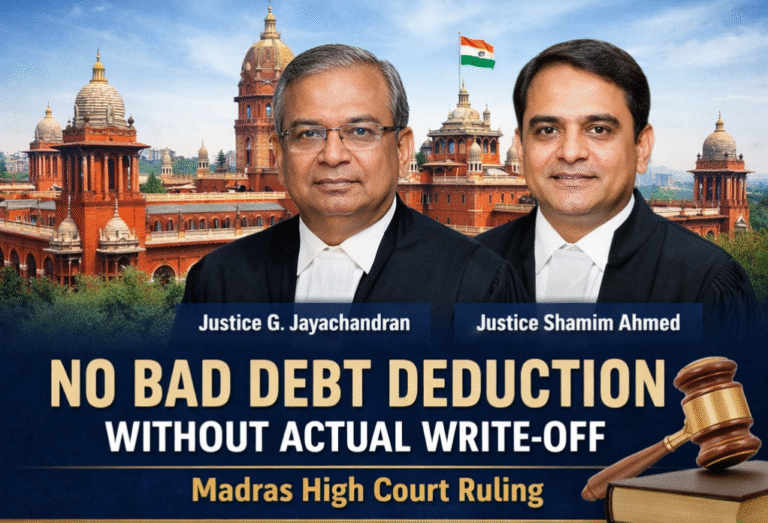
In a significant ruling that reinforces the strict compliance requirements under the Income Tax Act, the Madras High Court has held that taxpayers cannot claim a deduction for bad debts merely by labeling them as irrecoverable. The Court emphasized that an actual write-off in the books of accounts is mandatory to avail such deductions.
This judgment serves as an important reminder for businesses following the mercantile system of accounting, where income and expenses are recognized on an accrual basis rather than actual receipt or payment.
Background of the Case
The case arose from the income tax assessments of India Cements Ltd. for the Assessment Years 2003–04 and 2004–05. The company had reported losses and chose not to recognize interest income on advances extended to its subsidiaries, citing doubts over recoverability due to their weak financial position.
However, the Assessing Officer took a different view. He added the unrecognized interest to the company’s taxable income and also disallowed the claim of bad debt deduction. The reasoning was straightforward: since the company was following the mercantile system, income should be taxed when it accrues, irrespective of actual receipt.
Although the appellate authority and the Income Tax Appellate Tribunal initially ruled in favor of the company, the matter eventually reached the High Court upon challenge by the tax department.
Key Issue Before the Court
The primary questions before the Court were:
- Whether interest income on advances could be ignored on the ground of doubtful recovery.
- Whether a bad debt deduction could be claimed without a proper and demonstrable write-off in the books.
Court’s Observations
The Madras High Court categorically rejected the company’s position and ruled in favor of the tax department. The Court made several crucial observations:
1. Accrual of Income Cannot Be Avoided
The Court reiterated that under the mercantile system of accounting, income is taxable when it accrues, even if it is not actually received. The company had not demonstrated any fundamental change in the nature of the advances that would justify non-recognition of interest income.
Simply put, a taxpayer cannot selectively choose not to recognize income to reduce tax liability.
2. Doubtful Recovery Is Not Enough
The argument that the subsidiaries were financially weak and incapable of repayment was not accepted as sufficient grounds for non-recognition of income. The Court pointed out that if recovery was genuinely doubtful, the company should have taken appropriate accounting steps, including writing off the debt in accordance with law.
3. Mandatory Conditions for Bad Debt Deduction
The Court stressed that claiming a bad debt deduction requires strict compliance with:
- Section 36(1)(vii)
- Section 36(2)
- Explanation to Section 36(1)(vii)
A mere declaration that a debt is irrecoverable does not satisfy these provisions. The taxpayer must actually write off the debt in its books of accounts.
4. Inadequate Write-Off Not Acceptable
The Court found that India Cements Ltd. had written off debts in a consolidated manner at the head office level without providing debtor-wise details. This approach was held to be insufficient.
Unlike financial institutions dealing with thousands of accounts, the company could have easily provided party-wise write-off details to establish the genuineness of the claim.
5. Lack of Proper Verification
The Court also criticized the Tribunal for accepting generalized statements regarding a write-off amount of ₹17.72 crore without proper scrutiny. Notably, this figure did not appear clearly in the statutory audit reports, raising concerns about the authenticity of the claim.
Final Verdict
Based on these findings, the Madras High Court set aside the favorable orders passed by the appellate authorities and directed a fresh examination of the matter. The Court emphasized the need for proper verification of records and strict adherence to statutory provisions before allowing such deductions.
Key Takeaways for Taxpayers
This ruling carries important implications for businesses and tax professionals:
- Actual write-off is essential: Merely classifying a debt as doubtful or irrecoverable is not enough.
- Follow accounting discipline: Ensure that write-offs are clearly reflected in the books with proper documentation.
- Debtor-wise details matter: Maintain detailed records to substantiate bad debt claims.
- Accrual principle is binding: Income cannot be deferred or ignored without valid legal justification.
- Tribunal relief is not final: Higher courts may overturn decisions lacking proper scrutiny.
Conclusion
The Madras High Court’s ruling reinforces the principle that tax deductions are a matter of strict compliance, not subjective interpretation. Businesses must ensure that their accounting practices align with statutory requirements, especially when claiming deductions like bad debts.
For companies operating under the mercantile system, this judgment underscores the importance of consistency, transparency, and adherence to legal mandates. Failure to do so could result in disallowances, prolonged litigation, and increased tax exposure.
For Appellant: Senior Standing Counsel. T. Ravi Kumar, in both appeals,
For Respondent: Advocate R. Vijayaraghavan, in both appeals forSubbaraya Aiyar Padmanabhan Ramam
Case Title : Commissioner of Income Tax I, Chennai vs M/s.The India Cements Ltd. Case Number : Tax Case (Appeal) Nos. 53 & 54 of 2010