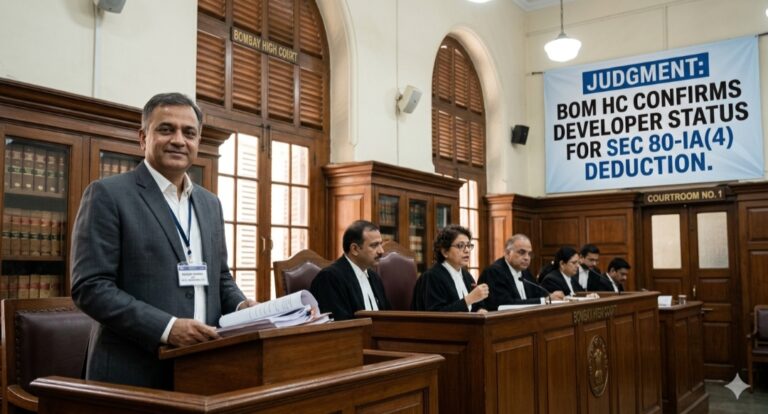
The distinction between a “works contractor” and a “developer” has long been a point of contention in the Indian tax landscape. In a significant victory for the infrastructure sector, the Bombay High Court recently delivered a landmark judgment on 11 March 2026, clarifying the eligibility for tax deductions under Section 80-IA(4) of the Income Tax Act.
The ruling, delivered by the Bench of Justices M. S. Karnik and S. M. Modak, provides much-needed clarity for companies undertaking large-scale Engineering, Procurement, and Construction (EPC) projects.
The Case: Revenue vs. Patel Engineering Ltd.
The Income Tax Department had challenged the deduction claims made by Patel Engineering Ltd. regarding two major hydroelectric projects: the Koyna Project (Maharashtra) and the Srisailam Project (Andhra Pradesh).
The Revenue’s primary argument was that because the state governments owned and funded the projects, the company was acting as a “mere works contractor” and was therefore ineligible for the tax holiday benefits reserved for project developers.
The Court’s Finding: Risk Over Ownership
The Bombay High Court dismissed the Revenue’s appeals, establishing that the ownership of the infrastructure facility is not a mandatory condition for claiming deductions under Section 80-IA(4). Instead, the Court emphasized the nature of the work and the degree of risk involved.
The Court identified three critical pillars that distinguish a Developer from a Contractor:
- Financial & Investment Risk: The company did not simply receive payments for labour; it mobilized its own resources, deployed heavy machinery, and bore the financial risks associated with project delays and execution.
- Technical & Operational Execution: The firm was responsible for the complete lifecycle of development—from intricate design and engineering as per tender specifications to the strategic deployment of assets.
- Autonomous Decision-Making: Rather than following a fixed set of instructions (typical of a contractor), the company exercised independent discretion in how the project was executed, demonstrating the entrepreneurial spirit of a developer.
Why This Matters for the Industry
This judgment is a massive win for the infrastructure industry for several reasons:
- Protects EPC Firms: It ensures that companies taking on “turnkey” responsibilities are not penalized by technicalities regarding project ownership.
- Encourages Private Participation: By upholding the legislative intent of Section 80-IA, the ruling reassures private players that their investments in national infrastructure will be supported by the promised tax incentives.
- Legal Precedent: This sets a strong precedent for other pending litigations where the Tax Department has sought to reclassify developers as contractors to deny benefits.
Conclusion
The Bombay High Court has sent a clear message: the tax law must look at the economic substance of a transaction. If a company takes on the risk, provides the technical expertise, and executes the development of a project, it is entitled to the benefits of a developer—regardless of whether the government retains ultimate ownership of the asset.