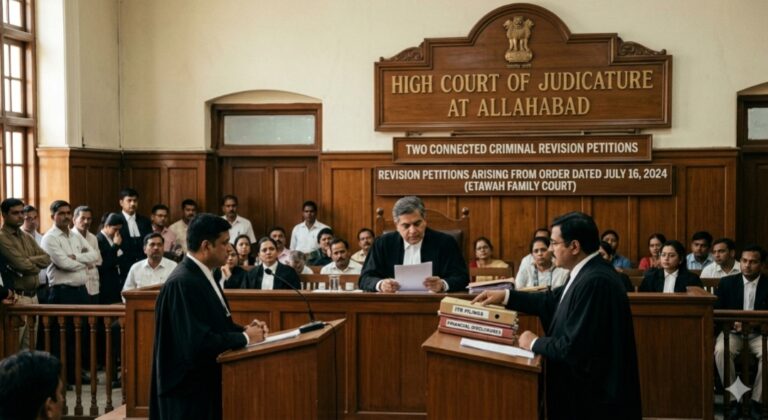
In a significant ruling highlighting the importance of financial transparency in matrimonial disputes, the Allahabad High Court has set aside a maintenance order granted to a wife, after finding glaring inconsistencies between her declared income and income tax records. The judgment reinforces the principle that truthful financial disclosure is the cornerstone of fair maintenance adjudication.
Background of the Case
The case arose from two connected criminal revision petitions challenging an order dated July 16, 2024, passed by the Family Court in Etawah. The family court had directed the husband to pay ₹8,000 per month to his wife and ₹5,000 per month towards the maintenance of their minor son.
While the husband contested the maintenance awarded to the wife, she filed a separate petition seeking enhancement of the amount. The matter ultimately reached the High Court, where it was heard by Justice Achal Sachdev.
Contradictory Income Disclosures Come to Light
A key turning point in the case was the examination of the wife’s financial disclosures. The High Court observed a stark contradiction between her claims before different judicial forums.
Before the family court, the wife had submitted an affidavit declaring her income as “nil.” However, documents presented by the husband revealed that she had filed income tax returns showing an annual income exceeding ₹4.5 lakh. In fact, records indicated an income of ₹4,58,570 for Assessment Year 2022–23, along with a net-worth certificate reflecting similar earnings.
The High Court noted that the wife did not deny filing these documents, nor did she dispute their authenticity. This inconsistency raised serious concerns about the credibility of her claims and the fairness of the maintenance awarded.
Failure of Family Court to Consider Crucial Evidence
The High Court found that the family court had failed to properly evaluate material evidence, including income tax returns and financial disclosures. Despite these documents being placed on record, they were neither discussed nor analyzed in the impugned order.
This omission, the court held, amounted to a serious procedural lapse. Maintenance decisions must be based on a comprehensive assessment of both parties’ financial status, and ignoring such critical evidence undermines the integrity of the judicial process.
Reliance on Supreme Court Guidelines
While delivering its judgment, the High Court relied heavily on the landmark ruling of the Supreme Court of India in Rajnesh v Neha (2021). This precedent mandates that both parties in maintenance proceedings must file detailed and truthful affidavits disclosing their income, assets, and liabilities.
The court emphasized that these disclosures are not mere formalities but form the foundation for determining fair and reasonable maintenance. Any suppression of facts or false statements can lead to adverse legal consequences, including perjury proceedings.
Maintenance to Wife Set Aside, Matter Remanded
Considering the inconsistencies and procedural lapses, the High Court set aside the ₹8,000 monthly maintenance awarded to the wife. However, instead of dismissing her claim entirely, the court remanded the matter back to the trial court for fresh determination.
The trial court has now been directed to reassess the quantum of maintenance after properly evaluating the wife’s actual income, assets, liabilities, and overall financial status, in line with the guidelines laid down in Rajnesh v Neha.
Income Alone Not a Disqualification
Importantly, the High Court clarified that the mere existence of income does not automatically disqualify a wife from claiming maintenance. The crucial test is whether her income is sufficient to maintain the standard of living she enjoyed during the marriage.
The court reiterated that maintenance laws are welfare-oriented and aimed at preventing destitution. Therefore, factors such as cost of living, medical expenses, and child-rearing responsibilities must also be taken into account.
Maintenance for Minor Son Upheld
The husband did not dispute his obligation to support his minor son. Accordingly, the High Court upheld the family court’s direction to pay ₹5,000 per month towards the child’s maintenance, finding no illegality in that portion of the order.
Wife’s Plea for Enhancement Rejected
The wife’s plea seeking enhancement of maintenance was also rejected. The High Court observed that its revisional jurisdiction is limited to examining the legality and correctness of orders and does not extend to reassessing the quantum of maintenance.
However, the court clarified that the wife is free to approach the trial court for modification if there is any change in circumstances.
Key Takeaways
This judgment underscores the critical role of income tax returns in maintenance disputes. It sends a strong message that:
- Financial disclosures must be accurate and consistent across proceedings
- Courts must carefully evaluate all financial evidence before granting maintenance
- Suppression of income can lead to adverse legal consequences
- Maintenance is not denied solely due to income, but depends on adequacy and circumstances
Overall, the ruling strengthens transparency and accountability in matrimonial litigation, ensuring that maintenance awards are fair, evidence-based, and legally sound.
Follow the Link below to Watch the Video: