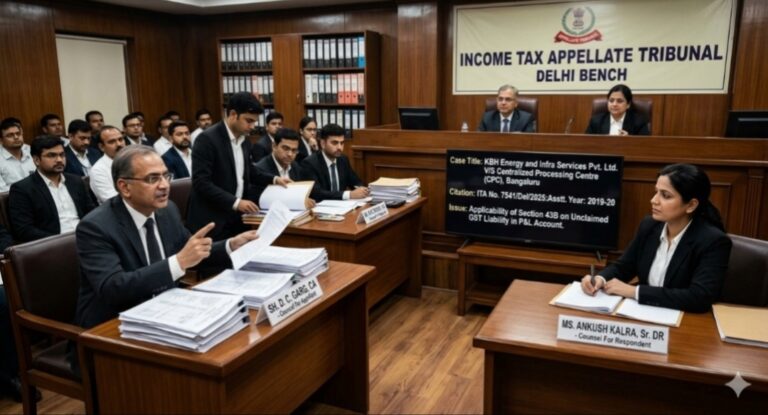
In a significant ruling that strengthens the interpretation of disallowance provisions under the Income Tax Act, the Delhi Bench of the Income Tax Appellate Tribunal (ITAT) has held that Section 43B cannot be invoked where Goods and Services Tax (GST) is merely reflected as a liability in the balance sheet and not claimed as an expense in the Profit & Loss account. The decision came in the case of KBH Energy and Infra Services Pvt. Ltd. v. Centralized Processing Centre (CPC), Bengaluru (ITA No. 7541/Del/2025) for Assessment Year 2019–20.
Background of the Case
The assessee, KBH Energy and Infra Services Pvt. Ltd., filed its Income Tax Return declaring a business income of ₹35,92,068 for the relevant financial year. However, during the processing of the return by the Centralized Processing Centre (CPC), Bengaluru, certain adjustments were made that significantly increased the taxable income.
The CPC made two major additions:
- ₹45,62,808 on account of unpaid GST liability
- ₹49,288 due to delayed payment of Provident Fund (PF)
These additions resulted in a substantial escalation of the company’s taxable income, triggering a tax demand exceeding ₹45 lakh.
Core Issue: Applicability of Section 43B
The central issue before the Tribunal revolved around the applicability of Section 43B of the Income Tax Act, 1961. This provision mandates that certain statutory liabilities, including taxes and duties, are allowable as deductions only when actually paid.
The Revenue authorities contended that since GST is a statutory liability, any unpaid amount should be disallowed under Section 43B, irrespective of its treatment in the books of accounts.
However, the assessee strongly disputed this position.
Assessee’s Argument
The taxpayer argued that the outstanding GST liability was never claimed as an expense in the Profit & Loss account. Instead, it was duly disclosed as a “current liability” in the balance sheet.
This distinction was critical. The assessee emphasized that Section 43B applies only when a deduction is claimed in computing taxable income. Since no such deduction was claimed for the GST amount, the question of disallowance under Section 43B did not arise.
The assessee also relied on various judicial precedents, including decisions from Delhi and Ahmedabad benches of the ITAT, which consistently held that Section 43B is triggered only when an expense is claimed.
Findings of the CIT(A)
The Commissioner of Income Tax (Appeals) [CIT(A)] acknowledged that the GST liability was not debited to the Profit & Loss account. However, the CIT(A) upheld the disallowance on the reasoning that GST forms part of turnover and must have been accounted for indirectly.
This reasoning lacked specific legal backing, especially in light of established jurisprudence.
ITAT’s Analysis and Decision
The ITAT Delhi bench conducted a detailed examination of the facts and legal position. It observed that:
- The GST liability of ₹45,62,808 was not routed through the Profit & Loss account
- No deduction was claimed in respect of this liability
- The amount was merely reflected as an outstanding liability in the balance sheet
The Tribunal emphasized a fundamental principle: Section 43B applies only to deductions claimed in the computation of income.
Relying on earlier Tribunal rulings and High Court judgments, the ITAT held that where no deduction has been claimed, there can be no disallowance. The mere presence of a statutory liability in the balance sheet does not attract Section 43B.
The Tribunal also noted that the CIT(A), despite recognizing that the GST amount was not debited to the Profit & Loss account, failed to provide any cogent legal reasoning for sustaining the addition.
Accordingly, the ITAT deleted the addition of ₹45,62,808 made on account of unpaid GST.
Key Takeaways from the Ruling
This judgment provides crucial clarity for taxpayers and professionals dealing with GST and income tax interplay:
- Section 43B is deduction-specific: It applies only when a statutory liability is claimed as an expense.
- Balance sheet disclosure is not enough: Merely showing a liability without claiming deduction does not trigger disallowance.
- Proper accounting treatment is critical: Businesses must ensure clear distinction between expenses and liabilities.
- Judicial consistency reaffirmed: The ruling aligns with earlier decisions, strengthening legal certainty.
Practical Implications for Businesses
This ruling is particularly beneficial for companies that follow proper accounting practices by segregating statutory liabilities from expenses. It prevents unnecessary tax additions where GST or similar dues are simply carried forward as liabilities.
Tax professionals should take note of this precedent while handling cases involving automated adjustments by CPC under Section 143(1), especially in matters relating to GST mismatches.
Conclusion
The ITAT Delhi’s decision in KBH Energy and Infra Services Pvt. Ltd. reinforces a well-established legal principle: no disallowance can be made under Section 43B unless a deduction is actually claimed. By striking down the unwarranted addition, the Tribunal has upheld both legal consistency and fairness in tax administration.
This ruling will serve as an important reference point for future litigation involving GST liabilities and their treatment under income tax law, ensuring that taxpayers are not penalized for liabilities that were never claimed as deductions in the first place.
Follow the Link Below to Watch the Video!