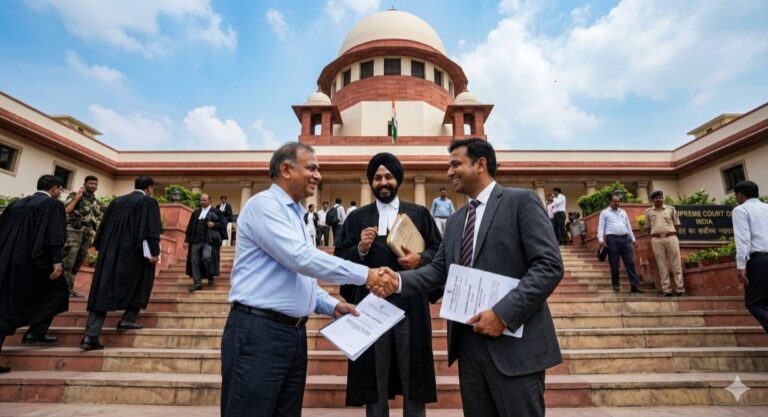
In a significant reaffirmation of the legal position on compounding of cheque dishonour offences, the Supreme Court of India has held that a conviction under Section 138 of the Negotiable Instruments Act, 1881 can be quashed if the parties arrive at a valid settlement. The ruling underscores the legislative intent behind Section 147 of the NI Act, which permits compounding of offences to promote amicable dispute resolution in commercial matters.
Key Highlights of the Judgment
The decision came in the case of Parsharvanath Weld Wires Pvt. Ltd. & Anr v. State of Chhattisgarh & Anr (2026 LiveLaw (SC) 585), where a bench comprising Justice Aravind Kumar and Justice P. B. Varale allowed the compounding of the offence after a settlement was reached between the complainant and the accused.
The Court relied on its earlier precedent in Gian Chand Garg v. Harpal Singh (2025 SCC OnLine SC 2317), reiterating that once parties have resolved their dispute amicably, continuation of criminal proceedings under Section 138 would serve no meaningful purpose.
Background of the Case
The appellant in the present case was a Director of a company who had been convicted in 2014 for cheque dishonour due to insufficiency of funds. The trial court sentenced him to one year of simple imprisonment and directed payment of ₹28,00,000 as compensation under Section 357(3) of the Code of Criminal Procedure.
This conviction was subsequently upheld by the Sessions Court and later by the High Court of Chhattisgarh, leaving the appellant with no relief at the appellate stages.
Following the dismissal of his appeals, the appellant was taken into custody to serve his sentence. However, within two days of incarceration, the parties entered into a settlement agreement. As part of the compromise, the appellant paid ₹30,00,000 to the complainant, exceeding the original cheque amount.
Procedural Challenges in Compounding
Despite the settlement, the appellant faced procedural hurdles. An application for compounding the offence under Section 147 of the NI Act was filed before the Judicial Magistrate First Class but was rejected. The Magistrate reasoned that the conviction had already attained finality and could not be reviewed.
This decision was further upheld by the High Court, which maintained that post-conviction compounding was not permissible in the absence of statutory review powers.
Supreme Court’s Ruling
The Supreme Court set aside the orders of the lower courts and allowed the compounding of the offence. Emphasizing the importance of settlement in cheque dishonour cases, the Court observed:
“In view of the law laid down by this Court in Gian Chand Garg vs. Harpal Singh, we have no hesitation to accept the compromise entered into and compound the offence, particularly in light of the settlement arrived at between the parties.”
The Court clarified that the objective of Section 138 proceedings is primarily compensatory rather than punitive. Therefore, once the complainant has been duly compensated and the dispute resolved, continuing the conviction would be unjustified.
Direction for Immediate Release
Taking note of the settlement and the legal position, the Supreme Court directed the immediate release of the appellant. It ordered the Jail Superintendent, Central Jail, Raipur, to ensure compliance and communicate the same to the Court’s registry without delay.
Legal Significance of the Judgment
This ruling reinforces several important legal principles:
- Compounding at Any Stage: Offences under Section 138 NI Act can be compounded even after conviction, provided there is a genuine settlement between the parties.
- Primacy of Settlement: Courts should encourage settlement in commercial disputes to reduce litigation burden and foster business confidence.
- Purpose of Section 138: The provision is intended to ensure financial discipline and recovery of dues rather than impose punitive sanctions.
The judgment also aligns with the broader judicial trend of promoting alternative dispute resolution mechanisms and reducing the criminalization of commercial disputes.
Conclusion
The Supreme Court’s ruling in this case provides much-needed clarity on post-conviction settlements in cheque dishonour cases. It emphasizes that the justice system should prioritize resolution and restitution over rigid procedural constraints.
For legal practitioners and businesses alike, this decision serves as a crucial reminder that even at advanced stages of litigation, amicable settlement remains a viable and effective remedy under the Negotiable Instruments Act.
Follow the Link below to Watch the Video: