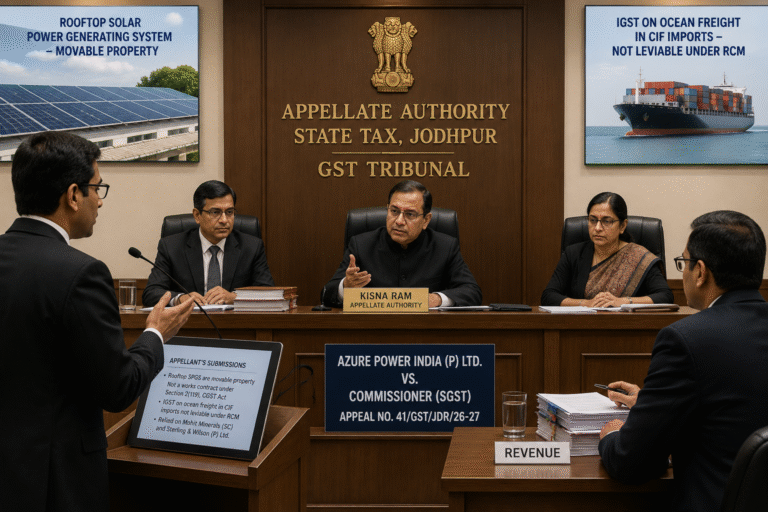
In a landmark ruling that provides substantial relief to the renewable energy sector, the Jodhpur Appellate Authority under the Goods and Services Tax (GST) framework has held that rooftop Solar Power Generating Systems (SPGS) constitute movable property and cannot be classified as “works contract services.” The authority also quashed the levy of Integrated Goods and Services Tax (IGST) on ocean freight under the reverse charge mechanism (RCM) in Cost, Insurance and Freight (CIF) import transactions.
The decision came in the case of Azure Power India Pvt. Ltd. v. Commissioner (SGST) and is expected to have far-reaching implications for solar energy developers and importers across India.
Background of the Dispute
Azure Power India Pvt. Ltd. was engaged in importing goods on a CIF basis and executing contracts involving the design, engineering, procurement, supply, installation, testing, and commissioning of rooftop solar power generating systems.
During GST proceedings initiated under Section 73 of the CGST Act and RGST Act, the adjudicating authority raised two major demands:
- Levy of IGST on ocean freight under the reverse charge mechanism for imports made on a CIF basis.
- Differential GST demand by treating rooftop solar projects as “works contract services” taxable at 18%, instead of granting the concessional GST rate applicable to solar power generating systems.
The tax department argued that since solar modules and supporting structures were attached to civil foundations and rooftops, the completed project became immovable property. Consequently, the activity was classified as a works contract under Section 2(119) of the CGST Act.
Aggrieved by the order, the company filed an appeal before the Appellate Authority, Jodhpur.
IGST on Ocean Freight in CIF Contracts Not Payable
One of the key issues before the appellate authority was whether IGST could be levied on the ocean freight component of imported goods under the reverse charge mechanism when imports were made on a CIF basis.
The authority observed that the issue had already been conclusively settled by the Supreme Court in Union of India v. Mohit Minerals Pvt. Ltd. In that landmark judgment, the Supreme Court held that the levy of IGST on ocean freight under reverse charge in CIF contracts was unconstitutional and contrary to the GST framework.
The appellate authority noted that in CIF transactions, the foreign exporter arranges transportation through a foreign shipping line. Therefore, the Indian importer is not the recipient of the transportation service.
Further, the ocean freight component is already included in the assessable value of imported goods on which IGST is paid at the time of customs clearance. Imposing a separate IGST liability on the same freight component would effectively result in double taxation.
Accordingly, the authority held that the demand of IGST on ocean freight was unsustainable in law and liable to be set aside.
Are Rooftop Solar Systems Movable or Immovable Property?
The second and more significant issue concerned the classification of rooftop solar power generating systems.
Under Section 2(119) of the CGST Act, a works contract can exist only when the contract relates to immovable property. Therefore, determining whether rooftop SPGS is movable or immovable property became crucial.
The appellate authority examined the nature of installation and observed that the solar modules were attached to rooftops primarily for operational efficiency, safety, and structural stability. The attachment was not intended to permanently merge the solar system with the building.
While deciding the issue, the authority relied on the principles laid down by the Supreme Court in Bharti Airtel Ltd. v. CCE, where various tests were prescribed for determining whether a property is movable or immovable. These include:
- Nature of annexation;
- Object and purpose of annexation;
- Intention of the parties;
- Degree of permanence;
- Functionality;
- Marketability and capability of relocation.
Applying these principles, the authority concluded that rooftop solar systems retain their independent commercial identity even after installation. They can be dismantled, relocated, reassembled, and reused without substantial damage.
The authority also relied on the decision in Sterling & Wilson Pvt. Ltd. v. Commissioner, which held that solar power generating systems do not become immovable property merely because supporting structures are fixed to the earth. The civil foundations exist for the efficient functioning of the solar system and not vice versa.
Appellate Authority’s Final Ruling
Based on the above findings, the Appellate Authority held that rooftop solar power generating systems are movable property and therefore do not satisfy the essential requirement of immovable property under Section 2(119) of the CGST Act.
Consequently, the supply and installation of rooftop SPGS cannot be classified as works contract services. The taxpayer remained entitled to the concessional GST rate applicable to solar power generating systems.
The authority ultimately allowed the appeal and set aside:
- IGST demand on ocean freight under reverse charge;
- Differential GST demand arising from works contract classification;
- Interest liability; and
- Associated penalties.
Key Takeaway
The ruling is a significant victory for the renewable energy sector and reinforces two important principles under GST law. First, IGST cannot be levied separately on ocean freight in CIF imports, as the issue stands settled by the Supreme Court in Mohit Minerals. Second, rooftop solar power generating systems are movable assets capable of relocation and therefore cannot be treated as works contracts merely because they are mounted on rooftops or civil structures.
This decision is expected to provide greater certainty to solar project developers and may help reduce GST disputes relating to the classification and taxation of solar power projects across India.
Follow the Link below to watch the video: