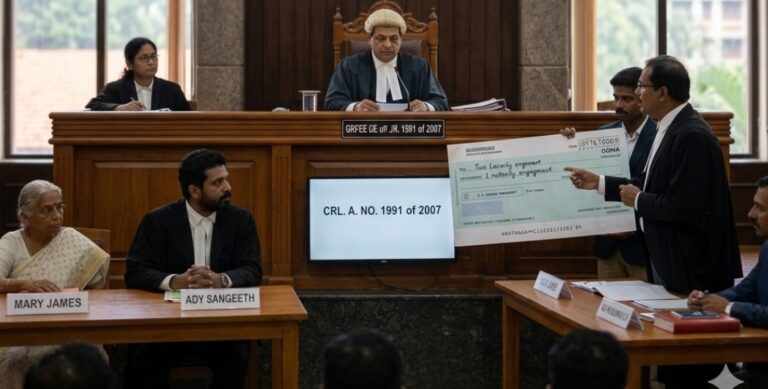
In a significant judgment concerning cheque dishonour cases under the Negotiable Instruments Act, 1881, the Kerala High Court has ruled that any alteration in the date of a cheque that is not authenticated by the drawer through a full signature constitutes a material alteration and renders the cheque legally void. Consequently, such a cheque cannot form the basis of criminal prosecution under Section 138 of the Negotiable Instruments Act.
The ruling came in the case of Mary James v. Gigi Jose and Another (Crl.A. No. 1991 of 2007), where the High Court upheld the acquittal of the accused and clarified the legal consequences of unauthorised alterations in negotiable instruments.
Background of the Case
The dispute arose from a cheque allegedly issued by the accused in favour of the complainant for a sum of ₹55,000 towards repayment of a liability. According to the complainant, the cheque was dated 20 September 2005 and was presented for encashment through the Kodikulam Service Co-operative Bank.
However, the cheque was returned unpaid by the bank. The return memo specifically mentioned the reasons for dishonour as “alteration in date” and “requires full signature.” Following the dishonour, the complainant issued a statutory legal notice demanding payment of the cheque amount. Since the amount remained unpaid, criminal proceedings were initiated under Section 138 of the Negotiable Instruments Act.
The Judicial First Class Magistrate Court-I, Thodupuzha, examined the matter and ultimately acquitted the accused. The trial court found that the cheque had been dishonoured not merely due to insufficiency of funds but primarily because of a material alteration in the date which had not been authenticated by the drawer. The complainant challenged this acquittal before the Kerala High Court.
Contentions Before the High Court
The complainant argued that the correction in the cheque date had been made by the drawer himself at the time the cheque was issued. It was further contended that the statutory presumption available under Section 139 of the Negotiable Instruments Act should operate in favour of the complainant, thereby supporting the validity of the cheque and the underlying debt.
On the other hand, the accused maintained that the cheque had originally been issued in the year 2004 and that the year mentioned on the cheque had subsequently been altered from “04” to “05” without his authentication or consent. According to the accused, such alteration rendered the cheque invalid and unenforceable.
Court’s Analysis
Justice A. Badharudeen closely examined the cheque and observed that the year portion of the date had indeed been altered. The figure “05” appeared to have been rewritten after erasing the original entry.
The Court then referred to Section 87 of the Negotiable Instruments Act, which deals with the legal effect of material alterations in negotiable instruments. Under this provision, any material alteration made without the consent of the parties liable under the instrument generally renders the instrument void.
The Court emphasised that alteration of the date of a cheque is a material alteration because the date directly affects the validity period and enforceability of the instrument. Therefore, any correction in the date must be properly authenticated by the drawer.
The Court held that if the drawer and payee mutually agree to alter the date, such alteration would not invalidate the cheque, provided the drawer authenticates the correction by affixing his full signature at the place of alteration.
Important Observation of the Court
The High Court made a crucial observation:
When there is an alteration in the date of a cheque and the correction is not authenticated by the drawer through his full signature at the place of alteration, the alteration amounts to a material alteration and renders the instrument void.
The Court clarified that mere correction of the date is not sufficient. The drawer must specifically authenticate the alteration with a full signature so that the intention behind the correction is evident and verifiable.
Decision of the Kerala High Court
Applying the above principles, the Court concluded that the alteration in the cheque date had not been authenticated by the drawer’s full signature. As a result, the cheque became a void instrument under Section 87 of the Negotiable Instruments Act.
Since a void cheque cannot legally support prosecution under Section 138 of the Act, the Court agreed with the findings of the trial court and upheld the acquittal of the accused. The appeal filed by the complainant was accordingly dismissed.
Key Takeaways
This judgment serves as an important reminder for individuals, businesses, and financial institutions dealing with cheques:
- Alteration of the date on a cheque is considered a material alteration.
- Any such alteration must be authenticated by the drawer through a full signature.
- An unauthenticated alteration renders the cheque void under Section 87 of the Negotiable Instruments Act.
- A void cheque cannot form the basis of criminal proceedings under Section 138.
- Parties should exercise caution while making corrections in negotiable instruments to avoid disputes and litigation.
The ruling reinforces the principle that strict compliance with the requirements governing negotiable instruments is essential to maintain their credibility and legal enforceability.
Case Citation: Mary James v. Gigi Jose and Another, Crl.A. No. 1991 of 2007, Kerala High Court.
Follow the Link below to watch the video: