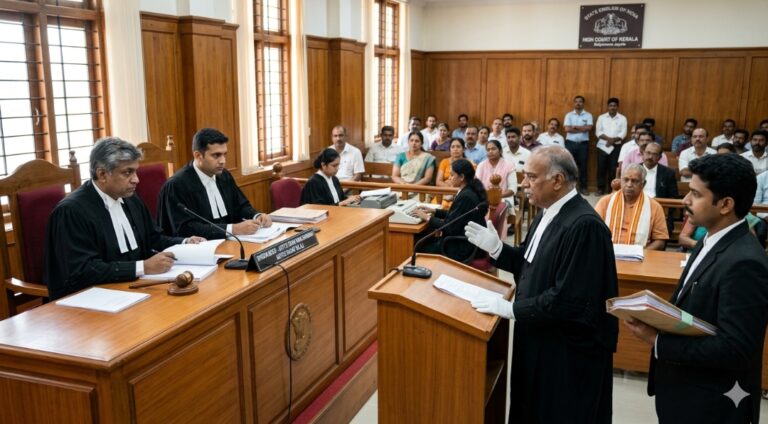
In a significant ruling for charitable and religious trusts seeking income tax exemptions, the Kerala High Court has directed the Commissioner of Income Tax (Exemptions) [CIT(E)] to reconsider the registration claim of Atma Bodhodaya Sangham Sree Subhananda Trust under Section 12A of the Income Tax Act, 1961, with effect from April 1, 2021. The Court emphasized the need to examine the applicability of CBDT Circular No. 7/2024, which provides relief in cases involving defective or delayed exemption applications.
The judgment was delivered on June 4, 2025, by a Division Bench comprising Justice Devan Ramachandran and Justice Basant Balaji in the case Atma Bodhodaya Sangham Sree Subhananda Trust v. Commissioner of Income Tax (Exemptions) (ITA No. 120 of 2025).
Background of the Dispute
The appellant trust, situated in Kerala’s Alappuzha district, has been engaged in charitable activities and had enjoyed registration under Section 12A since 1988. Such registration enables charitable institutions to claim tax exemptions under Sections 11 and 12 of the Income Tax Act.
Following changes in the registration framework introduced by the Finance Act, charitable organizations were required to migrate to a new registration regime. During this transition, the Trust submitted an online application for provisional registration.
However, according to the Trust, an inadvertent mistake occurred while filing the application. Instead of selecting Section 12A, the Trust allegedly selected Section 10(23C), a separate provision that grants tax exemption to specified funds, educational institutions, hospitals, and certain charitable entities.
The Income Tax Department processed the application under Section 10(23C) and subsequently granted both provisional and final approvals under that provision until March 2024.
Discovery of the Error and Fresh Application
Upon realizing the mistake, the Trust voluntarily surrendered its registration under Section 10(23C). It then filed a fresh application seeking registration under Section 12A and requested that the registration be granted retrospectively from Assessment Year 2021-22.
The Trust relied heavily on CBDT Circular No. 7/2024 dated April 25, 2024. The circular was issued to address hardships faced by charitable institutions due to technical errors, procedural defects, or delays in filing exemption applications. It provides a mechanism for regularizing certain defective applications and extending relief where genuine mistakes have occurred.
Despite the Trust’s request, the tax authorities granted registration only prospectively from Assessment Year 2023-24 onwards. The benefit for Assessment Years 2021-22 and 2022-23 was denied.
ITAT Upholds Department’s Stand
Aggrieved by the decision, the Trust approached the Income Tax Appellate Tribunal (ITAT).
The Tribunal upheld the orders passed by the Commissioner of Income Tax (Exemptions), holding that registration under Section 12A could not be granted retrospectively in the circumstances presented. Consequently, the Trust was denied the tax benefits it sought for the earlier assessment years.
Unsatisfied with the Tribunal’s findings, the Trust filed an appeal before the Kerala High Court.
Arguments Before the High Court
Before the High Court, the Trust contended that its situation squarely fell within the scope of CBDT Circular No. 7/2024. It argued that the incorrect selection of Section 10(23C) was a genuine technical mistake arising from the online filing process and should be treated as a curable defect.
The Trust further submitted that since the circular was specifically intended to address procedural mistakes and defective applications, it deserved the benefit of retrospective registration from April 1, 2021.
On the other hand, the Income Tax Department opposed the claim. It argued that the circular applies only in situations where exemption applications were rejected due to defects or procedural issues. Since the Department had accepted the Trust’s application and granted registration under Section 10(23C), the authorities maintained that the circular had no application in the present case.
High Court’s Observations
After examining the matter, the Kerala High Court found that the ITAT had failed to adequately consider the scope and applicability of CBDT Circular No. 7/2024.
The Bench observed that if the authorities had rejected the original application because of the incorrect statutory provision cited by the Trust, the relief contemplated under the circular might have become available. Therefore, the authorities were required to examine whether the original filing could be treated as a defective application capable of being regularized.
The Court also took note of the fact that the Trust had voluntarily surrendered the registration obtained under Section 10(23C), demonstrating its intention to seek registration under the correct statutory provision.
Accordingly, the High Court held that a fresh examination by the competent authority was necessary.
Court’s Final Direction
Allowing the appeal, the Kerala High Court set aside the orders of both the ITAT and the Commissioner of Income Tax (Exemptions). The matter was remanded to the CIT(E) with a direction to reconsider the Trust’s request for registration from Assessment Year 2021-22 after evaluating the applicability of CBDT Circular No. 7/2024.
The Court further directed the Commissioner to provide the Trust with an opportunity of hearing and complete the entire exercise within three months.
Importantly, the Bench kept all substantial questions of law open, leaving the final determination to be made by the tax authorities upon fresh consideration.
Conclusion
The ruling highlights the growing judicial emphasis on substantive justice over procedural technicalities in tax exemption matters involving charitable institutions. The decision may offer relief to trusts and non-profit organizations that have suffered adverse consequences due to genuine filing mistakes. It also underscores the importance of CBDT Circular No. 7/2024 as a remedial measure designed to address technical defects and ensure that deserving entities are not denied tax benefits solely because of procedural errors.
Follow the Link below to watch the video: