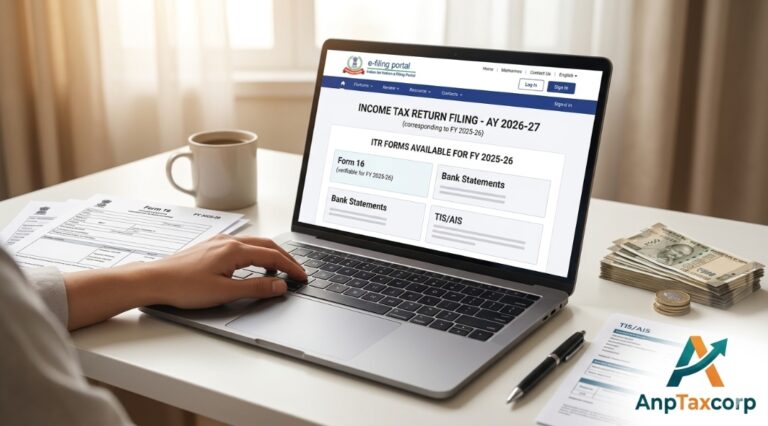
Filing an Income Tax Return (ITR) is a statutory obligation for many taxpayers in India. While the process has become more convenient with online filing facilities, taxpayers often make avoidable mistakes that can lead to notices, delayed refunds, additional tax liability, penalties, or unnecessary scrutiny. Understanding these common errors can help taxpayers file accurate returns and ensure compliance with the Income Tax Act.
Why Accurate ITR Filing Matters
An Income Tax Return serves as an official declaration of a taxpayer’s income, deductions, exemptions, and tax liability. Any discrepancy between the information reported in the return and the records available with the Income Tax Department may trigger verification proceedings or notices. Therefore, careful filing is essential.
1. Choosing the Wrong ITR Form
One of the most common mistakes taxpayers make is selecting an incorrect ITR form. Different categories of taxpayers are required to file different forms depending on the nature of income, residential status, and business activities.
For example, salaried individuals generally file ITR-1, whereas individuals having capital gains, foreign assets, or business income may need to file ITR-2 or ITR-3. Filing the wrong form may result in the return being treated as defective.
Before filing, taxpayers should carefully verify the eligibility conditions for the applicable ITR form.
2. Not Verifying Form 26AS, AIS, and TIS
Many taxpayers rely solely on Form 16 issued by their employer and ignore Form 26AS, Annual Information Statement (AIS), and Taxpayer Information Summary (TIS).
These records contain details of:
- TDS deducted by employers and banks
- Interest income
- Dividend income
- Securities transactions
- High-value financial transactions
Failure to reconcile income reported in these statements with the ITR may result in mismatch notices from the Income Tax Department.
3. Omitting Interest Income
Taxpayers often forget to disclose interest earned on savings accounts, fixed deposits, recurring deposits, and other investments.
Even when TDS has not been deducted, such income remains taxable and must be reported in the return. The Income Tax Department receives information directly from banks and financial institutions, making it easier to identify undisclosed interest income.
4. Incorrect Claim of Deductions
Many taxpayers claim deductions under sections such as 80C, 80D, and 80G without maintaining supporting documents.
Common mistakes include:
- Claiming deductions without actual investment
- Reporting incorrect premium amounts
- Claiming donations that are not eligible
- Double-claiming deductions
Taxpayers should retain proper evidence and ensure that deduction claims are genuine and supported by documentation.
5. Ignoring Capital Gains
Individuals investing in shares, mutual funds, property, or other capital assets frequently overlook reporting capital gains.
Even if tax liability is minimal or exempt due to available deductions, the transaction itself must be disclosed. Failure to report capital gains may invite notices and reassessment proceedings.
Taxpayers should obtain capital gain statements from brokers and accurately compute gains before filing their returns.
6. Providing Incorrect Bank Account Details
A simple error in bank account information can delay income tax refunds.
Common issues include:
- Incorrect account number
- Wrong IFSC code
- Unvalidated bank account
Before submitting the return, taxpayers should verify all bank account details and ensure that the refund account is pre-validated on the income tax portal.
7. Failure to Report All Sources of Income
Some taxpayers disclose only salary income while ignoring other income sources such as:
- Freelancing income
- Rental income
- Commission income
- Dividend income
- Interest income
The Income Tax Department increasingly uses data analytics and information reporting mechanisms to identify undisclosed income. Full disclosure is always advisable.
8. Not E-Verifying the Return
Many taxpayers assume that filing the return completes the process. However, the return must also be verified.
If a return is not e-verified within the prescribed period, it may be treated as invalid, effectively meaning that no return has been filed.
Taxpayers can complete verification through Aadhaar OTP, net banking, demat account, or bank account validation.
9. Ignoring Notices from the Income Tax Department
Sometimes taxpayers receive notices regarding mismatches, verification requests, or additional information requirements and fail to respond promptly.
Ignoring notices can result in adverse consequences, including penalties, reassessment proceedings, or denial of refunds.
Taxpayers should regularly check their registered email address and income tax portal account for updates.
10. Waiting Until the Last Date
Last-minute filing often leads to rushed decisions and errors.
Common consequences include:
- Missing important disclosures
- Incorrect tax calculations
- Portal-related issues
- Delayed payment of taxes
Early filing provides sufficient time to review information, correct discrepancies, and avoid unnecessary stress.
Conclusion
Income tax return filing is not merely a compliance requirement but also an important financial responsibility. Most tax notices arise from simple mistakes such as non-reporting of income, incorrect deduction claims, or mismatch with departmental records.
Taxpayers should carefully review Form 26AS, AIS, and TIS, disclose all sources of income, select the correct ITR form, and verify their return after filing. A few extra minutes spent reviewing the return can prevent future disputes and ensure a smooth tax compliance experience.
Accurate and timely filing not only helps avoid penalties and notices but also enables taxpayers to receive refunds faster and maintain a clean tax record.
Follow the Link below to watch the video: