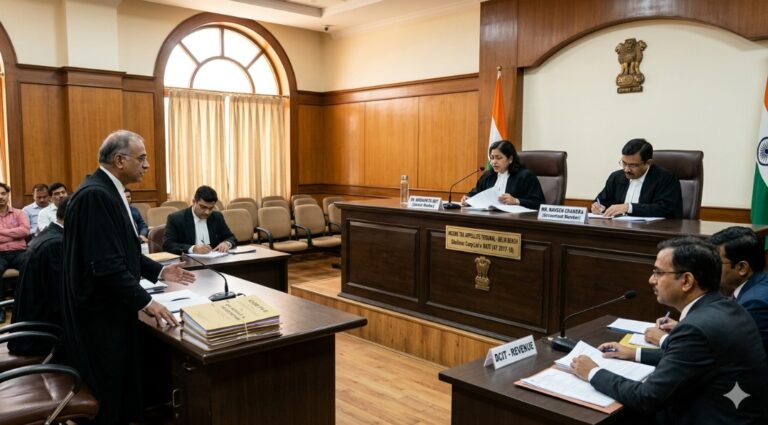
In a significant ruling for taxpayers engaged in real estate development, the Delhi Bench of the Income Tax Appellate Tribunal (ITAT) has granted substantial relief to Shalimar Corp Ltd by allowing 50% telescoping of cash deposits against undisclosed income earned from on-money receipts that had already been accepted in earlier assessment proceedings.
The decision in Shalimar Corp Ltd v. DCIT (AY 2017-18) highlights the importance of the doctrine of telescoping in income tax assessments and reiterates that once undisclosed income has been recognized and taxed, the same funds cannot be repeatedly subjected to tax without examining their nexus with subsequent transactions.
Background of the Dispute
Shalimar Corp Ltd, a prominent real estate developer, was subjected to a search and seizure operation under the Income Tax Act on 18 June 2015. During the search proceedings, authorities discovered documents and evidence indicating the receipt of substantial “on-money” payments in connection with its real estate projects.
Following the search, assessments for multiple years were completed. In earlier litigation involving the same assessee, the Tribunal had accepted the findings of a Special Auditor who quantified gross on-money receipts at approximately ₹197.82 crore. The Tribunal had directed that income be computed at 20% of such receipts or the profit already disclosed in the books, whichever was higher. It also held that additions relating to share capital and loans should be treated as part of regular business turnover and taxed accordingly.
For Assessment Year 2017-18, the assessee filed its return declaring an income of ₹27.49 crore.
Addition of ₹49.30 Crore Towards Cash Deposits
During scrutiny proceedings, the Assessing Officer (AO) observed that the company had deposited cash amounting to ₹65.79 crore in its bank accounts during Financial Year 2016-17.
The assessee explained that these deposits were sourced from opening cash balances and cash receipts already recorded in its books. While the AO accepted the opening cash balance of ₹12.41 crore, he rejected the explanation regarding the remaining deposits.
According to the AO, the assessee failed to establish that the cash represented on-money receipts generated in earlier years. Consequently, an amount of ₹49.30 crore was treated as unexplained cash deposits and added under Section 68 of the Income Tax Act.
The disputed amount primarily consisted of:
- ₹41.38 crore reflected as cash receipts during April 2016; and
- ₹8 crore deposited during December 2016.
Apart from this, the AO also made several other additions under Section 68 relating to advances from customers and unsecured loans.
Assessee’s Claim for Telescoping Benefit
Before the Tribunal, the assessee strongly argued that the cash deposits could not be viewed in isolation.
It was submitted that the Tribunal had already accepted the existence of undisclosed on-money receipts in earlier years. Since those receipts represented actual cash inflows, the same undisclosed income should be available for explaining subsequent cash deposits.
The assessee contended that the Commissioner (Appeals) had incorrectly relied upon the Supreme Court’s decision in Anantharam Veerasinghaiah & Co. while rejecting telescoping. According to the assessee, that judgment dealt with intangible additions, whereas the present case involved tangible and documented on-money receipts discovered during search proceedings.
The company also highlighted the substantial increase in reported turnover after the search and argued that business transactions were thereafter being fully reflected in the books of account.
Revenue’s Objections
The Revenue opposed the telescoping claim and argued that the cash deposits were made during the demonetisation period.
It further contended that no physical cash had been found during the search operation. Therefore, there was no evidence to demonstrate that the alleged unaccounted cash continued to exist and remained available for subsequent deposits.
According to the Revenue, the assessee’s explanation lacked documentary support and therefore deserved rejection.
ITAT Grants Partial Telescoping Relief
After examining the facts and rival submissions, the Tribunal noted that one important aspect was undisputed—the assessee had admittedly earned undisclosed income through on-money receipts in earlier years.
The Tribunal observed that in previous proceedings it had already accepted the Special Auditor’s quantification of ₹197.82 crore of on-money receipts and had directed taxation of income arising from such receipts.
The Bench emphasized that the question of telescoping depends upon the facts and circumstances of each case.
Significantly, the Tribunal found merit in the assessee’s argument because:
- The existence of on-money receipts had already been established;
- Earlier assessments had accepted such undisclosed income;
- The assessee had consistently raised the telescoping claim from the assessment stage itself; and
- Business turnover had substantially increased after the search.
At the same time, the Tribunal acknowledged the Revenue’s argument that no physical cash was discovered during the search proceedings.
Balancing these competing considerations, the Tribunal adopted a pragmatic approach and granted telescoping relief for 50% of the disputed cash deposits.
As a result, 50% of the addition of ₹49.30 crore, amounting to ₹24.65 crore, was directed to be deleted.
Relief on Section 115BBE Taxation
The Tribunal also examined the applicability of Section 115BBE, which provides for a higher tax rate on unexplained income.
Relying upon a Madras High Court ruling, the Tribunal held that the amended provisions of Section 115BBE would apply only to transactions undertaken on or after 1 April 2017.
Since the transactions in question related to an earlier period, the additions could not be subjected to taxation under Section 115BBE and were instead directed to be taxed under normal provisions of the Income Tax Act.
Deletion of Additions Relating to Advances and Loans
The Tribunal further deleted additions relating to:
- ₹2.78 crore shown as advances from customers; and
- ₹3.34 crore received from Saket Niketan Pvt. Ltd.
Following its earlier decisions in the assessee’s own cases, the Tribunal held that these receipts formed part of the business turnover and were already covered by the telescoping exercise. Therefore, separate additions under Section 68 were not justified.
Revenue’s Appeal on ₹40 Crore Advance Rejected
In the Revenue’s appeal, the primary issue concerned the deletion of a ₹40 crore addition relating to an advance received from Nihon Impex Pvt. Ltd.
The AO had treated the company as an accommodation entry provider and made an addition under Section 68. However, the Tribunal noted that the assessee had furnished all relevant documents, including agreements and Form 26AS, establishing the genuineness of the transaction.
The Tribunal also observed that investigations conducted by the department and assessments completed in the case of Nihon Impex Pvt. Ltd. did not reveal any adverse findings.
Since the assessee had discharged its burden of proving identity, creditworthiness, and genuineness, the deletion of the ₹40 crore addition was upheld.
Conclusion
The ruling in Shalimar Corp Ltd v. DCIT is an important precedent on the principle of telescoping. The Delhi ITAT recognized that once undisclosed on-money income has been accepted and taxed in earlier years, such income cannot be ignored while evaluating subsequent cash deposits. Although the Tribunal granted only partial relief, the decision reinforces the need for a realistic and fact-based approach in taxation of unexplained cash deposits and Section 68 additions.
Follow the Link below to watch the video: