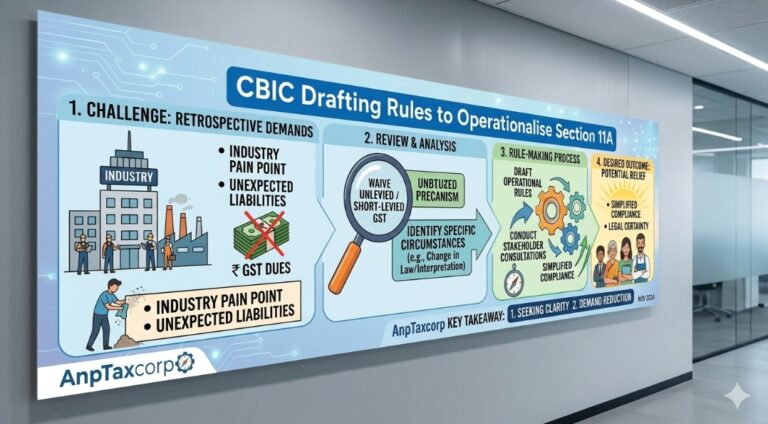
In a significant development under the Goods and Services Tax (GST) framework, the Central Board of Indirect Taxes and Customs (CBIC) is in the process of drafting rules to operationalise Section 11A of the Central Goods and Services Tax (CGST) Act. The provision empowers the government to waive GST dues for an entire industry under specific circumstances, offering a potential relief mechanism for sectors facing substantial retrospective tax liabilities.
The move has attracted considerable attention, particularly from the online gaming industry, which is currently grappling with GST demands exceeding ₹1 lakh crore following recent judicial developments.
What is Section 11A of the CGST Act?
Section 11A was introduced through the Finance Act, 2024, as a special provision enabling the Central Government, on the recommendation of the GST Council, to waive unpaid or short-paid GST liabilities for a specific period. The relief can be granted when the government is satisfied that the tax non-payment or under-payment occurred due to a generally prevalent trade practice followed across an industry.
The objective of this provision is to address situations where an entire sector has acted based on a widely accepted interpretation or business practice, rather than engaging in deliberate tax evasion. It provides the government with flexibility to resolve large-scale disputes that arise from differing interpretations of GST laws.
CBIC Working on Operational Rules
According to government officials familiar with the matter, the CBIC is currently formulating detailed rules that will govern the implementation of Section 11A. Once these rules are notified, the GST Council and the government will have a structured framework for considering industry-wide tax relief in appropriate cases.
Officials have indicated that the provision could be invoked whenever the GST Council determines that a particular industry’s tax practices were based on a commonly accepted understanding prevailing during a specific period.
The drafting of these rules is expected to provide clarity regarding eligibility conditions, procedural requirements, and the circumstances under which tax waivers may be granted.
Why Section 11A is Important
Section 11A is unique because it overrides the normal GST demand, recovery, and penalty provisions. Unlike individual tax dispute resolutions, this provision is designed to address industry-wide issues arising from prevalent trade practices.
For the provision to be invoked, the GST Council must be satisfied that:
- The tax shortfall occurred due to a generally accepted trade practice.
- The issue affected a broader industry segment.
- The non-payment was not the result of intentional tax avoidance by individual taxpayers.
This framework recognizes that businesses often operate based on prevailing industry interpretations, which may later be challenged by tax authorities or courts.
Online Gaming Industry May Seek Relief
The online gaming sector is widely viewed as a potential beneficiary of Section 11A. The industry has been facing massive GST demands following the Supreme Court’s recent decision upholding the constitutional validity of the 28% GST levy on online gaming transactions.
On May 27, the Supreme Court upheld both the applicability of the GST levy and its retrospective enforcement. The ruling strengthened the government’s position regarding tax notices issued to online gaming companies.
However, industry stakeholders have repeatedly argued that the retrospective tax demands are disproportionately high and, in many cases, exceed the total valuation of the companies concerned. Several firms have expressed concerns about their ability to meet such liabilities without severe financial consequences.
GST Council Yet to Take a Final Call
Government sources suggest that the GST Council may discuss the possible use of Section 11A during its upcoming meetings scheduled in July or August. Nevertheless, officials have clarified that no final decision is expected immediately.
While the provision legally enables retrospective waiver of tax demands under exceptional circumstances, authorities have not confirmed whether it will be specifically applied to the online gaming sector.
The government is expected to carefully evaluate whether the industry’s previous tax practices qualify as a “generally prevalent trade practice” under the requirements of Section 11A.
Conclusion
The operationalisation of Section 11A marks an important evolution in India’s GST framework. By allowing industry-wide tax relief in cases involving genuine and widespread trade practices, the provision creates a balanced mechanism for addressing complex tax disputes.
As CBIC finalises the rules and the GST Council examines potential applications, businesses across sectors will closely watch developments. If implemented effectively, Section 11A could become a powerful tool for resolving retrospective GST controversies while ensuring fairness and certainty in tax administration.
Source: Moneycontrol
Follow the Link below to watch the video: