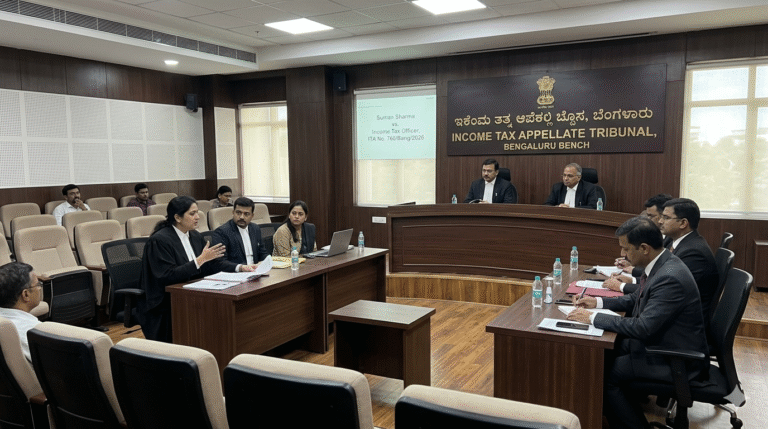
In a significant ruling concerning unexplained cash credit provisions under Section 68 of the Income Tax Act, the Bangalore Bench of the Income Tax Appellate Tribunal (ITAT) has held that a lender’s income for a particular assessment year cannot be the sole criterion for assessing creditworthiness. The Tribunal deleted an addition of ₹12 lakh made by the Assessing Officer (AO) in respect of unsecured loans received from family members.
The decision was delivered in the case of Suman Sharma vs. Income Tax Officer (ITA No. 760/Bang/2026) and provides important guidance on how tax authorities should evaluate the genuineness and creditworthiness of loan transactions, especially those involving close family members.
Background of the Case
The taxpayer, Ms. Suman Sharma, proprietor of Sri Shyam Timbers, had received unsecured loans aggregating to ₹12 lakh from her husband and her husband’s Hindu Undivided Family (HUF).
During the assessment proceedings, the Assessing Officer questioned the authenticity of these loans. According to the AO, the taxpayer had failed to furnish complete bank statements of the lenders. Further, the AO observed that the income disclosed by the lenders in their income tax returns was comparatively low when measured against the amount of loans advanced.
Based on these observations, the AO concluded that the taxpayer had failed to satisfactorily establish the creditworthiness of the lenders. The fact that no interest was charged on the loans was also viewed with suspicion. Consequently, the entire amount of ₹12 lakh was treated as unexplained cash credit under Section 68 and added to the taxpayer’s taxable income.
CIT(A) Upholds the Addition
Aggrieved by the assessment order, the taxpayer filed an appeal before the Commissioner of Income Tax (Appeals) [CIT(A)].
However, the appellate authority upheld the addition. The CIT(A) observed that merely submitting confirmation letters and copies of income tax returns of the lenders was insufficient to establish the genuineness of the transaction and the financial capacity of the creditors.
As a result, the addition made by the AO remained intact.
Arguments Before the ITAT
Before the Tribunal, the taxpayer contended that all essential conditions prescribed under Section 68 had been satisfied.
The taxpayer emphasized that:
- The identity of the lenders was fully established.
- The transactions were genuine and routed through proper banking channels.
- The lenders were close family members whose existence and tax records were undisputed.
- Creditworthiness could not be judged solely on the basis of income earned during the relevant assessment year.
- Family loans are often interest-free, and absence of interest should not automatically lead to adverse conclusions.
The taxpayer further argued that the department had failed to bring any evidence on record suggesting that the funds actually belonged to the assessee or that the lenders lacked sufficient resources to advance the loans.
On the other hand, the Revenue maintained that the taxpayer had failed to discharge the burden cast upon her under Section 68 and had not adequately demonstrated the financial capacity of the lenders.
ITAT’s Observations
The Bangalore ITAT carefully examined the facts and found merit in the taxpayer’s submissions.
The Tribunal observed that the identity of the lenders was never disputed by the department. It also noted that there was no allegation that the loan transactions were fictitious or fabricated.
Importantly, the Tribunal criticized the approach adopted by the tax authorities in comparing the amount of the loan with the income declared by the lenders during a single financial year.
According to the Tribunal, such an approach is fundamentally flawed because an individual’s ability to lend money is not determined solely by the income earned in the current year. A person may have accumulated savings, capital reserves, investments, withdrawals from bank accounts, inherited assets, or other financial resources available for advancing loans.
The Tribunal further held that unless there is evidence showing that the lenders lacked financial capacity or that the funds actually originated from the assessee, an addition under Section 68 cannot be sustained merely on assumptions and presumptions.
Family Transactions Require Practical Consideration
Another noteworthy aspect of the ruling is the Tribunal’s recognition of the practical realities of family transactions.
The Bench observed that loans between family members are often advanced without charging interest and may not always be supported by extensive documentation that is commonly found in commercial lending arrangements.
Therefore, the absence of interest payments or formal loan agreements, by itself, cannot justify an adverse inference regarding the genuineness of such transactions.
Tribunal’s Decision
After considering the facts and legal position, the Tribunal concluded that the taxpayer had successfully established the identity of the lenders and the genuineness of the transactions.
Since the Revenue failed to produce any evidence demonstrating that the funds belonged to the assessee or that the lenders lacked financial capability, the addition of ₹12 lakh made under Section 68 was held to be unsustainable.
Accordingly, the ITAT directed the deletion of the entire addition and allowed the taxpayer’s appeal.
Key Takeaway
This ruling reinforces an important principle under Section 68 of the Income Tax Act: creditworthiness cannot be assessed merely by comparing the loan amount with the lender’s current year income. Tax authorities must examine the lender’s overall financial position, accumulated wealth, savings, and other available resources before drawing adverse conclusions. The judgment also highlights that interest-free loans among family members are a common and legitimate practice and cannot automatically be treated as suspicious transactions.
Case Details
Case Name: Suman Sharma vs. Income Tax Officer
Appeal No.: ITA No. 760/Bang/2026
Forum: Income Tax Appellate Tribunal, Bangalore Bench
Bench: Shri Waseem Ahmed (Accountant Member) and Shri Soundararajan K (Judicial Member)
Follow the Link below to watch the video: