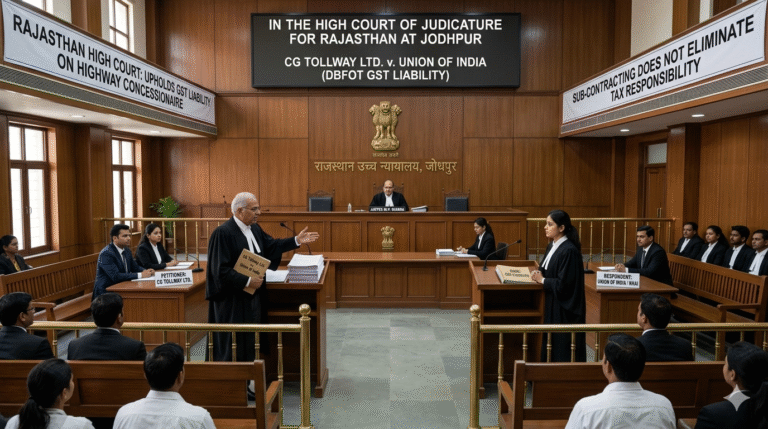
The judgment was delivered in CG Tollway Ltd. v. Union of India, decided on 22 May 2026, where the Court examined the taxability of a concession agreement executed between the National Highways Authority of India (NHAI) and the concessionaire.
Background of the Case
The dispute arose from a concession agreement entered into between NHAI and the petitioner company for the development of a section of National Highway-79. Under the agreement, the concessionaire was entrusted with the responsibility to design, build, finance, operate, maintain, and eventually transfer the highway project back to NHAI.
In return for undertaking the project, the concessionaire was granted the right to collect toll from road users during the concession period. Additionally, after a specified period from the Commercial Operation Date (COD), the concessionaire was required to pay an annual premium to NHAI.
For execution of the construction portion of the project, the petitioner engaged a subcontractor who discharged GST on the construction services provided to the concessionaire.
Subsequently, an internal audit by the tax authorities revealed an alleged GST liability exceeding ₹16 crore. The authorities concluded that the petitioner had failed to pay GST on the works contract services supplied to NHAI. A demand was consequently raised along with applicable interest and penalty.
The petitioner challenged the demand on the ground that construction activities had already been executed by the subcontractor, who had discharged GST liability on the services rendered.
Key Issues Before the Court
The Rajasthan High Court was called upon to determine the following crucial questions:
-
Whether the activities undertaken by the concessionaire constituted a taxable “supply” under the CGST Act.
-
Whether the arrangement qualified as a “works contract service”.
-
Whether GST liability could be avoided merely because the construction work was outsourced to a subcontractor.
-
Whether toll collection rights granted under the concession agreement were exempt from GST.
Court’s Analysis of ‘Supply’ and ‘Consideration’
The Court undertook a detailed examination of the provisions of the Central Goods and Services Tax Act, 2017.
It observed that Section 7 of the CGST Act defines “supply” in a broad manner and includes all forms of supply of goods or services made for consideration. Importantly, consideration need not always be monetary in nature. It can also include non-monetary benefits received in exchange for services rendered.
The Court noted that under the concession agreement, the petitioner was not simply constructing a road. In exchange for constructing, operating, and maintaining the highway, the concessionaire was granted valuable rights, including:
-
Right to collect toll from road users.
-
Right to access and utilize project land.
-
Right to operate the highway during the concession period.
-
Various commercial benefits flowing from the concession agreement.
These rights constituted consideration received by the concessionaire for services rendered to NHAI.
Therefore, the Court concluded that there was a clear supply of services by the concessionaire to NHAI.
Why the Arrangement Was Held to Be a Works Contract
The High Court further examined whether the transaction qualified as a “works contract” under Section 2(119) of the CGST Act.
A works contract generally involves construction, erection, installation, repair, maintenance, renovation, or alteration of immovable property.
The Court observed that the petitioner was engaged in the construction and maintenance of a national highway, which undoubtedly constitutes immovable property. Therefore, the activities squarely fell within the statutory definition of a works contract.
Since works contracts are specifically treated as supply of services under GST law, the transaction was held to be taxable.
Toll Collection Rights Treated as Consideration
One of the most important aspects of the judgment relates to the treatment of toll collection rights.
The petitioner argued that toll collection enjoys exemption under GST notifications and therefore no tax should be payable.
The Court rejected this contention.
According to the Court, the right to collect toll was not being exercised independently. Rather, it was granted as a reciprocal benefit under the concession agreement in exchange for construction and maintenance services provided to NHAI.
The Court characterized the arrangement as a form of barter transaction where:
-
The concessionaire constructed and maintained the highway.
-
NHAI granted toll collection rights as consideration.
Thus, toll collection was not merely a statutory levy being collected from road users. Instead, it formed an integral component of the consideration received by the concessionaire for the works contract services supplied to NHAI.
Consequently, the exemption available for simple toll collection could not be extended to such barter-based arrangements.
Sub-Contracting Does Not Remove Principal Contractor’s GST Liability
A major argument advanced by the petitioner was that the construction activities had been executed through a subcontractor who had already discharged GST liability on the services rendered.
The Court categorically rejected this argument.
It observed that there existed two entirely separate contractual relationships:
First Contract
Between NHAI and the concessionaire.
Second Contract
Between the concessionaire and the subcontractor.
The subcontractor supplied works contract services to the concessionaire and discharged GST on those services.
However, the concessionaire independently supplied works contract services to NHAI under the concession agreement.
Since both transactions were distinct and independent, payment of GST by the subcontractor could not absolve the concessionaire of its separate tax liability arising from its own supply of services to NHAI.
The Court emphasized that there was no contractual relationship or privity of contract between NHAI and the subcontractor.
Therefore, the principal contractor remained liable to discharge GST on services supplied under the concession agreement.
Rejection of Negative Equality Argument
The petitioner also relied upon instances where similar audit objections had reportedly been dropped by tax authorities in Karnataka and Gujarat.
The High Court refused to accept this argument.
It held that tax liability must be determined in accordance with statutory provisions and legal principles. Merely because another authority may have taken a different view in another case cannot create a legal right in favour of the taxpayer.
The Court reiterated the settled principle that there can be no concept of “negative equality” in taxation matters.
In other words, an incorrect benefit allegedly granted to another taxpayer cannot become a basis for claiming identical treatment.
Key Takeaways from the Judgment
This landmark judgment provides several important lessons for infrastructure developers and concessionaires:
-
DBFOT concession agreements can constitute taxable supplies under GST.
-
Toll collection rights may be treated as consideration when granted in exchange for construction services.
-
Works contract services relating to infrastructure projects remain taxable even when consideration is received in non-monetary form.
-
Subcontracting construction activities does not eliminate GST liability of the principal concessionaire.
-
Separate contracts create separate tax obligations.
-
Exemptions applicable to toll collection simpliciter may not apply where toll rights form part of a barter arrangement.
-
Taxpayers cannot rely on audit objections dropped in other states to claim exemption.
Conclusion
The Rajasthan High Court’s decision in CG Tollway Ltd. v. Union of India reinforces the broad scope of GST on infrastructure concession arrangements. The ruling makes it clear that concessionaires operating under DBFOT models cannot escape GST merely by outsourcing construction activities to subcontractors.
By recognizing toll collection rights as consideration for works contract services, the Court has reaffirmed the principle that GST applies not only to monetary transactions but also to barter and non-monetary exchanges. The judgment is expected to serve as an important precedent for infrastructure, highway, and public-private partnership (PPP) projects across India and will likely influence future GST assessments involving concession agreements and toll-based infrastructure models.
Follow the Link below to watch the video: