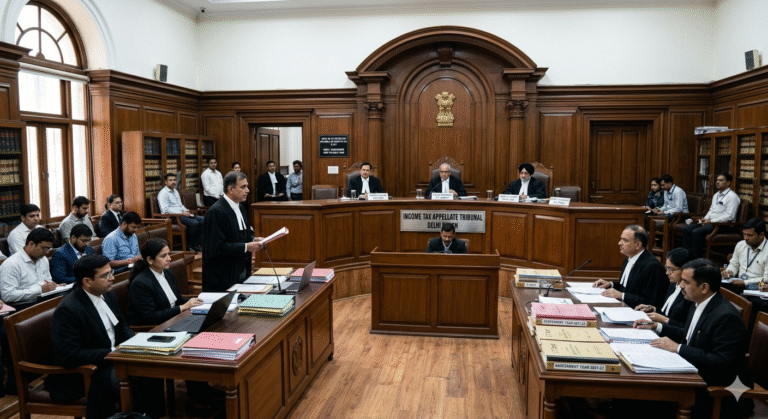
In a landmark ruling that could significantly influence the taxation of startup funding and corporate restructuring transactions in India, the Income Tax Appellate Tribunal (ITAT), Delhi Bench, has granted substantial relief to OYO Hotels and Homes Private Limited by deleting a massive tax addition of ₹3,885.51 crore made under the controversial “angel tax” provisions of the Income Tax Act.
The decision reinforces the principle that tax authorities cannot arbitrarily reject valuation reports prepared by qualified professionals and replace them with their own assumptions.
Background of the Dispute
The dispute arose during the Assessment Year 2021-22 following a corporate restructuring exercise within the OYO group.
As part of a court-approved scheme of arrangement, the India hotel business was demerged from Oravel Stays Limited, the parent company of OYO, and transferred to OYO Hotels and Homes Private Limited. Pursuant to this restructuring, OYO issued Compulsorily Convertible Preference Shares (CCPS) to Oravel Stays Limited at a premium.
The valuation of these shares was determined using the Discounted Cash Flow (DCF) method, a recognized valuation methodology under Rule 11UA of the Income Tax Rules. The valuation was supported by reports prepared by qualified valuers and merchant bankers.
However, the Income Tax Department questioned the share premium charged by OYO.
Why Did the Tax Department Raise the Demand?
The Assessing Officer (AO) observed that OYO had a negative net worth and was incurring substantial losses during the relevant period. The officer further alleged that the financial projections used for the DCF valuation were overly optimistic and failed to adequately account for the adverse impact of the COVID-19 pandemic on the hospitality industry.
Based on these observations, the AO rejected the DCF valuation method adopted by the company and effectively replaced it with his own valuation approach. Consequently, an addition of ₹3,737.99 crore was made under Section 56(2)(viib) of the Income Tax Act, commonly referred to as the angel tax provision.
An additional amount of ₹147.52 crore was added concerning the conversion of CCPS into equity shares, resulting in a total tax addition of ₹3,885.51 crore.
The Commissioner of Income Tax (Appeals) subsequently upheld the assessment order, agreeing with the tax department’s concerns regarding the valuation process.
OYO’s Arguments Before the ITAT
Challenging the additions, OYO contended that Section 56(2)(viib) was introduced as an anti-abuse measure to prevent the laundering of unaccounted money through inflated share premiums. According to the company, the provision was never intended to apply to genuine capital infusions between a parent company and its wholly-owned or substantially-owned subsidiary.
OYO further argued that the DCF method is expressly recognized under Rule 11UA and that tax authorities cannot substitute a legally accepted valuation methodology merely because they disagree with future business projections.
The company also emphasized that the investment represented legitimate downstream funding involving foreign investments made in compliance with the Foreign Exchange Management Act (FEMA) regulations and therefore could not be characterized as unaccounted money.
ITAT’s Findings and Ruling
The Delhi Bench of the ITAT, comprising Accountant Member S. Rifaur Rahman and Judicial Member Vimal Kumar, accepted OYO’s contentions and delivered a significant ruling in favour of the company.
The Tribunal held that tax authorities had exceeded their jurisdiction by undertaking a fresh valuation exercise despite the existence of valuation reports prepared by qualified experts.
The Bench observed that share valuation is a highly specialized and technical exercise requiring professional expertise. Assessing Officers do not possess the necessary valuation expertise to independently reassess the fair value of shares and replace a valuation carried out by registered valuers or merchant bankers.
The Tribunal further noted that the transaction in question was between a parent company and its subsidiary, arising from a demerger arrangement. The slight reduction in the parent company’s shareholding—from 100% to 99.6%—was merely a consequence of the restructuring process and did not indicate any attempt to introduce unaccounted funds.
Additionally, the ITAT recognized that the investments originated from legitimate foreign funds routed in accordance with FEMA regulations, thereby undermining the very basis for invoking the anti-abuse provisions of Section 56(2)(viib).
Accordingly, the Tribunal deleted the entire addition of ₹3,885.51 crore.
Issue Remanded for Fresh Verification
While granting relief on the share premium issue, the ITAT remanded a separate addition of ₹9.21 crore relating to management fees back to the Assessing Officer for fresh examination and verification.
Significance of the Judgment
The ruling is expected to have far-reaching implications for startups, private equity-backed companies, and corporate groups undertaking restructuring exercises.
The decision reiterates that tax authorities cannot disregard legally recognized valuation methods merely because actual business outcomes differ from projections. It also reinforces the view that genuine capital contributions between related entities should not automatically attract angel tax provisions.
For startups and growth-stage businesses that often rely on future projections for valuation purposes, the judgment provides much-needed certainty and protection against arbitrary tax assessments.
Case: Oyo Hotels and Homes Private Limited v. DCIT (ITAT Delhi)
Follow the Link below to watch the video: