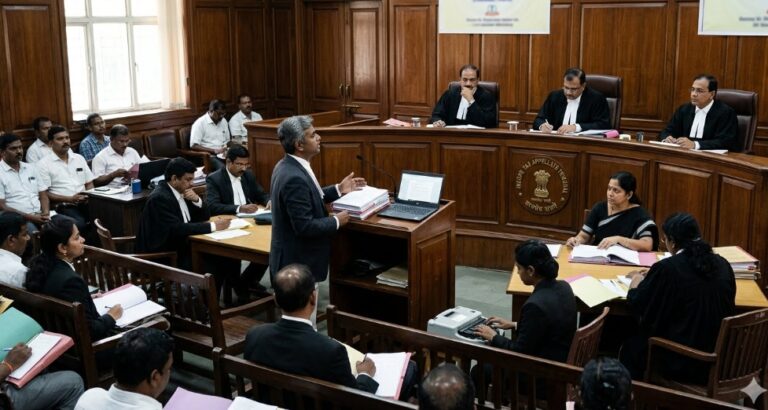
In a significant ruling that provides clarity on the treatment of client funds handled by professionals, the Income Tax Appellate Tribunal (ITAT), Chennai, in the case of Bose Saravanan Vs DCIT, held that amounts received by a Chartered Accountant exclusively for payment of clients’ statutory taxes cannot automatically be treated as unexplained money under Section 69A of the Income Tax Act, 1961.
The decision highlights the importance of examining the complete transaction trail, including corresponding debits and documentary evidence, before making additions on account of cash deposits.
Background of the Case
The dispute arose for Assessment Year (AY) 2016–17. The assessee, a practising Chartered Accountant, had filed his income tax return declaring total income of ₹2.95 lakh.
Subsequently, the Assessing Officer (AO) reopened the assessment after receiving information regarding substantial cash deposits made into the assessee’s bank account. According to the department, the deposits appeared disproportionate to the income disclosed in the return.
After examining the transactions, the AO concluded that the deposits lacked satisfactory explanation and invoked Section 69A of the Income Tax Act relating to unexplained money. As a result, an addition of approximately ₹23 crore was made to the assessee’s income.
Assessee’s Explanation Before Tax Authorities
The Chartered Accountant strongly disputed the addition and clarified that the deposits did not represent his personal income.
He explained that he operated in a relatively small town where many clients did not have adequate access to online tax payment mechanisms. To facilitate compliance, clients transferred funds into his bank account exclusively for payment of statutory dues such as:
- Income Tax
- Value Added Tax (VAT)
- Tax Deducted at Source (TDS)
- Service Tax
According to the assessee, he acted only as an intermediary or facilitator and remitted the collected amounts to government authorities on behalf of clients.
During appellate proceedings, extensive documentary evidence was submitted to support this explanation.
Enhancement by CIT(A)
Instead of granting relief, the Commissioner of Income Tax (Appeals)/National Faceless Appeal Centre went a step further.
Apart from sustaining the original addition, the appellate authority examined another HDFC Bank account and treated credits appearing therein as unexplained. Consequently, an additional amount of ₹6.87 crore was added, significantly increasing the tax exposure.
This enhancement became another major issue before the Tribunal.
Arguments Before ITAT Chennai
Before the Tribunal, the assessee reiterated that he had never exercised beneficial ownership over the funds.
To establish the genuineness of transactions, he produced multiple categories of evidence, including:
- Bank account statements
- Tax challans
- Client-related records
- Affidavits
- Supporting reconciliation documents
The assessee also explained that transfers between the Axis Bank account and HDFC Bank account were not diversions for personal use but internal fund movements intended for tax remittances.
The core argument was simple: the funds belonged to clients and were merely routed through his accounts to facilitate statutory payments.
Tribunal’s Findings and Observations
The ITAT Chennai carefully reviewed the records and found serious shortcomings in the approach adopted by the lower authorities.
The Tribunal observed that the tax department had concentrated only on the credit side of bank accounts while ignoring the corresponding debit entries reflecting payments made to government departments.
After analysing bank statements and tax challans, the Tribunal noted that tax payments aggregating approximately ₹29.83 crore had actually been made. Sample verification of challans matched with the debit transactions recorded in the bank accounts.
The Tribunal held that the documentary trail clearly established that the assessee had received funds in a fiduciary capacity and utilised them solely for payment of statutory liabilities of clients.
Since the money did not belong to the assessee, the essential requirement for invoking Section 69A was not satisfied.
Final Verdict
The ITAT allowed the appeal and directed the Assessing Officer to delete the additions made under Section 69A.
The ruling reinforces an important principle that mere receipt of funds in a bank account does not automatically lead to taxation if documentary evidence demonstrates that the recipient acted only as a conduit or intermediary.
Practical Implications
This judgment serves as an important precedent for professionals such as Chartered Accountants, consultants, tax practitioners, and intermediaries who temporarily handle client funds for compliance purposes.
The ruling also reminds tax authorities that bank deposits must be analysed in conjunction with utilisation patterns and supporting evidence before classifying them as unexplained income.
Where fiduciary transactions are substantiated through records, additions under Section 69A may not survive judicial scrutiny.
Follow the Link below to watch the video: