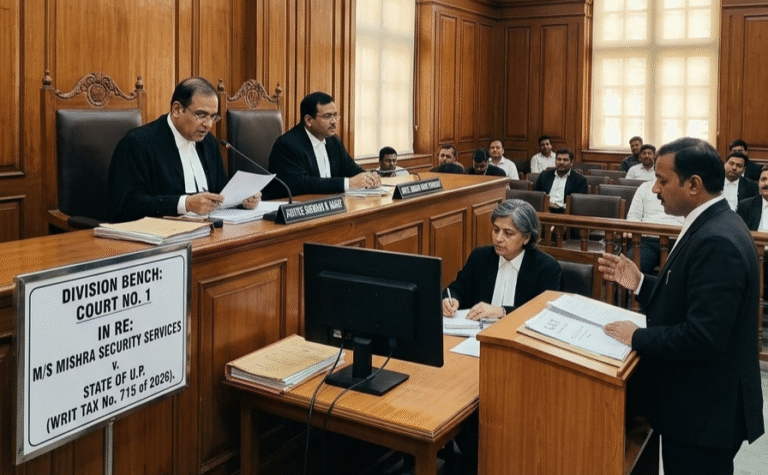
In a significant ruling reinforcing the importance of statutory remedies under tax laws, the Allahabad High Court has held that a taxpayer cannot invoke writ jurisdiction merely to avoid the limitation period prescribed for filing an appeal under the Goods and Services Tax (GST) regime. The Court made it clear that writ jurisdiction under Article 226 of the Constitution cannot become a substitute for an appellate mechanism that has already become time-barred.
The judgment was delivered in M/S Mishra Security Services Through Proprietor Smt. Sunita Mishra v. State of U.P. Through Additional Chief Secretary, State Tax and Others (WRIT TAX No. 715 of 2026) by a Division Bench comprising Justice Shekhar B. Saraf and Justice Abdhesh Kumar Chaudhary.
Background of the Case
The dispute arose after the tax authorities issued a show-cause notice dated 17 March 2025 to the petitioner under the GST framework. Subsequently, an assessment order dated 4 June 2025 was passed against the taxpayer.
Aggrieved by the assessment order, the petitioner approached the Allahabad High Court by filing a writ petition. The primary argument advanced was that the assessment proceedings had allegedly been initiated and concluded without jurisdiction and therefore deserved judicial interference.
However, during the proceedings, it emerged that the authorities had already provided the petitioner with an opportunity of personal hearing before finalising the assessment. This weakened the petitioner’s argument regarding procedural unfairness and violation of natural justice.
Statutory Appeal Under Section 107 of the GST Act
Under Section 107 of the Central Goods and Services Tax Act, a taxpayer aggrieved by an assessment order is entitled to file an appeal before the appellate authority.
The statutory framework prescribes:
- Three months from the date of communication of the order for filing an appeal; and
- An additional one-month condonable period, provided sufficient cause is demonstrated before the appellate authority.
The petitioner, however, did not file the statutory appeal within the prescribed period. Instead, after the limitation period had completely expired, the petitioner invoked the extraordinary jurisdiction of the High Court under Article 226.
High Court’s Observations
The Division Bench strongly disapproved of the petitioner’s attempt to bypass the statutory appellate process.
The Court observed that no convincing explanation was placed on record to justify:
- Failure to file the statutory appeal within time;
- Delay in approaching the High Court; or
- The prolonged inaction in pursuing legal remedies.
The judges emphasised that constitutional writ jurisdiction cannot be exercised in a manner that defeats legislative intent or renders statutory limitation provisions meaningless.
According to the Court, allowing such petitions would encourage litigants to ignore statutory timelines and later seek extraordinary judicial relief as an alternative route.
The Bench further remarked that the petitioner had effectively acted as a “fence-sitter” by remaining inactive until the statutory remedy became unavailable.
No Violation of Natural Justice Found
Another important aspect considered by the Court was whether there had been any breach of natural justice principles.
After examining the records, the Bench found that:
- A show-cause notice had been issued;
- Opportunity for personal hearing was granted; and
- The assessment order was passed after following due process.
Since procedural safeguards had been complied with, the Court found no extraordinary circumstance warranting interference.
Key Takeaways from the Judgment
This ruling carries important lessons for taxpayers and tax professionals:
- Writ Jurisdiction Is Not an Alternative to Appeal
High Courts generally discourage entertaining writ petitions where an effective statutory remedy exists.
- Limitation Periods Must Be Respected
Taxpayers cannot deliberately allow appellate deadlines to lapse and later seek constitutional remedies.
- Delay Must Be Properly Explained
Courts expect litigants to act diligently and provide genuine reasons for procedural delays.
- Natural Justice Violations Remain an Exception
Only in exceptional cases involving jurisdictional errors or serious procedural irregularities may writ jurisdiction be invoked despite alternative remedies.
Conclusion
The Allahabad High Court’s decision serves as a strong reminder that statutory appeal mechanisms under GST law must be followed within the prescribed timelines. Courts are unlikely to entertain writ petitions that appear to be attempts to circumvent limitation provisions after appellate remedies become unavailable.
For taxpayers, the message is clear—timely legal action and strict adherence to procedural requirements remain essential in GST litigation.
Follow the Link below to watch the video: