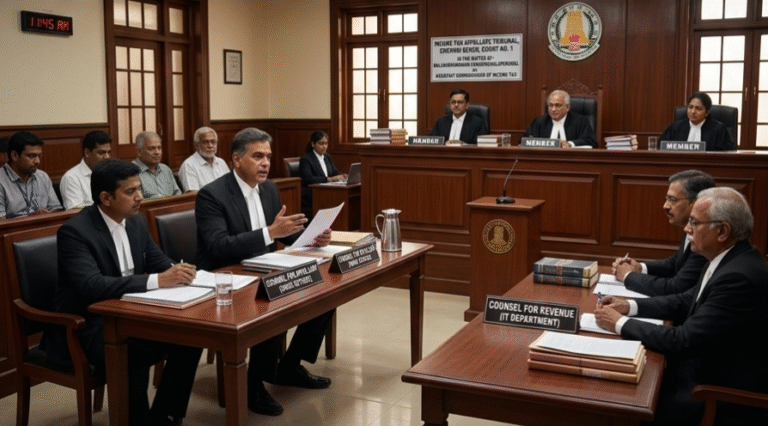
In a significant ruling that could impact thousands of retired Public Sector Undertaking (PSU) employees across India, the Chennai Bench of the Income Tax Appellate Tribunal (ITAT) has allowed a retired ONGC employee to claim tax exemption on the full amount of leave encashment received at retirement.
The decision has brought renewed attention to the taxation of leave encashment benefits and the interpretation of Section 10(10AA) of the Income-tax Act, 1961.
Background of the Case
Balasubramanian Venkatachalaperumal, a retired employee of Oil and Natural Gas Corporation (ONGC), retired during Financial Year 2019–20. Upon retirement, he received ₹19.06 lakh as leave encashment from his employer.
While filing his income tax return on October 29, 2021, the retiree claimed exemption for the entire leave encashment amount under Section 10(10AA)(ii) of the Income-tax Act. Based on this claim, he disclosed a total taxable income of ₹31.62 lakh.
However, the Income Tax Department did not accept the exemption in full.
During processing of the return, the department restricted the leave encashment exemption to ₹3 lakh and treated the balance amount as taxable income. This adjustment increased his taxable income substantially to ₹47.68 lakh and resulted in a tax dispute.
Why Did the Tax Dispute Arise?
The dispute centered on the applicable exemption limit for leave encashment received by non-government employees.
Under Section 10(10AA), leave encashment received at retirement is exempt subject to certain conditions:
- Government employees generally receive complete exemption under the applicable provisions.
- Non-government employees, including PSU employees, are entitled to exemption subject to prescribed monetary limits and conditions.
Historically, the exemption ceiling for non-government employees remained fixed at ₹3 lakh for nearly two decades.
Venkatachalaperumal argued that PSU employees should not continue to remain disadvantaged when compared to government employees, especially after changes introduced by the government to revise exemption limits.
Appeal Before the Commissioner of Income Tax (Appeals)
Unhappy with the assessment order, the retiree challenged the decision before the Commissioner of Income Tax (Appeals) [CIT(A)] on November 26, 2021.
His primary contention was that PSU employees perform public functions and therefore should receive treatment comparable to government employees in relation to leave encashment tax benefits.
He further argued that the old exemption cap of ₹3 lakh, introduced in 2002, had become outdated and required alignment with the revised exemption structure.
However, the CIT(A) rejected his appeal.
The appellate authority held that employees of Public Sector Undertakings cannot automatically be treated as Central or State Government employees for the purpose of claiming complete exemption under Section 10(10AA)(i).
Although the authority accepted that he was eligible for exemption under Section 10(10AA)(ii), it declined to extend government employee treatment.
ITAT Chennai Delivers Relief
The matter eventually reached the Chennai Bench of the Income Tax Appellate Tribunal.
On May 4, 2026, the tribunal ruled in favour of the retired ONGC employee.
ITAT observed that the government had significantly revised the exemption limit through Notification No. 31/2023, increasing the ceiling from ₹3 lakh to ₹25 lakh after a long gap of nearly twenty years.
The tribunal noted that the revision reflected the policy objective of reducing disparities between government and non-government employees concerning retirement benefits.
Considering the revised framework and legislative intent, the tribunal granted the benefit of the enhanced leave encashment exemption limit under Section 10(10AA)(ii).
As a result, the retiree became entitled to claim exemption on the entire ₹19.06 lakh leave encashment amount.
Impact of the Judgment
This ruling may have wider implications for retired employees of Public Sector Undertakings and other non-government sectors who received leave encashment benefits after the revised exemption notification came into effect.
The decision highlights the importance of interpreting tax provisions in line with current policy objectives rather than relying solely on outdated exemption thresholds.
Retired employees facing similar tax disputes may consider reviewing their cases in light of this development.
However, tax outcomes depend on individual facts, applicable assessment years, and prevailing legal provisions. Professional tax advice should be obtained before making or revising any exemption claim.
Conclusion
The ITAT Chennai ruling marks an important development in the taxation of retirement benefits in India. By allowing the enhanced leave encashment exemption, the tribunal has reinforced the principle that tax provisions should reflect contemporary economic realities and ensure fair treatment across employee categories.
For PSU employees and retirees, this judgment offers clarity and could potentially open the door to legitimate tax relief in eligible cases.