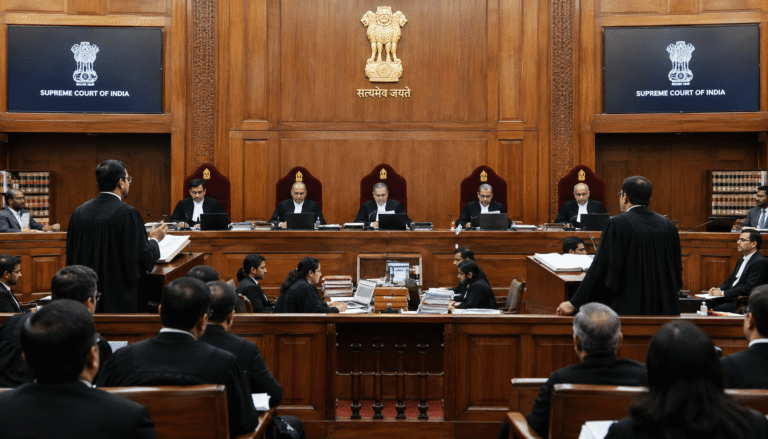
The doctrine of “Equal Pay for Equal Work” has evolved into one of the most significant labour and constitutional principles in Indian jurisprudence. What began as a Directive Principle of State Policy has gradually transformed into an enforceable constitutional right through judicial interpretation.
The Supreme Court of India has consistently held that workers performing substantially identical duties should not be discriminated against merely because of differences in employment status. However, recent judicial developments also clarify that the doctrine is not absolute. Contractual or temporary employees may be entitled to minimum pay parity under certain circumstances, but they cannot automatically claim complete equality in service benefits, promotional avenues, or regularisation.
The modern judicial position attempts to balance two competing constitutional values: fair wages and non-discrimination on one side, and merit-based public employment and administrative efficiency on the other.
This article examines the constitutional foundation, leading precedents, legal tests, and recent refinements shaping the doctrine of Equal Pay for Equal Work in India.
Constitutional Foundation of Equal Pay for Equal Work
The Indian Constitution does not expressly guarantee equal wages under Fundamental Rights. However, the principle originates from Article 39(d) under the Directive Principles of State Policy, which directs the State to ensure:
“Equal pay for equal work for both men and women.”
Although Directive Principles are non-justiciable by themselves under Article 37, the Supreme Court progressively linked Article 39(d) with Article 14 (Right to Equality) and Article 16 (Equality of Opportunity in Public Employment).
Through this interpretative approach, the Court elevated wage equality into a constitutional protection against arbitrary state action.
The judiciary repeatedly emphasized that unequal wages for identical work violate substantive equality and offend constitutional morality.
Randhir Singh v. Union of India (1982): Birth of the Constitutional Doctrine
The landmark judgment in Randhir Singh v. Union of India (1982) laid the constitutional foundation of the doctrine.
Facts
The petitioner, a driver employed in the Delhi Police Force, argued that despite performing functions similar to drivers in other government departments, he was paid substantially less.
Supreme Court’s Decision
The Court held that although “Equal Pay for Equal Work” is not expressly included among Fundamental Rights, it can be enforced through Articles 14 and 16 when unequal treatment lacks rational justification.
The Court observed that constitutional goals cannot remain abstract ideals and must influence employment practices.
Significance
This decision transformed the principle from a policy aspiration into a legally enforceable right.
It became the basis for subsequent wage parity jurisprudence across public employment.
Judicial Expansion of the Principle
Following Randhir Singh, the Supreme Court expanded the doctrine while simultaneously developing limitations.
Several important cases contributed to this evolution.
Dhirendra Chamoli v. State of Uttar Pradesh (1986)
The Court granted wage parity to casual workers engaged in government establishments.
The judgment emphasized that employees performing identical duties cannot be denied equal remuneration merely because of temporary status.
Surinder Singh v. Engineer-in-Chief, CPWD (1986)
The Supreme Court held that daily wage employees should receive wages equivalent to regular employees when the nature of work and responsibilities remain identical.
The Court rejected artificial classification based solely on employment labels.
Daily Rated Casual Labour v. Union of India (1988)
This decision further reinforced that temporary employees cannot be subjected to exploitative wage practices where actual work performed remains substantially identical.
State of Punjab v. Jagjit Singh (2016): The Modern Framework
One of the most influential decisions in contemporary labour jurisprudence is State of Punjab v. Jagjit Singh (2016).
Background
The dispute involved temporary, contractual, ad hoc, and daily wage employees who sought salary parity with regularly appointed government staff.
Supreme Court’s Findings
The Court held that:
- Equal pay applies irrespective of the nomenclature of employment.
- Temporary employees performing duties equivalent to regular employees cannot be paid significantly lower wages.
- Economic compulsion cannot be treated as voluntary acceptance of unequal compensation.
The Court observed that workers often accept lower pay due to unequal bargaining power and limited alternatives.
Principle Established
Temporary employees performing identical work are entitled to at least:
Minimum of the pay scale applicable to regular employees holding the same post.
However, the Court carefully clarified that this does not mean entitlement to increments, promotional benefits, or complete service parity.
State of Uttar Pradesh v. Ram Singh & Others (2026): Strengthening Wage Protection
In a recent reaffirmation, the Supreme Court reiterated that public employers cannot exploit temporary employment structures to suppress wages.
Key Observations
The Court emphasized:
- Temporary status cannot justify paying wages below the minimum entry-level regular scale.
- Arbitrary differentiation violates Article 14.
- Identical work deserves constitutionally fair compensation.
The judgment reflects growing judicial concern regarding institutional dependence on contract-based labour while avoiding fair remuneration obligations.
The ruling reinforced that labour flexibility cannot become a tool for wage discrimination.
The Legal Tests: When Is Work Truly Equal?
Indian courts do not apply the doctrine mechanically.
A claim succeeds only when substantial identity exists across multiple dimensions.
- Nature of Duties
Courts examine actual day-to-day functions rather than job titles.
Minor overlap in responsibilities is insufficient.
The work must be substantially and wholly similar.
- Educational Qualifications
Differences in qualifications may justify wage differences.
For example:
- Degree holders versus diploma holders
- Specialized certifications
- Professional licensing requirements
Qualification distinctions often reflect differences in expertise and accountability.
- Responsibilities and Accountability
Courts assess:
- Supervisory authority
- Decision-making power
- Administrative liability
- Disciplinary obligations
Regular employees often carry additional institutional responsibilities that justify higher compensation.
- Recruitment Process
Recruitment remains one of the most decisive factors.
Courts recognize distinctions where:
- Regular employees passed competitive examinations;
- Contractual staff entered through simplified selection;
- Constitutional recruitment procedures differ.
Limits of the Doctrine: Equal Pay Does Not Mean Equal Status
The Supreme Court has repeatedly clarified that wage equality does not automatically create employment equality.
This distinction became especially important after the Court’s decisions restricting automatic regularisation.
Secretary, State of Karnataka v. Umadevi (2006)
This landmark ruling held that:
- Public employment must comply with constitutional recruitment procedures.
- Temporary appointments cannot become a backdoor route to permanent government jobs.
The Court warned against judicial regularisation that bypasses merit-based selection.
Recent Refinement (2025–2026): Contractual Employees and Full Parity
Recent rulings by the Supreme Court further refined the doctrine.
The Court clarified that granting complete parity of benefits to contractual employees may undermine constitutional recruitment norms.
The judiciary noted:
- Permanent employees undergo rigorous competitive selection.
- Equal pay cannot erase legitimate structural distinctions.
- Service benefits, promotions, pension, and seniority remain separate considerations.
The Court stressed that indiscriminate parity may create unfairness toward regularly selected employees.
Role of Expert Bodies and Judicial Restraint
Another important aspect of recent jurisprudence is judicial restraint in pay fixation.
The Supreme Court consistently holds that:
- Wage structures involve economic and technical assessment.
- Pay Commissions and expert committees are better suited for evaluating compensation models.
- Courts intervene only where discrimination is arbitrary or unconstitutional.
Judicial review focuses on legality—not administrative wage design.
Conclusion
The doctrine of Equal Pay for Equal Work represents a remarkable example of constitutional evolution in India. Through judicial creativity, Article 39(d) has been integrated with Articles 14 and 16 to create enforceable labour rights.
At the same time, the Supreme Court has carefully drawn boundaries to preserve merit-based public employment.
Today, the legal position is clear:
Employees performing substantially identical work cannot be denied the minimum corresponding pay scale merely because they are temporary or contractual. However, equal wages do not automatically translate into equal status, equal benefits, or regularisation.
The Indian judiciary continues to maintain a delicate balance between social justice and constitutional governance—ensuring dignity for workers while preserving fairness in public recruitment.
Follow the Link below to watch the video: