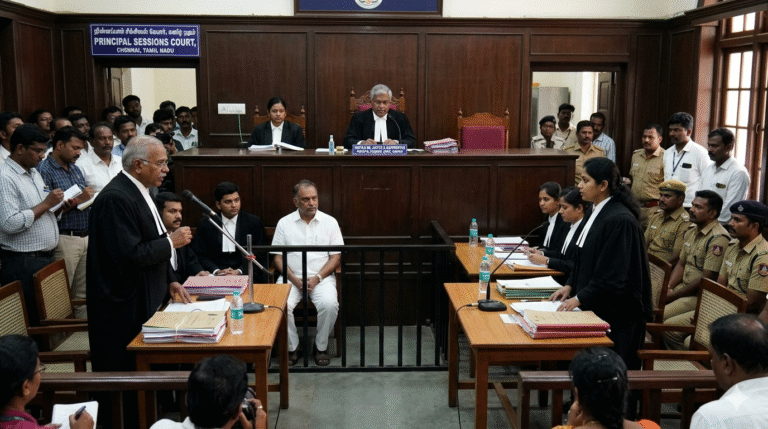
In a significant ruling on the scope of arrest powers under the Goods and Services Tax (GST) framework, a Chennai court has held that tax authorities are not required to wait for completion of assessment or adjudication proceedings before initiating arrest action, provided they possess sufficient material to form a statutory “reason to believe” that an offence under the GST law has been committed.
The decision came while rejecting the bail application filed by Dr. Obed Ulla A, a director of Attica Gold Pvt. Ltd., who was arrested by the Directorate General of GST Intelligence (DGGI) in connection with an alleged large-scale GST evasion investigation.
Background of the Case
The matter arose from an investigation conducted by the DGGI into the business operations of Attica Gold Pvt. Ltd., a company engaged in purchasing second-hand gold jewellery and reselling it while availing benefits available under the GST margin scheme.
According to the investigation authorities, the company allegedly misused the margin scheme mechanism. Instead of reselling the jewellery in its original form, the authorities claimed that significant quantities of gold were transported to Bengaluru, melted into Gatti Gold, and thereafter supplied to jewellery manufacturers without proper accounting and tax disclosures.
The investigation reportedly indicated tax evasion exceeding ₹100 crore.
Following the investigation, Dr. Obed Ulla A was arrested on 12 June under provisions of the Central Goods and Services Tax (CGST) Act.
Petitioner’s Arguments Before the Court
Seeking bail, the petitioner challenged the legality and necessity of the arrest.
His principal arguments included:
- He became a director of the company only in 2024 and therefore could not automatically be connected with the alleged transactions.
- No incriminating documents or material were recovered from his residential premises.
- The allegation of GST evasion exceeding ₹100 crore lacked sufficient evidentiary backing.
- Authorities had allegedly granted arrest approval mechanically without proper application of mind.
- Arrest under GST provisions should not become a substitute for tax recovery proceedings.
- Since no adjudication or assessment had determined any final tax liability, arrest action was premature.
The petitioner also relied on judicial precedents, including the Supreme Court’s decision in Radhika Agarwal v. Union of India, along with certain High Court decisions concerning safeguards against arbitrary arrest.
DGGI’s Stand Before the Court
Opposing the bail request, the Directorate General of GST Intelligence argued that substantial evidence had emerged during the investigation.
According to the prosecution, searches conducted at company premises led to recovery of multiple categories of evidence, including:
- Transport and movement records;
- CCTV footage;
- Electronic devices and digital records;
- Accounting data and tally records;
- Gold melting documentation; and
- Statements of employees.
The DGGI further submitted that the petitioner had repeatedly failed to comply with summons issued during investigation despite assurances of cooperation. Authorities also pointed out that he subsequently retracted an earlier statement, raising concerns regarding his willingness to assist the investigation process.
Court’s Findings on Arrest Under Section 69 of the CGST Act
Principal Sessions Judge S. Karthikeyan examined the statutory framework under Section 69 of the CGST Act dealing with arrest powers.
The court emphasised that the legal requirement for authorising arrest is not completion of tax adjudication but the existence of adequate material giving rise to a bona fide “reason to believe” that an offence punishable under Section 132 of the CGST Act has occurred.
While analysing the arrest approval, the court noted that the approval was supported by multiple categories of material collected during investigation, including employee statements, transporter information, CCTV recordings from the melting facility, tally data, melting reports and seized documents.
Rejecting the argument that the approval had been issued mechanically, the court held that the available material demonstrated sufficient grounds for invoking arrest powers.
The court specifically observed that final adjudication of tax liability is not a precondition for arrest under GST law.
It clarified that at the stage of deciding whether arrest is justified, authorities are only required to possess sufficient material supporting a reasonable belief regarding commission of the alleged offence.
The court also noted that while considering a bail application, it is not restricted to examining only the formal “reasons to believe” document and may evaluate the broader body of evidence collected during investigation.
Bail Rejected Considering Investigation Stage
Taking into account the seriousness of the allegations, the ongoing nature of the investigation and concerns regarding cooperation by the accused, the court concluded that custodial interrogation remained necessary.
Accordingly, the bail application was dismissed.
Case Details
Case Title: Dr. Obed Ulla A v. State
Case Number: Crl.M.P. No. 5550 of 2026 in R.R. No. 9 of 2026
Key Takeaway
This ruling reinforces an important principle under GST enforcement jurisprudence: arrest powers under Section 69 of the CGST Act are triggered by the existence of credible material creating a “reason to believe” and are not dependent upon completion of assessment or tax adjudication proceedings. The judgment may influence future GST enforcement actions involving allegations of large-scale tax evasion and the scope of pre-adjudication arrests.
Follow the Link below to watch the video: