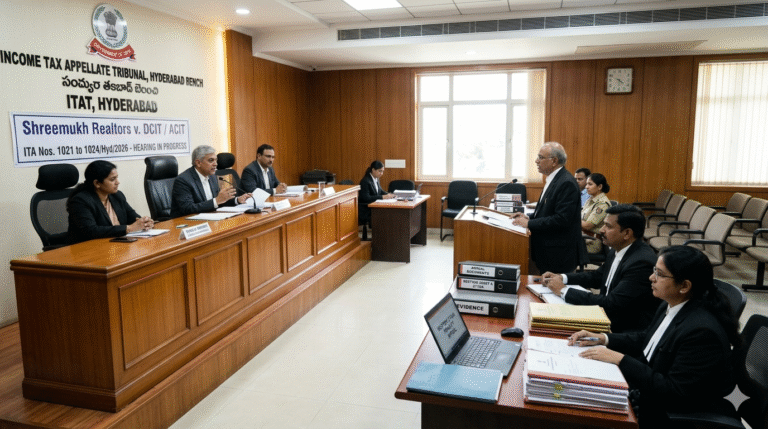
In a significant ruling on the scope of penalty proceedings under the Income Tax Act, the Hyderabad Bench of the Income Tax Appellate Tribunal (ITAT) has deleted penalties imposed under Section 271DA, holding that the Income Tax Department failed to establish any actual violation of Section 269ST through credible and corroborative evidence.
The decision came in the case of Shreemukh Realtors v. Deputy Commissioner of Income Tax / Assistant Commissioner of Income Tax (ITA Nos. 1021 to 1024/Hyd/2026) and provides important guidance on the evidentiary standards required before imposing penalties for alleged cash transactions.
Background of the Dispute
The dispute originated from a search operation conducted by the Income Tax Department on the Vasavi Group in August 2022. During the course of the search, authorities seized electronic tally records and certain other materials that allegedly indicated unaccounted cash receipts.
Based on the seized information, the Assessing Officer (AO) proceeded to reject the books of account of Shreemukh Realtors during assessment proceedings. The officer estimated income using the material gathered during the search and simultaneously initiated penalty proceedings under Section 271DA of the Income Tax Act.
Subsequently, the Additional Commissioner imposed penalties for multiple assessment years—2020–21 to 2023–24—on the allegation that the assessee had accepted cash receipts in violation of Section 269ST.
The Commissioner of Income Tax (Appeals) later upheld these penalty orders.
Assessee’s Arguments Before the Tribunal
Challenging the penalty orders, Shreemukh Realtors argued before the Tribunal that the Revenue authorities had failed to establish the fundamental ingredients necessary to invoke Section 269ST.
The taxpayer contended that the Department did not identify:
- The actual payer of the alleged cash receipts;
- Dates of receipt;
- Nature and character of the transactions;
- Mode through which payments were received; and
- Documentary evidence connecting the tally entries with real transactions.
It was also submitted that the Department had relied entirely on rough tally data without supporting documents such as sale agreements, receipts, invoices, buyer confirmations, or independent verification from purchasers.
According to the assessee, unverified electronic records alone could not become the sole basis for imposing severe penalties under Section 271DA.
ITAT Hyderabad’s Findings
After examining the facts and available records, the Hyderabad ITAT ruled in favour of the taxpayer and held that the Revenue had failed to discharge its burden of proof.
The Tribunal observed that before invoking penalty provisions under Section 271DA, the Department must first conclusively demonstrate that there was an actual violation of Section 269ST.
The Bench specifically noted:
“The A.O has not conclusively proved the violation of provisions of section 269ST of the Act, so as to levy penalty under section 271DA of the Act.”
The Tribunal emphasised that penalty proceedings cannot be sustained merely on assumptions or unverified data entries.
According to the Bench, reliance only on tally software records, without corroborative evidence such as sale documents, cash receipts, or confirmation from alleged purchasers, does not meet the legal threshold required to impose penalties.
Tribunal Criticises Selective Use of Evidence
A notable aspect of the judgment was the Tribunal’s criticism of the Department’s inconsistent approach toward the same set of seized materials.
The Tribunal observed that while the Assessing Officer rejected those records for determining actual taxable income and instead resorted to estimation, the Department simultaneously treated the same data as conclusive evidence for imposing penalty.
The Bench found this selective reliance contradictory and legally unsustainable.
It also pointed out inconsistencies in the transaction details relied upon by the appellate authority while affirming the penalties.
Penalty Under Section 271DA Is Not Automatic
The Tribunal further interpreted the proviso to Section 271DA and clarified that levy of penalty is not automatic upon allegation of a violation.
The provision allows relief where the taxpayer establishes good and sufficient reasons regarding the alleged contravention.
Another important observation made by the Bench concerned proportionality.
The Tribunal highlighted that the Assessing Officer had estimated profit at only 16 percent of the alleged receipts but imposed penalty equal to 100 percent of the same receipts.
Commenting on this inconsistency, the Tribunal observed that once the Department itself considered only a limited percentage as income, imposing full-value penalty lacked justification.
Conclusion
Setting aside the orders of the Commissioner (Appeals), the Hyderabad ITAT directed deletion of penalties for all four assessment years.
The ruling reinforces an important principle in tax jurisprudence: penalty provisions must be applied strictly and only after clear evidence establishes the alleged default.
The judgment also serves as a reminder that electronic records and internal accounting data, without independent corroboration, may not by themselves justify penalty under Section 271DA for alleged violations of Section 269ST.
Case Title: Shreemukh Realtors v. Deputy Commissioner of Income Tax / Assistant Commissioner of Income Tax
Case Number: ITA Nos. 1021 to 1024/Hyd/2026
Follow the Link below to watch the video: