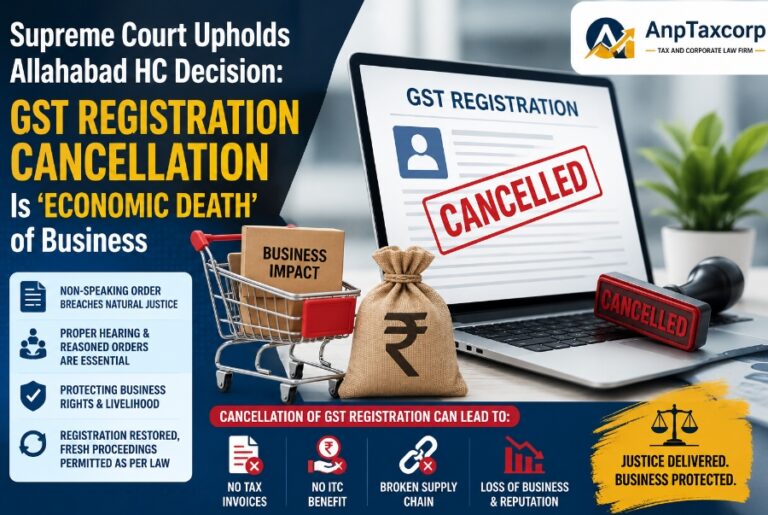
In a significant decision reinforcing taxpayer rights under the Goods and Services Tax (GST) regime, the Supreme Court has upheld the judgment of the Allahabad High Court, which observed that cancellation of a GST registration without recording proper reasons can result in the “economic death” of a business. The Apex Court declined to interfere with the High Court’s findings and allowed the taxpayer to pursue the statutory appellate remedy by extending the limitation period for filing the appeal.
The case, M/s Anil Art and Craft vs. State of Uttar Pradesh (Civil Appeal Nos. 17892–17893 of 2026), highlights the importance of transparency, fairness, and adherence to the principles of natural justice while exercising powers to cancel GST registrations.
Background of the Dispute
The controversy arose when the GST authorities cancelled the taxpayer’s GST registration after issuing a show-cause notice. The cancellation order merely stated that the taxpayer’s reply to the notice was “not satisfactory” without explaining why the explanation was unacceptable or recording any specific findings.
Aggrieved by the cancellation, the taxpayer approached the Allahabad High Court, contending that the order was arbitrary, non-speaking, and violative of the principles of natural justice.
Allahabad High Court’s Observations
The Allahabad High Court held that an order cancelling GST registration must contain clear reasons and cannot be based on vague or mechanical observations. According to the Court, merely stating that the taxpayer’s reply is unsatisfactory does not constitute a legally sustainable reason.
The High Court emphasized that GST registration is the foundation of a registered person’s business operations. Cancellation of registration prevents a taxpayer from legally issuing tax invoices, collecting GST, availing or passing on Input Tax Credit (ITC), and participating in the GST supply chain.
Recognising the far-reaching consequences of such action, the High Court observed that arbitrary cancellation of GST registration may effectively amount to the “economic death” of a business, as it can completely disrupt commercial activities and damage the taxpayer’s credibility in the market.
Directions Issued by the High Court
Apart from restoring the taxpayer’s GST registration, the Allahabad High Court directed the Commercial Tax Commissioner, Uttar Pradesh, to issue appropriate administrative guidelines for GST officers.
The Court instructed that officers should:
- Pass reasoned and speaking orders while cancelling GST registrations.
- Provide taxpayers with an effective opportunity of being heard.
- Ensure compliance with the principles of natural justice.
- Avoid arbitrary or mechanical cancellation of GST registrations.
The Court also clarified that restoration of registration would not prevent the department from initiating fresh proceedings in accordance with law, provided due process is followed.
Supreme Court Affirms the High Court’s View
The State challenged the Allahabad High Court’s judgment before the Supreme Court. However, the Apex Court found no reason to interfere with the well-reasoned decision.
The Supreme Court dismissed the challenge, thereby affirming the observations made by the High Court. At the same time, it permitted the taxpayer to pursue the statutory appellate remedy and extended the limitation period for filing the appeal.
By refusing to disturb the High Court’s findings, the Supreme Court has reinforced the requirement that GST authorities must exercise their powers fairly, reasonably, and in accordance with law.
Significance of the Judgment
This ruling carries substantial importance for businesses across India. GST registration is not merely a procedural requirement—it is the legal identity that enables a business to operate within the GST ecosystem.
The judgment reiterates that administrative authorities cannot cancel GST registrations through cryptic or non-speaking orders. Every adverse decision affecting a taxpayer must disclose the reasons on which it is based, enabling the taxpayer to understand the basis of the action and effectively challenge it before the appellate authority.
The decision also serves as an important reminder to GST officers that procedural fairness and reasoned decision-making are indispensable components of good governance. Businesses facing cancellation of GST registration now have stronger judicial support against arbitrary administrative action.
Conclusion
The Supreme Court’s decision in M/s Anil Art and Craft vs. State of Uttar Pradesh strengthens the safeguards available to taxpayers against arbitrary cancellation of GST registrations. By endorsing the Allahabad High Court’s observation that such cancellation can amount to the “economic death” of a business, the Apex Court has reaffirmed that authorities must pass well-reasoned orders, provide a fair hearing, and strictly adhere to the principles of natural justice. The ruling is expected to promote greater accountability in GST administration while protecting the legitimate interests of businesses operating under the GST framework.