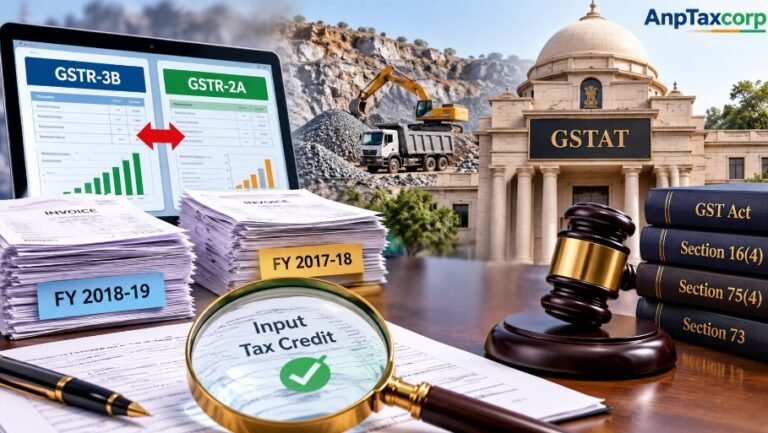
The Goods and Services Tax Appellate Tribunal (GSTAT) has reiterated an important principle concerning Input Tax Credit (ITC) disputes arising from differences between GSTR-3B and GSTR-2A. The Tribunal held that ITC cannot be disallowed merely because the credit claimed in GSTR-3B exceeds the ITC appearing in GSTR-2A for the corresponding financial year, without properly examining the underlying invoices and supporting records.
The ruling is particularly relevant for taxpayers facing GST demands based on GSTR-2A/ GSTR-3B reconciliation differences, especially where invoices relating to an earlier financial year were legitimately claimed in a subsequent year within the time limit prescribed under Section 16(4) of the CGST Act.
Background of the Case
The taxpayer, M/s N. R. Builders, was engaged in the business of quarrying and selling crushed stones. During proceedings relating to FY 2018-19, the GST authorities noticed that the ITC reported by the taxpayer in GSTR-3B was higher than the ITC reflected in GSTR-2A for that financial year.
The authorities treated the difference of ₹2,33,502, comprising CGST of ₹1,16,751 and SGST of ₹1,16,751, as excess ITC.
Consequently, proceedings under Section 73 of the CGST Act resulted in confirmation of tax, interest and penalty aggregating to approximately ₹4,60,582.
The taxpayer challenged the demand and explained that the apparent mismatch did not represent wrongful or excess ITC.
Taxpayer’s Explanation for the ITC Difference
According to the taxpayer, part of the ITC claimed during FY 2018-19 actually related to invoices pertaining to FY 2017-18.
The taxpayer contended that these invoices had not been claimed in the earlier year and were subsequently availed in FY 2018-19 within the permissible time prescribed under Section 16(4) of the CGST Act.
Therefore, comparing the ITC claimed in GSTR-3B for FY 2018-19 exclusively with the ITC appearing in GSTR-2A for FY 2018-19 could create an artificial mismatch.
The taxpayer maintained that the relevant invoices and corresponding ITC were reflected in the GSTR-2A of FY 2017-18 and, therefore, the discrepancy required proper invoice-level reconciliation before treating the credit as ineligible.
Demand Confirmed Without Proper Verification
Despite the explanation, the First Appellate Authority confirmed the demand without undertaking the necessary detailed reconciliation.
The taxpayer also raised a significant procedural objection. It was submitted that no effective personal hearing had been granted before the adverse decision was taken. The show-cause notice reportedly contained the hearing information as “NA”.
The matter was therefore carried before the GSTAT.
GSTAT’s Findings on GSTR-2A Mismatch
The Tribunal observed that GSTR-2A for the relevant financial year cannot automatically be treated as conclusive evidence for determining the eligibility of ITC.
A mere difference between ITC reported in GSTR-3B and the ITC appearing in GSTR-2A does not, by itself, establish that the taxpayer has wrongly availed credit.
Where a taxpayer provides a specific explanation that certain invoices belong to an earlier financial year but the credit was availed in a subsequent year within the statutory limitation period, the authorities must examine that explanation through proper documentary verification.
The Tribunal therefore directed an invoice-wise verification rather than relying solely on an annual comparison of GSTR-3B and GSTR-2A.
Personal Hearing Under Section 75(4)
The Tribunal also examined the taxpayer’s grievance regarding denial of a personal hearing.
Section 75(4) of the CGST Act requires that an opportunity of hearing be granted where a request is received or where an adverse decision is contemplated against the person chargeable with tax.
The Tribunal held that the absence of a proper personal hearing, in circumstances where an adverse decision was proposed, amounted to a serious procedural deficiency.
Accordingly, the adjudication could not be sustained in its existing form.
Non-Issuance of ASMT-10 Does Not Invalidate Section 73 Proceedings
Another issue before the Tribunal concerned the alleged failure to issue FORM GST ASMT-10 under Section 61.
The Tribunal clarified that scrutiny proceedings under Section 61 and proceedings for determination of tax under Section 73 operate as independent statutory mechanisms.
Therefore, merely because FORM GST ASMT-10 was not issued, the proceedings under Section 73 would not automatically become invalid.
This distinction is important for taxpayers challenging GST demands on procedural grounds.
Matter Remanded for Fresh Adjudication
The GSTAT ultimately allowed the appeal by way of remand and set aside the earlier orders.
The matter was sent back to the Proper Officer for fresh adjudication after undertaking a detailed verification of the taxpayer’s ITC claim.
The verification is required to consider relevant records, including:
- Invoice-wise details of the disputed ITC;
- GSTR-2A for FY 2017-18;
- Suppliers’ GSTR-1 returns;
- ITC registers;
- Books of accounts;
- GSTR-9 and GSTR-9C; and
- Other relevant supporting documents.
The Proper Officer was also directed to consider the principles contained in CBIC Circular No. 183/15/2022-GST, wherever applicable.
Further, the taxpayer must be given a proper opportunity of personal hearing before a fresh, reasoned order is passed. The Tribunal directed that the fresh order be issued within twelve weeks.
The final liability towards tax, interest and penalty will consequently depend upon the outcome of the fresh adjudication.
Key Takeaway for GST Taxpayers
The ruling provides useful guidance in cases involving ITC mismatch between GSTR-3B and GSTR-2A.
A year-wise comparison cannot always provide the complete picture of ITC eligibility. Credit relating to invoices of an earlier financial year may legitimately be availed in a subsequent year, subject to the statutory conditions and time limit under Section 16(4).
Therefore, before confirming an ITC-related demand, the GST authorities should examine the taxpayer’s explanation and supporting documents through appropriate invoice-wise reconciliation.
At the same time, taxpayers facing such demands should maintain proper purchase invoices, supplier details, ITC registers, books of accounts, GSTR-2A/2B records and year-wise reconciliation statements to substantiate their claims.
Case Details
Case: M/s N. R. Builders vs. Commissioner of Commercial Taxes
Case No.: APL/2/BUR/2026
Issue: ITC mismatch between GSTR-3B and GSTR-2A
Amount of disputed ITC: ₹2,33,502
Counsel for Appellant: Shri Sujay Subramanya Naidu
Conclusion
The GSTAT ruling reinforces the principle that ITC cannot be disallowed mechanically merely because the credit claimed in GSTR-3B does not match the ITC appearing in GSTR-2A for the same financial year.
Where a taxpayer has a plausible explanation supported by records, the authorities must undertake a proper verification of the underlying transactions. Equally important, taxpayers must be given the procedural safeguards prescribed under the GST law, including a meaningful opportunity of personal hearing before an adverse order is passed.