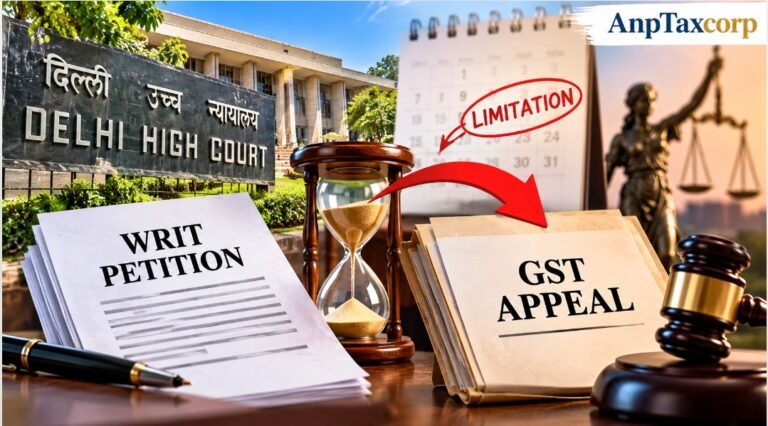
The Delhi High Court clarifies that time spent pursuing a writ petition is not automatically excluded from GST appeal limitation. Learn about Section 14 of the Limitation Act and its implications for taxpayers.
Introduction
Taxpayers challenging adverse orders under the Goods and Services Tax (GST) law must carefully comply with the statutory time limits for filing appeals. A common difficulty arises when a taxpayer initially approaches the High Court through a writ petition and subsequently seeks to pursue the statutory appellate remedy. Whether the time spent in the writ proceedings can be excluded while calculating the limitation period becomes a crucial legal question.
In an important clarification, the Delhi High Court has held that the period spent pursuing a writ petition cannot be automatically excluded from the limitation period for filing a statutory GST appeal. Even if the taxpayer applies for exclusion of this period under Section 14 of the Limitation Act, 1963, the application must be examined by the competent appellate authority in accordance with law.
The ruling highlights the importance of limitation compliance and makes it clear that approaching the High Court does not, by itself, guarantee protection against a limitation objection.
Case Details
- Case Name: Hans Raj Kaushik, Proprietor, Kaushik Industries v. Union of India & Others
- Court: Delhi High Court
- Case Number: W.P.(C) 15157/2026
- Relevant Legislation: Central Goods and Services Tax Act, 2017, and Section 14 of the Limitation Act, 1963.
The matter concerned GST adjudication proceedings relating to the financial year 2018–19 and involved a penalty imposed under the CGST framework.
Background of the Dispute
The petitioner approached the Delhi High Court challenging a show-cause notice dated June 30, 2025, an adjudication order dated December 17, 2025, and a subsequent rectification order dated December 30, 2025.
A significant issue concerned the communication of the adjudication order and the date from which the limitation period for filing an appeal should be calculated.
According to the petitioner, the relevant particulars of the adjudication order became available on the GST portal only on May 11, 2026. On this basis, the petitioner contended that the date on which the order was effectively communicated required examination.
The Revenue, on the other hand, submitted that the adjudication order had been sent to the petitioner’s registered email address and also dispatched through Speed Post.
Thus, the parties had differing positions regarding service of the order and the commencement of the limitation period.
The dispute raised an important practical question: when a taxpayer pursues a writ petition before the High Court, can the period spent in those proceedings automatically be deducted from the time available for filing a statutory appeal under GST law?
What Did the Delhi High Court Hold?
A Division Bench comprising Justices Anil Kshetarpal and Bharat Parashar clarified that the exclusion of time spent in writ proceedings is not automatic.
The Court observed that if the petitioner files an application under Section 14 of the Limitation Act, 1963, seeking exclusion of the period during which the writ petition remained pending, the competent appellate authority must consider the application in accordance with law.
However, the mere filing of such an application cannot be treated as sufficient to secure exclusion of the entire period.
The appellate authority must independently examine the request in light of the applicable legal principles and the facts and circumstances placed before it.
Importantly, the High Court left the rival contentions concerning service of the adjudication order, the date of communication, and the computation of limitation open for consideration by the competent appellate authority. It did not conclusively decide these disputed issues in favour of either party.
The ruling therefore preserves the petitioner’s opportunity to raise the relevant limitation-related arguments before the statutory forum without guaranteeing that the requested exclusion will be allowed.
Understanding Section 14 of the Limitation Act, 1963
Section 14 of the Limitation Act provides for the exclusion of time spent by a litigant in pursuing proceedings before a court that is unable to entertain them because of a defect of jurisdiction or another cause of a similar nature, provided the statutory conditions are satisfied.
The provision is intended to protect litigants who have pursued legal remedies diligently and in good faith before a forum that ultimately cannot entertain the proceedings.
However, the benefit of Section 14 is not unconditional. Its applicability depends on the facts of the particular case, the nature of the earlier proceedings, the reasons for the forum’s inability to entertain them, and compliance with the statutory requirements.
The Delhi High Court’s clarification reinforces this distinction. A taxpayer cannot presume that the entire period spent in writ proceedings will necessarily be excluded while computing the limitation period for a GST appeal. The claim must be properly raised and legally examined.
Implications for GST Taxpayers and Professionals
The ruling carries several practical lessons for taxpayers, businesses and GST practitioners.
1. Do not assume that a writ petition suspends limitation
Filing a writ petition should not be treated as an automatic suspension or extension of the statutory period for filing an appeal. Taxpayers must remain conscious of the applicable limitation requirements.
2. Examine the date of communication of the order
The date on which an adjudication order is legally communicated may be significant in determining the commencement of the appeal period. Taxpayers should preserve relevant emails, postal records, GST portal screenshots and other evidence relating to communication of the order.
3. Raise the Section 14 claim with supporting evidence
Where exclusion of time is legally available, the taxpayer should submit a reasoned application supported by the relevant court orders, filing records, dates of proceedings and evidence demonstrating compliance with the applicable requirements.
4. Do not overlook the statutory appellate remedy
Where an appeal is available under the CGST Act, the taxpayer should carefully assess the appropriate legal strategy. If a writ petition is pursued, the limitation implications of that decision must also be considered.
5. Remember that exclusion and condonation are different concepts
Exclusion of time under Section 14 and condonation of delay are legally distinct. Section 14 concerns the exclusion of qualifying periods from limitation computation, whereas condonation involves excusing a delay where the applicable law permits it. Neither remedy should be assumed to apply automatically.
Conclusion
The Delhi High Court’s decision in Hans Raj Kaushik, Proprietor, Kaushik Industries v. Union of India & Others serves as an important reminder that limitation is a substantive procedural concern in GST litigation.
The Court clarified that the period spent pursuing a writ petition cannot automatically be excluded from the limitation period for filing a statutory GST appeal merely because an application under Section 14 of the Limitation Act has been filed.
The competent appellate authority must examine the application in accordance with law, considering the relevant legal principles and supporting facts. The questions concerning service of the adjudication order and the actual computation of limitation also remain open for consideration by that authority.
For taxpayers and practitioners, the practical message is clear: preserve evidence of communication, calculate limitation carefully, and support every request for exclusion of time with appropriate legal grounds and documentation.
Disclaimer: This article is intended for general legal information and educational purposes. The applicability of Section 14 of the Limitation Act and the computation of limitation in a particular GST dispute depend on the governing law and the specific facts of the case.