Introduction
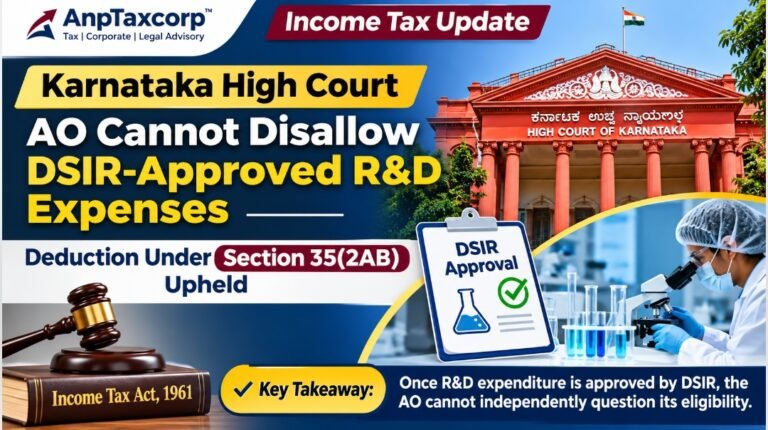
In an important ruling concerning tax incentives for scientific research and development, the Karnataka High Court has held that an Assessing Officer (AO) cannot independently question or reassess the eligibility of research and development (R&D) expenditure already examined and approved by the Department of Scientific and Industrial Research (DSIR), being the prescribed authority under the Income Tax Act, 1961.
The Court clarified that once the prescribed authority has approved the eligible R&D expenditure under Section 35(2AB), the Assessing Officer’s role is primarily confined to verifying whether the approved expenditure has actually been incurred and is supported by appropriate documentary evidence. The AO cannot sit in appeal over the technical assessment undertaken by the prescribed authority.
The decision provides significant relief to companies investing in in-house scientific research and reinforces the statutory framework governing deductions for research and development expenditure.
Background of the Case
The dispute arose in the case of Deputy Commissioner of Income Tax, Circle-12(4) v. Tejas Networks Limited, concerning Assessment Year 2009-10.
The taxpayer, Tejas Networks Limited, had undertaken scientific research and development activities through its recognised in-house R&D facilities. It claimed weighted deduction under Section 35(2AB) of the Income Tax Act, 1961, in respect of expenditure incurred on these activities.
The company’s R&D facilities had been recognised by the DSIR, which examined the expenditure and approved eligible R&D expenditure amounting to approximately ₹46.01 crore through Form 3CL dated 10 April 2013.
However, during assessment proceedings, the Assessing Officer disallowed a substantial portion of the deduction. The disallowance primarily related to expenditure associated with product development, incomplete projects, know-how and capital work-in-progress.
The Revenue authorities took the view that such expenditure did not satisfy the conditions prescribed under Section 35(2AB). The Dispute Resolution Panel also upheld the disallowance, prompting the taxpayer to challenge the action before the High Court.
Key Issue Before the Karnataka High Court
The principal question before the Court was whether the Assessing Officer could independently examine the nature and eligibility of R&D expenditure after the same had already been scrutinised and approved by the DSIR.
Another important issue was whether expenditure incurred on developing intellectual property, proprietary rights and technological know-how could automatically be excluded from the benefit of Section 35(2AB).
High Court’s Observations and Findings
A Division Bench comprising Chief Justice Vibhu Bakhru and Justice K.S. Hemalekha dismissed the Revenue’s appeal and upheld the order setting aside the disallowance.
1. AO Cannot Revisit DSIR’s Approval
The High Court held that the Assessing Officer cannot independently review or reconsider the approval granted by the prescribed authority.
Once the DSIR has examined the R&D activities and approved the eligible expenditure, the AO cannot substitute its own technical assessment regarding the eligibility of such expenditure.
The AO’s responsibility is limited to verifying the actual incurrence of expenditure through supporting documents, audited financial statements and relevant accounting records.
2. Section 35(3) Provides the Appropriate Mechanism
The Court further explained that if any dispute arises regarding whether a particular activity constitutes scientific research, the Assessing Officer cannot independently determine that question.
Section 35(3) provides a specific statutory mechanism whereby the CBDT must refer such questions to the Central Government or the prescribed authority, depending upon the nature of the activity involved.
Thus, the statutory procedure must be followed instead of permitting the AO to independently overrule the technical findings of the competent authority.
3. Expenditure Resulting in Know-How Cannot Be Automatically Disallowed
The Revenue also argued that expenditure resulting in intellectual property, proprietary rights or technological know-how should not qualify for deduction under Section 35(2AB).
The High Court rejected this interpretation.
It observed that the development of technological knowledge and know-how is itself an important objective of scientific research. Merely because research activities result in the creation of intellectual property or technological advancements, the related expenditure cannot automatically be excluded from the deduction.
The Court also distinguished expenditure incurred on acquiring existing rights arising from scientific research conducted by another person from expenditure incurred by an assessee on its own in-house scientific research.
4. Alternative Remedy Does Not Bar Writ Jurisdiction
The Court also clarified that the availability of an alternative statutory remedy does not automatically prevent the High Court from exercising its jurisdiction under Article 226 of the Constitution.
Accordingly, the Revenue’s challenge was dismissed.
Final Decision
The Karnataka High Court dismissed the Revenue’s appeal and upheld the order setting aside the disallowance of R&D expenditure claimed by Tejas Networks Limited.
The ruling reinforces the principle that the Assessing Officer cannot assume the role of the prescribed technical authority and reopen matters already examined and approved under the statutory framework.
Legal Implications for Businesses
This judgment is particularly relevant for companies engaged in research-intensive industries, including telecommunications, information technology, electronics, engineering and technology development.
Businesses claiming deductions for approved in-house R&D expenditure should maintain proper DSIR approvals, Form 3CL, audited accounts, expenditure statements and supporting records.
The ruling also provides an important safeguard against arbitrary disallowances based merely on the Assessing Officer’s independent interpretation of the technical nature of approved research activities.
Conclusion
The Karnataka High Court’s decision strengthens the statutory protection available to businesses investing in scientific research and development. It establishes that the tax authorities must respect the prescribed authority’s technical approval and follow the mechanism provided under the Income Tax Act when questions concerning the nature of scientific research arise.
The judgment is a significant reminder that administrative and assessment authorities must exercise their powers within the limits prescribed by law, particularly where specialised technical determinations have been entrusted to a designated statutory authority.
Case Details:
- Case Title: Deputy Commissioner of Income Tax, Circle-12(4) v. Tejas Networks Limited
- Court: Karnataka High Court
- Case Number: Writ Appeal No. 2473 of 2015 (T-IT)
- Assessment Year: 2009-10
- Decision Date: 2 November 2026
- Relevant Provision: Section 35(2AB) of the Income Tax Act, 1961
Disclaimer: This case summary is intended solely for general information and educational purposes. It does not constitute legal advice or a substitute for the original judgment. Readers are advised to seek professional legal advice based on the facts and circumstances of their individual cases.