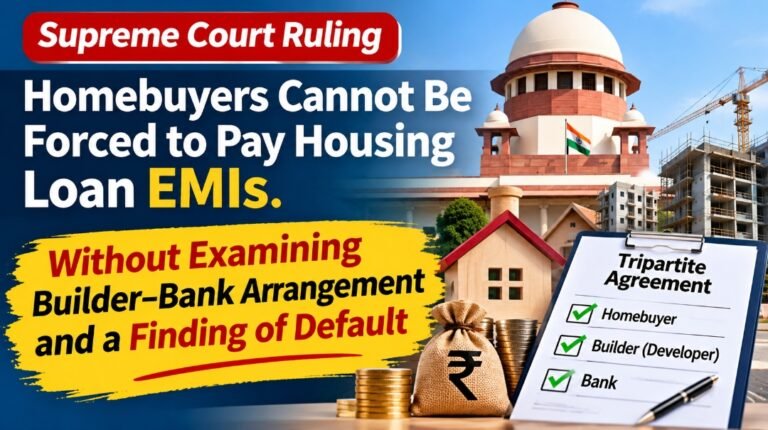
The Supreme Court protects homebuyers from coercive housing loan recovery, ruling that courts must examine builder-bank agreements and establish default before directing EMI payments.
The Supreme Court of India has emphasised that courts must examine the tripartite agreement between the homebuyer, builder and lending bank before directing homebuyers to continue paying housing loan instalments. A categorical finding of default is necessary, particularly where the bank may have disbursed loan funds to the developer contrary to the agreed construction-linked payment schedule.
Introduction
In an important ruling concerning the rights of homebuyers and their obligations towards lending banks, the Supreme Court has held that courts cannot mechanically direct homebuyers to pay housing loan instalments without first determining whether they have actually committed a default.
The Court highlighted the importance of examining the contractual relationship between the homebuyer, real estate developer and financial institution, particularly where the housing loan is governed by a tripartite agreement linking loan disbursement to the progress of construction.
The ruling provides significant protection to homebuyers who may face financial liability because of alleged irregularities in the disbursement of housing loans by banks to developers.
Background of the Case
The matter arose from the Krishna Housing Scheme in Gurugram, developed by Raheja Developers Limited.
The homebuyers had entered into tripartite agreements with the developer and the State Bank of India (SBI) for obtaining housing loans. Under these arrangements, the bank was required to release loan amounts to the developer in accordance with the progress of construction.
However, the homebuyers alleged that the developer failed to fulfil its contractual obligations and that SBI had released loan amounts to the developer without corresponding progress in construction activities.
Consequently, the homebuyers questioned their liability to pay loan instalments when the funds had allegedly been disbursed contrary to the agreed contractual arrangements.
The situation became more complicated when the developer was admitted into the Corporate Insolvency Resolution Process (CIRP) by the National Company Law Tribunal (NCLT) on August 21, 2025.
During the insolvency proceedings, the developer proposed to refund the amounts deposited by homebuyers in six monthly instalments.
Meanwhile, SBI initiated recovery proceedings against the homebuyers before the Commercial Court at Saket Courts, New Delhi. During these proceedings, interim directions were issued concerning payment of housing loan instalments.
Aggrieved by these directions, the homebuyers approached the Supreme Court seeking protection against coercive recovery measures.
Key Observations of the Supreme Court
A Bench comprising Chief Justice Surya Kant, Justice Joymalya Bagchi and Justice V. Mohana considered the dispute.
The Supreme Court stressed that the competent court must first investigate the relationship and arrangement between the builder and the bank before imposing payment obligations upon homebuyers.
The Bench observed that it was the duty of the competent court to determine the nexus between the builder and bank authorities and examine whether the bank had disbursed the loan amount strictly in accordance with the terms of the tripartite agreement.
The Court further clarified that an interim direction requiring homebuyers to pay loan instalments cannot be issued unless a categorical finding is first recorded that the homebuyers are actually in default.
This observation is particularly important in cases involving construction-linked housing loans, where the bank’s obligation to release funds may be dependent upon the completion of specified stages of construction.
Supreme Court’s Directions
While granting interim protection to the petitioners, the Supreme Court directed that the Commercial Court should not initiate coercive action against the petitioners or similarly placed homebuyers without first determining whether they had committed a default.
The Bench also clarified that it had not expressed any final opinion on the merits of the dispute.
The Commercial Court was given liberty to reconsider or modify its existing interim directions after hearing the concerned parties and examining the relevant contractual arrangements.
Accordingly, the writ petition was disposed of.
Legal Significance of the Judgment
This decision reinforces the principle that contractual obligations arising from housing loan arrangements must be examined in their entirety before courts impose interim financial liabilities.
A tripartite agreement is not merely a formal document. It establishes the respective obligations of the builder, bank and homebuyer, including the conditions governing loan disbursement.
Where loan releases are linked to construction milestones, courts must examine whether the bank complied with those conditions before determining the homebuyer’s liability in the recovery proceedings.
The ruling is particularly relevant where developers fail to complete projects, enter insolvency proceedings or receive loan disbursements allegedly without achieving the agreed construction milestones.
However, the judgment does not automatically discharge homebuyers from their housing loan obligations. The actual contractual terms, evidence of disbursement and circumstances of default must still be examined by the competent court.
Conclusion
The Supreme Court’s ruling is a significant development for homebuyers involved in disputes with builders and lending institutions.
It makes clear that banks cannot obtain interim recovery directions against homebuyers without proper judicial examination of the tripartite agreement and a finding regarding the existence of default.
The decision strengthens procedural safeguards for homebuyers and highlights the responsibility of courts to examine the conduct of both builders and banks before imposing financial obligations on purchasers.
Case Details:
- Case Name: Ravi Kumar Jangra and Another v. Union of India and Others
- Court: Supreme Court of India
- Case Number: W.P. (C) No. 1415/2026
- Bench: Chief Justice Surya Kant, Justice Joymalya Bagchi and Justice V. Mohana
- Decision Date: 24 November 2026
Source: LiveLaw Business | Supreme Court of India
Disclaimer: This article is intended solely for general legal information and educational purposes. It should not be treated as legal advice. The outcome of individual disputes depends upon the contractual terms and facts of each case.