GST | Delhi High Court | Corporate Guarantee | Section 7 of CGST Act | Rule 28(2)
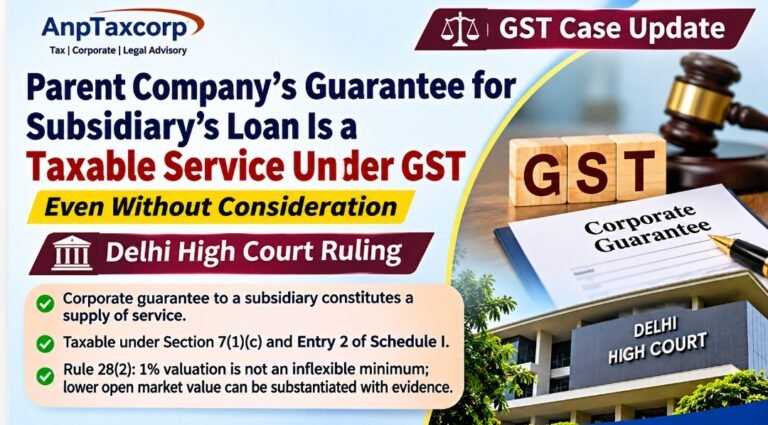
The Delhi High Court has delivered an important ruling on the applicability of GST to corporate guarantees provided by holding companies for loans obtained by their subsidiaries.
The Court held that a corporate guarantee furnished by a parent or group company to secure the borrowing of a related entity constitutes a supply of services under the GST law, even where no commission, fee or other consideration is charged.
At the same time, the Court has provided significant relief on valuation by holding that the 1% deemed valuation prescribed under Rule 28(2) of the CGST Rules cannot be treated as an inflexible minimum where the taxpayer can establish a lower open market value through reliable evidence.
The judgment has important implications for corporate groups, holding companies, subsidiaries and businesses engaged in inter-company financial arrangements.
Background of the Dispute
The matter arose from a batch of writ petitions filed by several corporate entities, including Sterlite Power Transmission Limited, ReNew Private Limited, Jindal Stainless Limited and Azure Power India, challenging the levy of GST on corporate guarantees furnished by holding companies for the loans taken by their subsidiaries or group companies.
The principal dispute was whether such guarantees could be treated as a taxable supply of services when the holding company did not receive any consideration from its subsidiary.
The petitioners contended that:
-
Corporate guarantees were furnished as part of shareholder activities and to protect the holding company’s investment in its subsidiary.
-
The parent company did not provide any commercial service for earning commission or other income.
-
In the absence of consideration, there could be no taxable supply of services.
-
The principles laid down by the Supreme Court in Commissioner of CGST & Central Excise v. Edelweiss Financial Services Ltd. under the erstwhile service tax regime supported their position.
The Revenue, on the other hand, maintained that furnishing a corporate guarantee involved assuming financial risk on behalf of a related entity and therefore constituted a service under the GST legislation.
Delhi High Court’s Analysis of Corporate Guarantees
The Division Bench comprising Justice Anil Kshetarpal and Justice Bharat Parashar examined the legal and commercial nature of corporate guarantees.
The Court identified three separate relationships in such arrangements:
-
The loan agreement between the subsidiary and the lending bank or financial institution.
-
The guarantee agreement between the holding company and the lender.
-
The underlying relationship between the holding company and its subsidiary, under which the parent company assumes the risk of the subsidiary’s failure to repay the loan.
The Court observed that although the guarantee is formally issued in favour of the bank or financial institution, the actual benefit of the arrangement accrues to the subsidiary.
By providing the guarantee, the parent company places its financial standing and creditworthiness behind the subsidiary’s borrowing obligations. This enables the subsidiary to secure loans that might otherwise be difficult to obtain or to obtain financing on more favourable terms.
The Court accordingly held that the assumption of financial risk and the extension of creditworthiness constitute an economic benefit to the subsidiary and fall within the scope of services under Section 2(102) of the CGST Act, 2017.
Corporate Guarantee Between Related Persons Is Taxable Even Without Consideration
One of the most significant aspects of this judgment concerns the interpretation of Section 7(1)(c) read with Entry 2 of Schedule I of the CGST Act, 2017.
Ordinarily, consideration is an essential element for establishing a taxable supply. However, the GST legislation specifically recognises certain transactions between related persons as supplies even when no consideration is involved, provided they are made in the course or furtherance of business.
Entry 2 of Schedule I expressly covers supplies of goods or services between related persons or distinct persons, as specified under Section 25, when made in the course or furtherance of business.
The Delhi High Court held that a corporate guarantee provided by a holding company for the borrowing of its subsidiary falls within this statutory framework.
Consequently, the absence of any guarantee commission, service fee or other monetary payment does not automatically take the transaction outside the GST net.
The Court also clarified that the commercial purpose or motive behind providing the guarantee cannot, by itself, determine its taxability. Even where the parent company provides the guarantee to protect its investment in the subsidiary, the transaction may still qualify as a business-related supply under GST.
Who Is the Recipient of the Corporate Guarantee Service?
Another important question before the Court was whether the recipient of the service was the lending bank or the subsidiary whose loan was guaranteed.
The Court clarified that the subsidiary or related company is the recipient of the service.
Although the guarantee document is executed in favour of the lender, the credit support is provided for the benefit of the subsidiary. It is the subsidiary that obtains improved access to finance through the parent’s financial backing.
Accordingly, the subsidiary is treated as the recipient in terms of Section 2(93)(c) of the CGST Act.
Supreme Court’s Edelweiss Judgment Distinguished
The petitioners relied upon the Supreme Court’s decision in Commissioner of CGST & Central Excise v. Edelweiss Financial Services Ltd., which dealt with the taxability of corporate guarantees under the earlier service tax framework.
The Delhi High Court distinguished that decision on the ground that the statutory provisions governing service tax and GST are materially different.
Under the earlier service tax legislation, consideration formed part of the relevant definition of taxable service. However, the CGST Act contains an express provision under Section 7(1)(c), read with Schedule I, bringing specified supplies between related persons within the scope of taxable supply even in the absence of consideration.
Therefore, the earlier Supreme Court ruling could not be applied mechanically to determine the taxability of corporate guarantees under the GST regime.
Important Relief: Rule 28(2) Valuation Cannot Be an Inflexible Minimum
While upholding the taxability of corporate guarantees, the Delhi High Court also examined the validity and interpretation of Rule 28(2) of the CGST Rules, 2017.
Rule 28(2), introduced through Notification No. 52/2023-Central Tax dated 26 October 2023, prescribes a deemed valuation mechanism for services supplied by way of providing corporate guarantees to a banking company or financial institution on behalf of a related person.
The provision prescribes a value equivalent to 1% of the amount of the guarantee offered or the actual consideration, whichever is higher, subject to the applicable provisions.
The petitioners challenged this valuation mechanism, arguing that the prescribed percentage could result in an artificial and excessive valuation, irrespective of the actual economic value of the guarantee.
The Court accepted the need to examine the valuation provision in this context and held that the prescribed 1% value could not operate as an inflexible minimum in every case.
It read down Rule 28(2) to permit taxpayers to establish a lower open market value through cogent and verifiable evidence.
This is an important aspect of the ruling because it provides an opportunity to taxpayers to substantiate the actual value of corporate guarantee services rather than automatically adopting the prescribed 1% benchmark in every situation.
The ruling, therefore, distinguishes between the existence of a taxable supply and the determination of its taxable value.
Key Legal Provisions Involved
| Legal provision | Relevance |
|---|---|
| Section 2(17), CGST Act | Definition of business |
| Section 2(93)(c), CGST Act | Identification of recipient |
| Section 2(102), CGST Act | Definition of services |
| Section 7(1)(c), CGST Act | Supplies covered under Schedule I |
| Entry 2, Schedule I | Supplies between related persons without consideration |
| Rule 28(2), CGST Rules | Valuation of corporate guarantee services |
| Article 14, Constitution | Challenge concerning arbitrariness of valuation |
Practical Implications for Businesses and Corporate Groups
This judgment has considerable significance for companies operating through holding and subsidiary structures.
Businesses should particularly examine the following aspects:
-
Review existing corporate guarantees: Holding companies should review guarantees already furnished on behalf of subsidiaries and related entities.
-
Evaluate GST exposure: The absence of guarantee commission or any monetary consideration should not be treated as sufficient grounds for non-payment of GST.
-
Determine the correct recipient: The subsidiary receiving the benefit of the credit support is generally the recipient of the service.
-
Maintain valuation documentation: Companies seeking to adopt a value lower than the prescribed 1% benchmark should maintain appropriate evidence supporting their open market valuation.
-
Review GST compliance: Corporate groups should examine their GST registration, invoicing, valuation and return-filing positions in relation to inter-company guarantees.
The ruling also highlights the importance of distinguishing between the taxability of a transaction and the valuation of the supply. Even where the existence of a taxable supply is established, the value adopted for GST purposes remains open to examination in accordance with the applicable valuation provisions and the High Court’s interpretation.
Conclusion
The Delhi High Court’s ruling establishes an important principle under the GST regime: a corporate guarantee furnished by a holding company for the borrowing of its subsidiary can constitute a taxable supply of services even without consideration.
The Court has recognised that the extension of creditworthiness and assumption of financial risk have economic value and benefit the subsidiary.
However, the ruling is equally significant from the valuation perspective. By reading down Rule 28(2), the Court has allowed taxpayers to demonstrate a lower open market value through reliable and verifiable evidence rather than treating the prescribed 1% benchmark as an absolute minimum.
The judgment is therefore an important development in GST jurisprudence concerning related-party transactions, corporate guarantees and valuation of services.
Case Reference: Sterlite Power Transmission Limited & Others v. Union of India & Others and connected matters
-
Court: Delhi High Court
-
Bench: Justice Anil Kshetarpal and Justice Bharat Parashar
-
Case No.: W.P.(C) 2966/2024 and connected petitions
-
Judgment Date: 17 November 2026