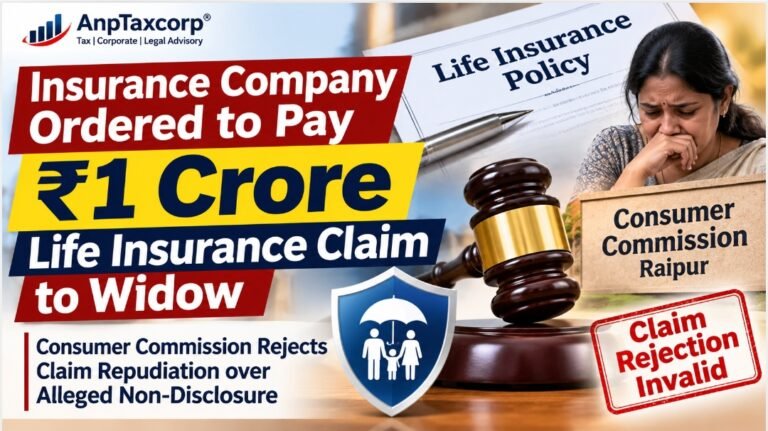
Raipur Consumer Commission directs an insurer to pay ₹1 crore life insurance death benefit to a widow after wrongful claim rejection over non-disclosure of other policies.
A Consumer Commission in Raipur has directed a life insurance company to pay ₹1 crore as death benefit to a widow after the insurer rejected her claim on the ground that her deceased husband had failed to disclose other life insurance policies. The Commission also awarded compensation and litigation costs, holding the rejection to be an unfair trade practice and deficiency in service.
Introduction
Life insurance is intended to provide financial security to the family of an insured person in the event of an unfortunate death. However, disputes frequently arise when insurance companies reject death benefit claims by alleging non-disclosure or suppression of material information in the insurance proposal.
In an important consumer dispute, a District Consumer Disputes Redressal Commission in Raipur, Chhattisgarh, has directed an insurance company to release a death benefit of ₹1 crore to a widow whose husband died of sudden cardiac arrest approximately 15 months after purchasing the life insurance policy.
The case highlights an important question: Can an insurance company deny a genuine death claim merely because the policyholder allegedly failed to disclose other life insurance policies taken from different insurers?
The Consumer Commission has ruled against the insurer in this particular dispute.
Background of the Case
The complainant, Chanda Pincha, approached the Consumer Commission following the death of her husband, Pawan Pincha, who was employed as a director in a private company.
According to the reported facts:
- The deceased purchased a life insurance policy on 10 September 2018.
- The annual premium was approximately ₹36,969.40.
- The policy provided life insurance coverage of ₹1 crore for the husband, with an additional cover of ₹50 lakh for his wife as the secondary insured.
- The policy was issued for a term of 39 years, with maturity scheduled for 10 September 2057.
- Unfortunately, the policyholder died due to sudden cardiac arrest on 21 December 2019, approximately 15 months after purchasing the policy.
Following his death, his wife submitted a claim seeking payment of the ₹1 crore death benefit as the nominated beneficiary.
Why Did the Insurance Company Reject the Claim?
The insurance company rejected the widow’s claim on 17 March 2020.
The principal ground cited by the insurer was that the deceased policyholder had allegedly failed to disclose his other life insurance policies held with different insurance companies.
According to the insurer, the non-disclosure of existing insurance coverage constituted a failure to disclose relevant information while obtaining the policy.
The widow challenged the rejection before the District Consumer Disputes Redressal Commission, seeking payment of the insured amount along with compensation for the hardship caused by the wrongful denial of the claim.
Consumer Commission’s Findings
After examining the affidavits, medical records, insurance documents and correspondence between the parties, the Additional Bench of the District Consumer Disputes Redressal Commission, Raipur, rejected the insurance company’s defence.
The Commission took note of several important circumstances:
1. Insurer had an opportunity to verify the insurance details
The Commission observed that the insurance company had accepted the proposal and collected the premium while having an opportunity to verify the policyholder’s existing insurance coverage before issuing the policy.
2. No justification for denying the death benefit
The insurer failed to establish sufficient grounds to justify repudiation of the claim under the policy.
3. Widow was not responsible for alleged non-disclosure
The Commission found no evidence indicating that the complainant had any involvement in withholding information regarding her husband’s other insurance policies.
4. Other insurers had settled their claims
The Commission also considered that claims under certain other life insurance policies held by the deceased had already been settled by the respective insurance companies.
Considering the overall facts and evidence, the Commission concluded that the insurer had wrongly denied the death benefit under a policy that was in force at the time of the policyholder’s death.
The rejection was held to constitute an unfair trade practice and deficiency in service.
What Compensation Did the Consumer Commission Award?
The Commission, by its order dated 3 November 2026, directed the insurance company to make the following payments:
| Particulars | Amount |
|---|---|
| Life insurance death benefit | ₹1,00,00,000 |
| Compensation for mental and physical harassment | ₹1,00,000 |
| Litigation expenses | ₹15,000 |
| Total amount payable | ₹1,01,15,000 |
The insurer was directed to comply with the order within 45 days.
The Commission further directed that failure to make payment within the stipulated period would attract interest at the rate of 7% per annum on the total amount until settlement.
Legal Implications: Can an Insurer Reject a Claim for Non-Disclosure of Other Insurance Policies?
This case raises an important issue concerning the obligations of policyholders and insurance companies under life insurance contracts.
When applying for life insurance, a proposer is expected to provide truthful and complete information in response to questions contained in the proposal form. Information concerning existing insurance policies, medical history, occupation and other relevant circumstances may be material to the insurer’s underwriting decision.
However, an allegation of non-disclosure does not automatically justify rejection of every insurance claim.
The insurer must establish that the alleged omission is legally material and that repudiation is justified under the applicable insurance contract and statutory framework.
The relevant legal considerations include:
- Whether the proposal form specifically sought information regarding existing insurance policies.
- Whether the policyholder furnished incorrect or incomplete information.
- Whether the information withheld was material to the insurer’s decision to issue the policy.
- Whether the insurer followed the applicable statutory requirements while repudiating the claim.
- Whether the insurer can substantiate its allegations through documentary evidence.
In particular, Section 45 of the Insurance Act, 1938, provides an important statutory framework governing when a life insurance policy can be called into question on grounds of misstatement or suppression of material facts. Its applicability depends on the period for which the policy has been in force and the specific circumstances of the alleged suppression.
Therefore, insurance companies cannot rely on vague allegations of non-disclosure without satisfying the applicable legal requirements.
Important Lessons for Life Insurance Policyholders
This decision offers several practical lessons for individuals purchasing life insurance and their family members.
1. Disclose existing insurance policies: Always provide accurate details of existing life insurance policies in the proposal form.
2. Preserve policy documents: Maintain copies of proposal forms, policy documents, premium receipts and medical declarations.
3. Nominate family members: Ensure that nomination details are properly recorded and updated.
4. Do not accept arbitrary claim rejection: A repudiation letter should be examined carefully to determine whether the insurer has sufficient legal and contractual grounds.
5. Challenge wrongful repudiation: Beneficiaries may seek appropriate remedies before the Insurance Ombudsman or the Consumer Commission, subject to the applicable jurisdictional and procedural requirements.
Conclusion
The Raipur Consumer Commission’s decision reinforces the importance of fair treatment of insurance policyholders and their beneficiaries.
An insurance company cannot escape its contractual obligations merely by raising allegations of non-disclosure without establishing legally sustainable grounds for repudiation.
The decision also highlights the importance of examining the circumstances surrounding policy issuance, the information disclosed by the policyholder and the evidence relied upon by the insurer before rejecting a death benefit claim.
For families depending on life insurance for financial protection, this case serves as an important reminder that an unjustified rejection of an insurance claim can be challenged through appropriate legal remedies.
Source: Report published by Mint on 22 November 2026, concerning an order of the Additional Bench of the District Consumer Disputes Redressal Commission, Raipur, dated 3 November 2026.
Disclaimer: This article is intended solely for general legal awareness and informational purposes. The observations discussed are based on the reported facts of the case and should not be treated as a substitute for examination of the original consumer commission order or professional legal advice.