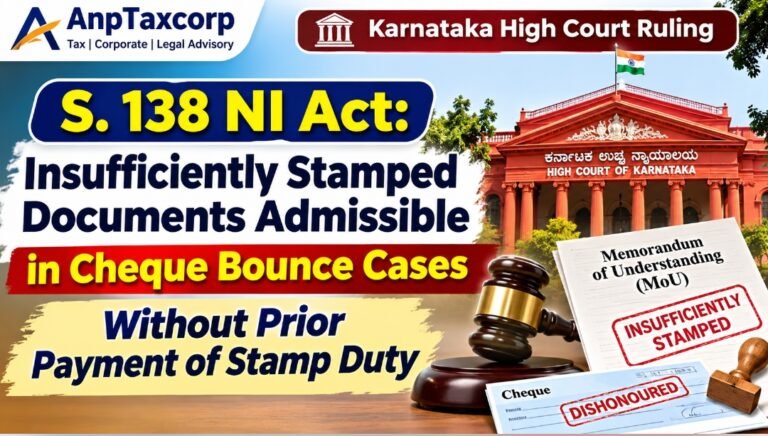
The Karnataka High Court has delivered an important ruling concerning the admissibility of insufficiently stamped documents in criminal proceedings, particularly cheque dishonour cases under Section 138 of the Negotiable Instruments Act, 1881. The Court held that an insufficiently stamped document can be admitted in evidence in criminal proceedings even if the applicable stamp duty and penalty have not been paid.
The judgment clarifies that the requirement to pay stamp duty and the question of admissibility of a document in criminal proceedings operate in different legal spheres. Consequently, non-payment of stamp duty cannot automatically become a ground for excluding a document from evidence in a prosecution under Section 138 of the NI Act.
The decision is significant for creditors, businesses, financial institutions and litigants involved in cheque bounce proceedings.
Background of the Case
The dispute arose from a cheque dishonour complaint filed by M/s Grind Stone Crusher LLP against Sri Erigala Ram Pula Reddy under Section 138 of the Negotiable Instruments Act.
During the proceedings, the complainant produced a Memorandum of Understanding (MoU) dated September 19, 2021, which was marked as Exhibit P1 in support of its case.
The accused objected to the admissibility of the document, contending that it was insufficiently stamped under the Karnataka Stamp Act, 1957. On this basis, he sought to prevent the document from being admitted into evidence.
However, the Magistrate rejected the objection and permitted the document to be exhibited. The accused subsequently challenged this decision before the Sessions Court, but the revision petition was also unsuccessful.
Aggrieved by the concurrent decisions of the subordinate courts, Sri Erigala Ram Pula Reddy approached the Karnataka High Court by filing Criminal Petition No. 554 of 2026.
Legal Issue Before the High Court
The principal question before the High Court was whether an insufficiently stamped document could be admitted as evidence in a criminal proceeding under Section 138 of the Negotiable Instruments Act without first paying the applicable stamp duty and penalty.
The Court was required to examine the interplay between the provisions of the Karnataka Stamp Act, 1957, particularly Sections 33 and 34, concerning insufficiently stamped instruments and their admissibility in evidence.
The issue also involved determining whether the process of impounding an insufficiently stamped document necessarily prevents its admission in criminal proceedings until the stamp duty and applicable penalty are paid.
Karnataka High Court’s Observations and Findings
Justice Anant Ramanath Hegde examined the relevant provisions of the Karnataka Stamp Act and explained that the provisions dealing with the examination and impounding of insufficiently stamped documents operate independently from those governing their admissibility in criminal proceedings.
The Court observed that Section 33(1) of the Karnataka Stamp Act empowers the concerned authority to examine an instrument and impound it if it is found to be insufficiently stamped.
However, the legal consequences of impounding a document must be distinguished from the question of whether that document can be admitted in evidence in a criminal proceeding.
The High Court clarified that even if a document is impounded for insufficient stamping, it does not automatically become inadmissible in every criminal proceeding.
The Court held that an insufficiently stamped instrument remains admissible in criminal proceedings that do not fall within the specifically excluded chapters referred to under the relevant provisions of the Karnataka Stamp Act.
Importantly, the Court ruled that payment of the applicable stamp duty or penalty cannot be imposed as a precondition for admitting such a document in those criminal proceedings.
Relationship Between Stamp Duty and Admissibility of Evidence
One of the significant aspects of this judgment is the distinction drawn between the obligation to pay stamp duty and the admissibility of documentary evidence.
The Karnataka High Court recognised that the State’s right to recover legally payable stamp duty and penalty remains unaffected. An insufficiently stamped instrument may still be examined and impounded in accordance with the Karnataka Stamp Act.
However, the recovery of stamp duty and penalty is a separate statutory matter. It cannot automatically prevent the use of the document as evidence in criminal proceedings where the statutory exclusion does not apply.
The Court also clarified that references to the corresponding chapters of the repealed Code of Criminal Procedure, 1898, must be understood with reference to the corresponding provisions of the subsequent criminal procedure legislation, including the Bharatiya Nagarik Suraksha Sanhita, 2023.
Final Decision of the Karnataka High Court
After examining the statutory provisions and the orders passed by the subordinate courts, the High Court found no legal error in permitting the Memorandum of Understanding to be admitted in evidence.
Accordingly, the Court dismissed the criminal petition filed by Erigala Ram Pula Reddy and upheld the decisions of the Magistrate and Sessions Court.
Case Details:
- Court: Karnataka High Court
- Judge: Justice Anant Ramanath Hegde
- Case Title: Sri Erigala Ram Pula Reddy v. M/s. Grind Stone Crusher LLP
- Case Number: Criminal Petition No. 554 of 2026
- Relevant Legislation: Karnataka Stamp Act, 1957 and Section 138 of the Negotiable Instruments Act, 1881
- Decision: Criminal petition dismissed.
Legal Significance of the Judgment
This ruling provides important clarification regarding the admissibility of documentary evidence in cheque dishonour cases.
Frequently, objections concerning insufficient stamping are raised during trial proceedings to challenge the admissibility of documents relied upon by the complainant. Such objections may potentially delay the adjudication of cheque bounce complaints.
The Karnataka High Court has clarified that the mere absence of sufficient stamp duty does not necessarily render a document inadmissible in criminal proceedings.
For creditors, financial institutions and commercial entities, the ruling reinforces the principle that procedural objections relating to stamp duty must be examined in accordance with the applicable statutory provisions rather than being treated as an automatic bar to the admission of evidence.
Nevertheless, the judgment should not be interpreted to mean that stamp duty requirements can be ignored. The liability to pay applicable stamp duty and penalty continues to exist, and the ruling operates within the statutory framework governing admissibility in criminal proceedings.
The decision is therefore an important development in the intersection of stamp duty law, documentary evidence and cheque dishonour litigation.
Disclaimer: This article is intended for general legal information and educational purposes only. Readers should refer to the original judgment and applicable statutory provisions before relying on the legal position.